Our 2019 Spain travel was filled with adventure, great food & Wine and history.
We learned about the many locations where The Game of Thrones chose Spain for its episodes.
We visited The Alcazar, where Dorne is filmed, and headed to Italica, located north of modern-day Santiponce, which is 9 kilometers North West of Seville, Spain.
An elaborate Roman city, the birthplace of Roman Emperor Trajan, most likely that of Hadrian and possibly that of Theodosius. The modern town of Santiponce overlies the pre-Roman Iberian settlement and part of the well-preserved Roman city.
Italica is a treasure beyond compare, it was founded in 206 BC by the great Roman general Publius Cornelius Scipio, aka Africanus, to settle his victorious veterans from the 2nd Panic Wars against Hannibal and the Carthaginians, and close enough to the Guadalquivir to control the area.
The city was built upon a native Iberian town of the Turdetani dating back at least to the 4th Century BC. The name Italica reflected the veterans' Italian origins, i.e from auxiliary Italic units.
The old city developed into a prosperous one and was built on a Hippodamian street plan with public buildings and a forum at the center, linked to a busy river port.
At some point, members of the Roman tribes Gens Ulpia and Aelia had moved to Italica, as these tribes were the respective families of the Roman emperors Trajan and Hadrian who were later born here.
Italica thrived especially under the patronage of Hadrian, but it was especially favored as his birthplace. He expanded the city northwards and elevated it to the status of colonia -Colonia Aelia Augusta Italica- even though Hadrian expressed surprise as it already enjoyed the rights of Municipium.
He also added temples, including the enormous and unique Trajaneum in the center of the city to venerate his predecessor and adopted father, and rebuilt public buildings.
The city started to dwindle as early as the 3rd century; a shift of the Guadalquivir River bed, probably due to siltation, a widespread problem in antiquity that followed removal of the forest cover, left Italica's river port high and dry whilst Hispalis continued to grow nearby. The city may have been the birthplace of the emperor Theodosius I.
Italica was important enough in late Antiquity to have a bishop of its own, and had a garrison during the Visigothic age. The walls were restored by Leovigildo in 583 AD during his struggles against Hermenegildo.
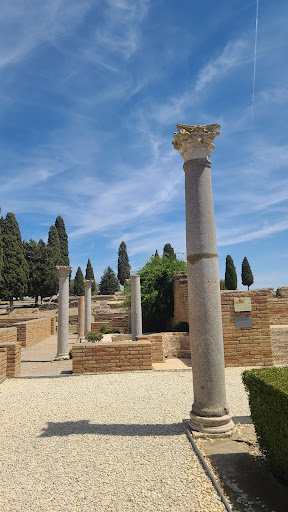
As no modern city built or covered many of Italica's buildings, the result is an unusually well-preserved Roman city with cobbled Roman streets and mosaic floors still in situ.
Many rich finds can also be seen in the Seville Archeological Museum, with its famous marble colossus of Trajan.
The archaeological site of Italica encompasses mainly the urbs nova –new city- with its many fine buildings from the Hadrianic period. The original urbs vetus (old town) lies under the present town of Santiponce.
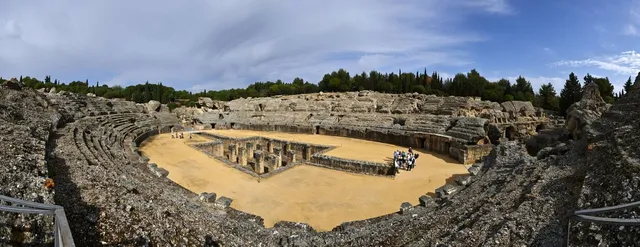
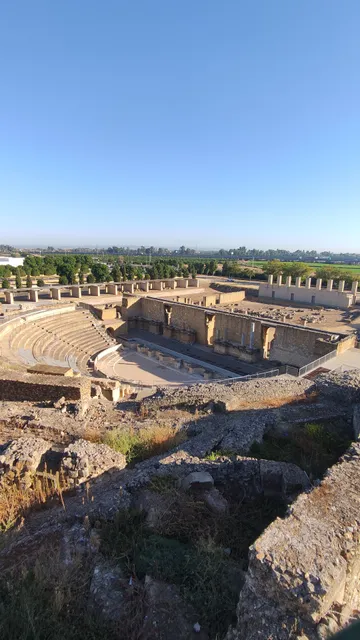
Extensive excavation and renovation of the site has been done recently and is continuing. The small baths and the Theatre are some of the oldest visible remains, both built before Hadrian. Italica’s amphitheatre was the 3rd largest in the Roman Empire at the time, being slightly larger than the Tours Amphitheater in France. It seated 25,000 spectators, about half as many as the Colosseum in Rome. The size is surprising given that the city's population at the time is estimated to have been only 8,000, and shows that the local elite demonstrated status that extended far beyond Italica itself through the games and theatrical performances they funded as magistrates and public officials.
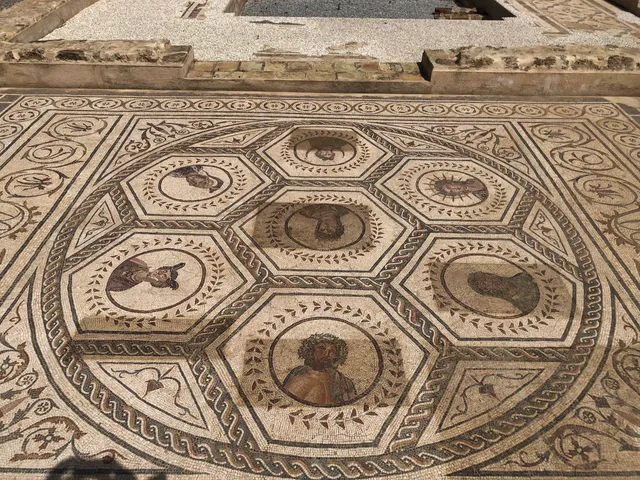
From the same period is the elite quarter with several beautiful (and expensive) houses decorated with splendid mosaics visible today, particularly the:
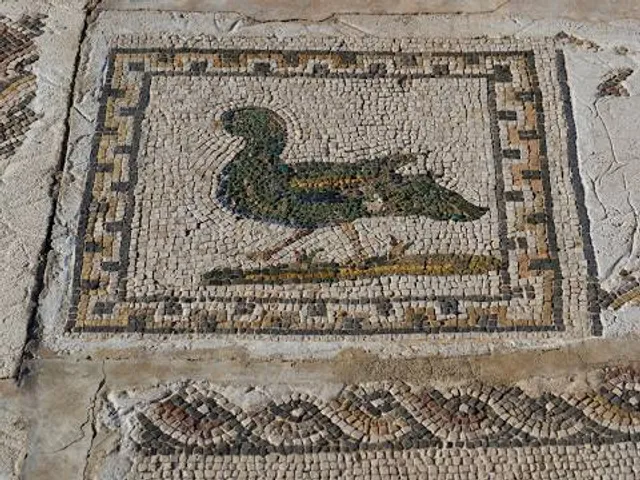
House of the Exedra House of the Neptune Mosaic House of the Birds Mosaic House of the Planetarium Mosaic House of Hylas House of the...
Read moreTucked away in the small town of Santiponce, just a short drive from Seville, the Amphitheatre of Italica is one of those rare archaeological sites that stirs the imagination and leaves a deep impression long after you’ve left its ancient stone walls behind. Though lesser-known compared to the Colosseum in Rome, this amphitheatre is a magnificent relic of the Roman Empire—beautifully preserved, deeply atmospheric, and remarkably accessible.
Built in the 1st century AD under Emperor Hadrian—himself born in Italica—the amphitheatre once hosted over 25,000 spectators, making it one of the largest in the Roman Empire. This statistic alone is staggering when you consider the relatively modest size of the town today. Standing in the centre of the arena, it’s easy to imagine the roar of the crowds, the drama of gladiatorial games, and the prestige this structure once carried in Roman Hispania.
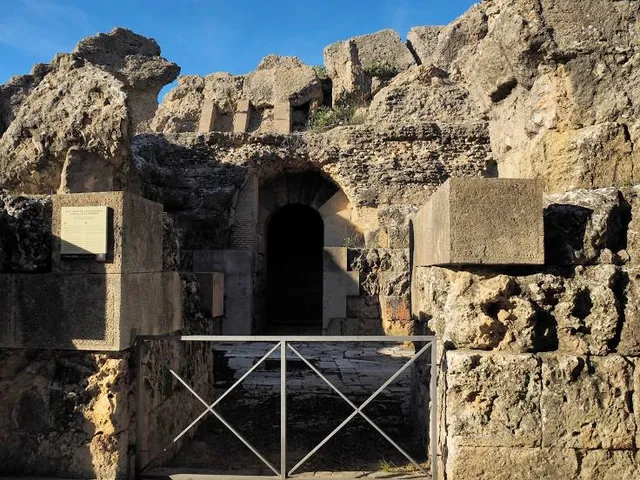
What makes Italica’s amphitheatre particularly captivating is its architectural elegance and scale. The three-tiered seating design, though partially eroded, still displays the clear social hierarchy of ancient Rome. The subterranean passages used to prepare animals and fighters for battle are intact and open for exploration—offering a visceral, behind-the-scenes look at the mechanics of Roman entertainment.
The central pit where the stage machinery and trapdoors once operated is especially evocative, and in some ways, even more engaging than its better-known Roman cousins due to the freedom you have to explore at your own pace.
The amphitheatre is part of the larger archaeological site of Italica, the first Roman city founded outside Italy, and the broader ruins are equally worth exploring. You’ll find cobbled streets, remnants of mosaicked Roman villas, thermal baths, and temple ruins—all framed by olive trees and Andalusian skies. The mosaics, especially those in the House of the Birds, are exquisite examples of Roman decorative artistry and still vibrant after nearly two millennia.
There’s something humbling about walking these ancient streets, surrounded by timeworn stone and silence, broken only by birdsong and the occasional tour group murmuring in awe.
One of the most appealing aspects of Italica is the accessibility. The site is rarely crowded, allowing for moments of quiet reflection, photography without obstruction, and a more intimate connection with the history beneath your feet. The surrounding environment is peaceful, almost meditative, in stark contrast to more commercialized heritage sites.
Entry is very affordable (often free for EU citizens), and the staff are courteous and helpful. Information signage around the site is well-curated and available in multiple languages, including English.
Visiting the Amphitheatre of Italica is not just a tour of an ancient ruin—it’s a journey into a powerful civilization, a tactile history lesson, and a meditation on time, endurance, and cultural legacy. It’s a reminder that greatness often hides in quieter places, away from the tourist crowds.
For history lovers, architecture buffs, or even casual travelers seeking something profound and unexpected, Italica delivers in spades. Bring a hat, water, and curiosity—you’ll leave with awe, insight, and a new appreciation for the grandeur of...
Read moreThe Amphitheatre of Italica (Anfiteatro de Itálica) provides a fascinating insight into ancient Roman history, even though much of it is in ruins. One of the most remarkable aspects is the freedom visitors have to explore the site. You can wander around almost everywhere and even climb on some of the ancient structures, which creates a more immersive experience.
The tunnels beneath the amphitheatre are particularly captivating, giving you a sense of what it might have been like for gladiators preparing for their fights. The views from the higher levels are stunning, adding an extra layer of enjoyment to the visit.
Practical amenities like free parking on the road outside and a small café for refreshments make the visit more convenient. Additionally, the shaded areas under the trees are a welcome relief from the intense heat, especially during the summer months.
Overall, the Amphitheatre of Italica is a captivating historical site that combines exploration, scenic views, and practical facilities, making it well...
Read more