HTML SitemapExplore
logo
Find Things to DoFind The Best Restaurants

Aluviharaya Rock Cave Temple — Attraction in Central Province

Name
Aluviharaya Rock Cave Temple
Description
Nearby attractions
Nearby restaurants
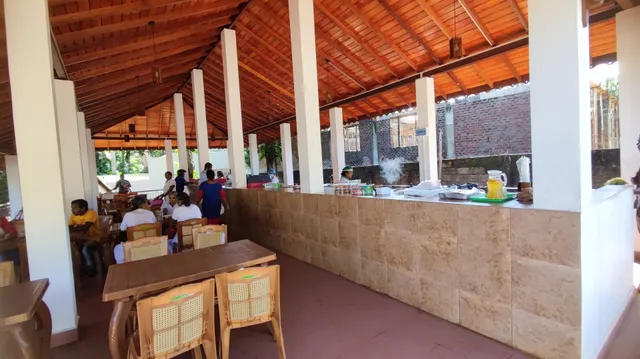
Hela Bojun Hala හෙළ බොජුන් හල உள்ளூர் உணவு விற்பனை நிலையம்
Matale, Sri Lanka
Nearby hotels
Ama Residence
1080 Tricomalee Street, Matale, Sri Lanka
Lekham Walauwa
47 Sir Richard Aluwihare Mawatha, Matale, Sri Lanka
Hotel Spring View
A9, Thotagamuwa, Sri Lanka
Chanaka Inn
845B Kandy jaffna High way Aluwihare, 21000, Sri Lanka
Sanasuma Holiday Home
845, Aluvihare, matale Unit number, suite, floor, building, etc, 21000, Sri Lanka
Reveston Holidays
Matale, Thotagamuwa, Sri Lanka
Related posts
Keywords
Aluviharaya Rock Cave Temple tourism.Aluviharaya Rock Cave Temple hotels.Aluviharaya Rock Cave Temple bed and breakfast. flights to Aluviharaya Rock Cave Temple.Aluviharaya Rock Cave Temple attractions.Aluviharaya Rock Cave Temple restaurants.Aluviharaya Rock Cave Temple travel.Aluviharaya Rock Cave Temple travel guide.Aluviharaya Rock Cave Temple travel blog.Aluviharaya Rock Cave Temple pictures.Aluviharaya Rock Cave Temple photos.Aluviharaya Rock Cave Temple travel tips.Aluviharaya Rock Cave Temple maps.Aluviharaya Rock Cave Temple things to do.
Aluviharaya Rock Cave Temple things to do, attractions, restaurants, events info and trip planning
Aluviharaya Rock Cave Temple
Sri LankaCentral ProvinceAluviharaya Rock Cave Temple

Basic Info

Aluviharaya Rock Cave Temple

FJXC+3PV, Thotagamuwa, Sri Lanka
4.7(1.0K)
Open 24 hours
Save
spot

Ratings & Description

Info

Cultural
Scenic
Family friendly
attractions: , restaurants: Hela Bojun Hala හෙළ බොජුන් හල உள்ளூர் உணவு விற்பனை நிலையம்
logoLearn more insights from Wanderboat AI.
Phone
+94 662 222 533

Plan your stay

hotel
Pet-friendly Hotels in Central Province
Find a cozy hotel nearby and make it a full experience.
hotel
Affordable Hotels in Central Province
Find a cozy hotel nearby and make it a full experience.
hotel
The Coolest Hotels You Haven't Heard Of (Yet)
Find a cozy hotel nearby and make it a full experience.
hotel
Trending Stays Worth the Hype in Central Province
Find a cozy hotel nearby and make it a full experience.

Reviews

Things to do nearby

Explore Sigiriya from Kandy with Janaka
Fri, Dec 12 • 7:00 AM
Kandy, Central Province 20000, Sri Lanka
View details
Explore Sigiriya & Dambulla heritage sites
Thu, Dec 11 • 8:30 AM
Gurudeniya, Central Province 20189, Sri Lanka
View details

Nearby restaurants of Aluviharaya Rock Cave Temple

Hela Bojun Hala හෙළ බොජුන් හල உள்ளூர் உணவு விற்பனை நிலையம்

Hela Bojun Hala හෙළ බොජුන් හල உள்ளூர் உணவு விற்பனை நிலையம்

Hela Bojun Hala හෙළ බොජුන් හල உள்ளூர் உணவு விற்பனை நிலையம்

4.6

(18)

Click for details
Get the Appoverlay
Get the AppOne tap to find yournext favorite spots!
Wanderboat LogoWanderboat

Your everyday Al companion for getaway ideas

CompanyAbout Us
InformationAI Trip PlannerSitemap
SocialXInstagramTiktokLinkedin
LegalTerms of ServicePrivacy Policy

Get the app

© 2025 Wanderboat. All rights reserved.
logo

Reviews of Aluviharaya Rock Cave Temple

4.7
(1,003)
avatar
5.0
1y

14:11

Home Things To Do MATALE ALU VIHARAYA

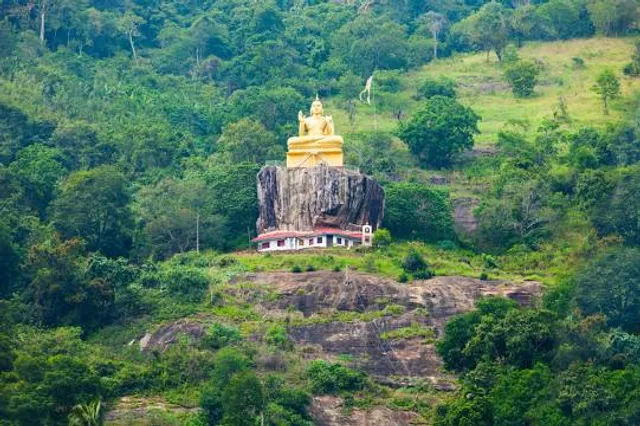
MATALE ALU VIHARAYA The Alu vihare Rock Temple (also called Matale Alu Viharaya) is a sacred Buddhist temple located in Aluvihare, Matale District of Sri Lanka. Surrounded by hills, the Alu vihara cave temple is situated 30 km north of Kandy on the Matale-Dambulla road.

The history of Aluvihare Rock Temple is traced back to the 3rd Century B.C to the reign of King Devanampiyatissa. It is believed that the King built the dagoba, planted the Bo sapling and founded the temple after the introduction of Buddhism to the country during his reign.

Aluvihare Rock Temple was the historic location where the oral teachings of Buddhism (Tripitaka), were written into Pali on palm leaves. In between the 100 - 89 Century BC, during the reign of King Walagamba, Sri Lanka underwent a famine known as 'Baminithiyasaya' for 12 years. There was also a South Indian invasion at the same time and the Buddhist monks of that era realized that these problems would be a danger to the existence of Buddha Sasana in the country. Under these conditions, memorizing and repeating the Dhamma (doctrine) was difficult. Due to the famine Buddhist monks did not receive sufficient alms and faced many difficulties, and they had to eat yams, roots and leaves of trees for their survival. A group of about 60 of them went to Malaya Rata, which is said to be the hilly area of the country. They managed to live on the banks of Mahaweli river under harsh conditions and survived for 12 years till the famine came to an end. King Walagamba who was overthrown by a rebellion during the invasion from South India, regained the throne by defeating the invaders after fourteen years.

The monks who left to India and to the hilly areas of Sri Lanka, during the difficult period, returned to Anuradhapura, and decided to transcribe the Tripiṭaka (philosophical doctrines of Buddhism) for the preservation and for the use of future generations. The monks selected Aluvihare Rock temple in Matale as the most suitable and secured place to carry out this important event. This transcription was carried out due to the fear that the doctrine would be lost during the upheaval caused by repeated South Indian invasions. It is said that 500 scholarly monks congregated at Aluvihare Rock temple to perform the difficult task of first reciting the doctrines and agreeing on an acceptable version before transcription. The entire transcription was done in books made of ola leaves, locally known as puskola poth. These books were made up from thick strips created from the leaves of either the palmyra or talipot palm and the doctrines were written down in Pali language. A metal stylus was used to inscribe the characters on the ola leaves.

The old library at Aluvihare Rock Temple, which had safely housed the volumes of this transcribed manuscripts for so many centuries, was totally destroyed during the Matale Rebellion in 1848. Many parts of the temple complex was destroyed too by this incident. The consequences of this disaster are still evident today at the temple premises. It took a long a time for the recompilation, as few generations of monks had to transcribe the Tripiṭaka again. The recompilation and transcription took a long time as only few monks were engaged in this painstaking task, and the first of the three “baskets of the law” was only completed in 1982.

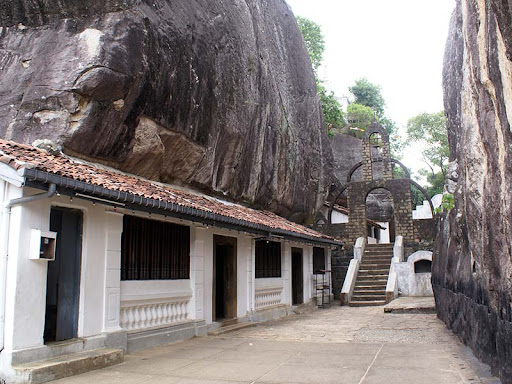
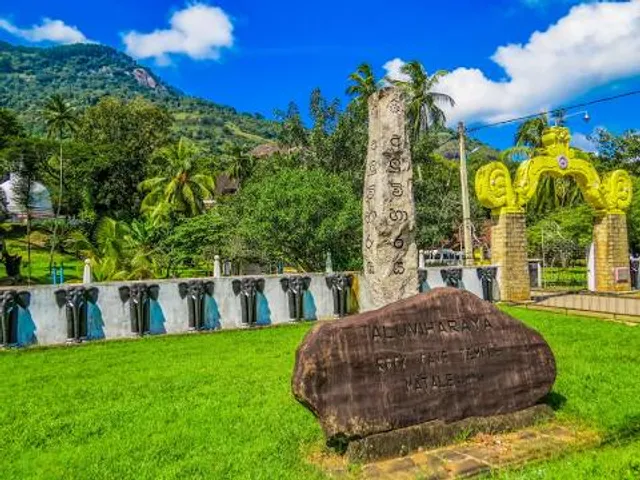
Aluvihare Rock temple has many caves with ancient inscriptions. These caves enclose comparatively modern wall and ceiling paintings of interest, and impressive statues and images of Lord Buddha. The main cave of these, has a large reclining statue of the Buddha, together with standing and seated images. In the entrance-way of another cave with a reclining statue of the Buddha there are terrifying depictions of the hellish afterlife that awaits people who commits sins. One cave is dedicated to the revered Indian monk-scholar Buddhagosa, who is regarded as the greatest exponent and interpreter of the Pali...

   Read more

avatar
5.0
9y

Aluvihare Rock Temple was the historic location where the Pāli Canon was first written down completely in text on ola (palm) leaves. Many monastery caves, some of which exhibit frescoes are situated near this temple. In the 1st Century BC, during the reign of King Walagamba, Sri Lanka underwent a famine known as 'Baminithiyasaya' for 12 years. There was also a South Indian invasion at the same time and the Buddhist monks of that era realized that these problems would be a danger to the existence of Buddha Sasana in the country. Under these conditions, memorizing and repeating the Dhamma(doctrine) was difficult. Due to the famine Buddhist monks did not receive sufficient alms and faced many difficulties, and they had to eat yams, roots and leaves of trees for their survival. A group of about 60 of them went to Malaya Rata, which is said to be the hilly area of the country. They managed to live on the banks of Mahaweli river under harsh conditions and survived for 12 years till the famine came to an end. King Walagamba who was overthrown by a rebellion during the invasion from South India, regained the throne by defeating the invaders after fourteen years.

The monks who left to India and to the hilly areas of Sri Lanka, during the difficult period, returned to Anuradhapura, and decided to transcribe the Tripiṭaka (philosophical doctrines of Buddhism) for the preservation and for the use of future generations. The monks selected Aluvihare Rock temple in Matale as the most suitable and secured place to carry out this important event. This transcription was carried out due to the fear that the doctrine would be lost during the upheaval caused by repeated South Indian invasions.[5] It is said that 500 scholarly monks congregated at Aluvihare Rock temple to perform the difficult task of first reciting the doctrines and agreeing on an acceptable version before transcription. The entire transcription was done in books made of ola laves, locally known as puskola poth. These books were made up from thick strips created from the leaves of either the palmyra or talipot-palm and the doctrines were written down in Pali language. A metal stylus was used to inscribe the characters on the ola leaves.

The old library atof Aluvihare Rock Temple, which had safely housed the volumes of this transcribed manuscripts for so many centuries, was totally destroyed during theMatale Rebellion in 1848.[6] Many parts of the temple complex was destroyed too by this incident. The consequences of this disaster are still evident today at the temple premises. It took a long a time for the recompilation, as few generations of monks had to transcribe the Tripiṭaka again. The recompilation and transcription took a long time as only few monks were engaged in this painstaking task, and the first of the three “baskets of the law” was only completed in 1982.

Aluvihare Rock temple has many caves with ancient inscriptions. These caves enclose comparatively modern wall and ceiling paintings of interest, and impressive statues and images of Lord Buddha. The main cave of these, has a large reclining statue of the Buddha, together with standing and seated images. In the entrance-way of another cave with a reclining statue of the Buddha there are terrifying depictions of the hellish afterlife that awaits people who commits sins. One cave is dedicated to the revered Indian monk-scholarBuddhagosa,[7] who is regarded as the greatest exponent and interpreter of the Pali canonical scriptures. He resided at Anuradhapura during the 4th and 5th centuries and is supposed to have spent several years at the Matale Alu Viharaya to engage in his...

   Read more
avatar
5.0
6y

In 103 BC, King Vaţţagāmini Abhaya, popularly known as Valagambā, ascended the throne of Sri Lanka. After anointed king a young Brahamin named Tissa, in Rohana seat in Sri Lanka, led a rebel against the king. At the same time, Sri Lanka was invaded by seven South Indians (Damilas). Tissa the Brahamin and the seven Indian rebels sent the king a written massage concerning handing over of the parasol (symbol of kingly rank). The sagacious king sent a written message to Tissa Brahamin stating that the kingdom was his, therefore to conquer it. He fought a battle with invaders but he was defeated. Thereupon the South Indian invaders made war upon the king Valagambā and was forced to flee from Anurādhapura. The invasion caused a severe famine throughout the island. The famine became known as “Brahmana Tissa” famine. It devastated the whole country as people were unable to obtain any food and as a consequence many died. Large number of monks left Sri Lanka and sought shelter in India. Sacred shrines such as Thūpārāma and Mahā Thūpa (the colossal dāgaba in Anurādhapura built by King Dutugamunu) were left unattended and deserted.

Over the years it was overgrown with weeds and their precincts were grown over with vegetation. Some Arahant monks left Anurādhapura for the central hills in the island. Those monks who stayed back led a hard life and they preserved the teaching as enshrined in the Tipiţaka in oral form. While the South Indian armed forces ruled the country for twelve years, the king remained in hideouts in the dense jungle.

According to the Great Chronicles, Dīpavansa and Mahāvansa, the Fifth Buddhist Council convened at Aluvihāra because the Arahant monks saw the degradation of the Dhamma (Teaching). People at that time were not practicing the true Dhamma and so to preserve the true doctrine, (Geiger 1953: P 131) they held the Fifth Buddhist Council. Though the ancient sources like Dipavamsa and Mahavamsa are ambiguous on the notes concerning the ground, time, presidency, venue, participants, duration and its results regarding Aluvihāra Buddhist Council, Nikāya Sangrahaya, Asgiri Talpata record it at its best. Pujāwalie author is the first to give fresh and encouraging information much more than what the chronicles had recorded regarding the Aluvihāra council.

At the same time, a teacher from Pallavārāma monastery of Vajjiputtaka sect in India arrived here and became the teacher of Abhayagiri sect.

Theravāda, the Doctrines of the ‘Elders’ commenced and was propagated in Sri Lanka with the advent of Arahant Mahinda in the 3rd century BC. Theravādins preserved the Teaching with complete respect and dedication. The rise of the powerful Mahayāna or Abhayagiri sect, as how it had been called later in Sri Lanka, disturbed the Theravādins’ minds that it would strike root in the country. The great advisor monk of the king Valgambā, Kupikkala Tissa Mahā Thero, was excluded from Mahā Vihāra on a disciplinary action taken by the Mahā Theros in Anurādhapura. Bahalamahalu Tissa Thero and Mahadeliyātissa Thero, two disciples of Kupikkala Tissa Mahā Thero, disagreed with this action. In the first place, Bahalamahalu Tissa thero took five hundred monks with him and set out to Abhayagiri monastery and settled down there, marking out the first dissention in the Sri Lankan monastic...

   Read more
Page 1 of 7
Previous
Next

Posts

Gayan DhanushkaGayan Dhanushka
Aluvihare Rock Temple was the historic location where the Pāli Canon was first written down completely in text on ola (palm) leaves. Many monastery caves, some of which exhibit frescoes are situated near this temple. In the 1st Century BC, during the reign of King Walagamba, Sri Lanka underwent a famine known as 'Baminithiyasaya' for 12 years. There was also a South Indian invasion at the same time and the Buddhist monks of that era realized that these problems would be a danger to the existence of Buddha Sasana in the country. Under these conditions, memorizing and repeating the Dhamma(doctrine) was difficult. Due to the famine Buddhist monks did not receive sufficient alms and faced many difficulties, and they had to eat yams, roots and leaves of trees for their survival. A group of about 60 of them went to Malaya Rata, which is said to be the hilly area of the country. They managed to live on the banks of Mahaweli river under harsh conditions and survived for 12 years till the famine came to an end. King Walagamba who was overthrown by a rebellion during the invasion from South India, regained the throne by defeating the invaders after fourteen years. The monks who left to India and to the hilly areas of Sri Lanka, during the difficult period, returned to Anuradhapura, and decided to transcribe the Tripiṭaka (philosophical doctrines of Buddhism) for the preservation and for the use of future generations. The monks selected Aluvihare Rock temple in Matale as the most suitable and secured place to carry out this important event. This transcription was carried out due to the fear that the doctrine would be lost during the upheaval caused by repeated South Indian invasions.[5] It is said that 500 scholarly monks congregated at Aluvihare Rock temple to perform the difficult task of first reciting the doctrines and agreeing on an acceptable version before transcription. The entire transcription was done in books made of ola laves, locally known as puskola poth. These books were made up from thick strips created from the leaves of either the palmyra or talipot-palm and the doctrines were written down in Pali language. A metal stylus was used to inscribe the characters on the ola leaves. The old library atof Aluvihare Rock Temple, which had safely housed the volumes of this transcribed manuscripts for so many centuries, was totally destroyed during theMatale Rebellion in 1848.[6] Many parts of the temple complex was destroyed too by this incident. The consequences of this disaster are still evident today at the temple premises. It took a long a time for the recompilation, as few generations of monks had to transcribe the Tripiṭaka again. The recompilation and transcription took a long time as only few monks were engaged in this painstaking task, and the first of the three “baskets of the law” was only completed in 1982. Aluvihare Rock temple has many caves with ancient inscriptions. These caves enclose comparatively modern wall and ceiling paintings of interest, and impressive statues and images of Lord Buddha. The main cave of these, has a large reclining statue of the Buddha, together with standing and seated images. In the entrance-way of another cave with a reclining statue of the Buddha there are terrifying depictions of the hellish afterlife that awaits people who commits sins. One cave is dedicated to the revered Indian monk-scholarBuddhagosa,[7] who is regarded as the greatest exponent and interpreter of the Pali canonical scriptures. He resided at Anuradhapura during the 4th and 5th centuries and is supposed to have spent several years at the Matale Alu Viharaya to engage in his scholarly work. K
Jagath Sapumal - GeographyJagath Sapumal - Geography
In 103 BC, King Vaţţagāmini Abhaya, popularly known as Valagambā, ascended the throne of Sri Lanka. After anointed king a young Brahamin named Tissa, in Rohana seat in Sri Lanka, led a rebel against the king. At the same time, Sri Lanka was invaded by seven South Indians (Damilas). Tissa the Brahamin and the seven Indian rebels sent the king a written massage concerning handing over of the parasol (symbol of kingly rank). The sagacious king sent a written message to Tissa Brahamin stating that the kingdom was his, therefore to conquer it. He fought a battle with invaders but he was defeated. Thereupon the South Indian invaders made war upon the king Valagambā and was forced to flee from Anurādhapura. The invasion caused a severe famine throughout the island. The famine became known as “Brahmana Tissa” famine. It devastated the whole country as people were unable to obtain any food and as a consequence many died. Large number of monks left Sri Lanka and sought shelter in India. Sacred shrines such as Thūpārāma and Mahā Thūpa (the colossal dāgaba in Anurādhapura built by King Dutugamunu) were left unattended and deserted. Over the years it was overgrown with weeds and their precincts were grown over with vegetation. Some Arahant monks left Anurādhapura for the central hills in the island. Those monks who stayed back led a hard life and they preserved the teaching as enshrined in the Tipiţaka in oral form. While the South Indian armed forces ruled the country for twelve years, the king remained in hideouts in the dense jungle. According to the Great Chronicles, Dīpavansa and Mahāvansa, the Fifth Buddhist Council convened at Aluvihāra because the Arahant monks saw the degradation of the Dhamma (Teaching). People at that time were not practicing the true Dhamma and so to preserve the true doctrine, (Geiger 1953: P 131) they held the Fifth Buddhist Council. Though the ancient sources like Dipavamsa and Mahavamsa are ambiguous on the notes concerning the ground, time, presidency, venue, participants, duration and its results regarding Aluvihāra Buddhist Council, Nikāya Sangrahaya, Asgiri Talpata record it at its best. Pujāwalie author is the first to give fresh and encouraging information much more than what the chronicles had recorded regarding the Aluvihāra council. At the same time, a teacher from Pallavārāma monastery of Vajjiputtaka sect in India arrived here and became the teacher of Abhayagiri sect. Theravāda, the Doctrines of the ‘Elders’ commenced and was propagated in Sri Lanka with the advent of Arahant Mahinda in the 3rd century BC. Theravādins preserved the Teaching with complete respect and dedication. The rise of the powerful Mahayāna or Abhayagiri sect, as how it had been called later in Sri Lanka, disturbed the Theravādins’ minds that it would strike root in the country. The great advisor monk of the king Valgambā, Kupikkala Tissa Mahā Thero, was excluded from Mahā Vihāra on a disciplinary action taken by the Mahā Theros in Anurādhapura. Bahalamahalu Tissa Thero and Mahadeliyātissa Thero, two disciples of Kupikkala Tissa Mahā Thero, disagreed with this action. In the first place, Bahalamahalu Tissa thero took five hundred monks with him and set out to Abhayagiri monastery and settled down there, marking out the first dissention in the Sri Lankan monastic order............................
Saranga KarunarathnaSaranga Karunarathna
Aluvihara Temple, situated in Matale, Sri Lanka, is one of the most historically and spiritually significant Buddhist temples in the country. This sacred site holds a unique place in Buddhist history due to its role in preserving the teachings of the Buddha. It is most renowned for being the location where the Tripitaka and its commentaries (Atthakatha) were committed to writing on ola (palm) leaves for the first time in history. During the 1st century BCE, Sri Lanka faced a period of great unrest due to South Indian invasions and internal conflicts. King Walagamba, who ruled during this time, had to face constant threats to the country’s stability. With wars, famine, and political disturbances spreading across the island, there was a real danger that the oral tradition of preserving the Buddha’s teachings might disappear. Until then, the Dhamma — including the Vinaya Pitaka (rules of discipline), Sutta Pitaka (sermons), and Abhidhamma Pitaka (philosophical teachings) — had been passed down orally by generations of monks. Realizing the possibility of this sacred knowledge being lost, the Buddhist monastic community decided to write down the teachings to ensure their survival. Under the guidance of Ven. Mahānāma Thero, the Tripitaka and the Atthakatha were inscribed onto ola leaves at the Aluvihara rock cave complex. This monumental effort not only safeguarded the teachings of the Buddha but also marked one of the most significant moments in the history of Theravāda Buddhism. The Aluvihara temple complex is built among large rock formations, which give it a serene and secluded atmosphere, ideal for meditation and spiritual practices. The caves where the scriptures were written can still be visited today. These caves also feature ancient paintings, statues of the Buddha, and various depictions of Buddhist teachings and history. The temple’s surroundings, set amidst natural rocky landscapes and greenery, create an environment of peace and reverence. Today, Aluvihara remains an important pilgrimage site for Buddhists as well as a major historical attraction for visitors from around the world. It serves as a reminder of the resilience and dedication of the ancient monastic community, who ensured the preservation of Buddhism during a time of great adversity. The temple continues to be active, with resident monks conducting daily rituals, Bodhi Pujas, and other religious ceremonies that keep the traditions alive. Aluvihara Temple is not only a place of worship but also a monument to the intellectual and spiritual determination of the Buddhist monks of ancient Sri Lanka. It stands as a symbol of the island’s rich cultural heritage and its lasting contributions to the preservation and spread of Buddhist teachings
See more posts
See more posts
hotel
Find your stay

Pet-friendly Hotels in Central Province

Find a cozy hotel nearby and make it a full experience.

Aluvihare Rock Temple was the historic location where the Pāli Canon was first written down completely in text on ola (palm) leaves. Many monastery caves, some of which exhibit frescoes are situated near this temple. In the 1st Century BC, during the reign of King Walagamba, Sri Lanka underwent a famine known as 'Baminithiyasaya' for 12 years. There was also a South Indian invasion at the same time and the Buddhist monks of that era realized that these problems would be a danger to the existence of Buddha Sasana in the country. Under these conditions, memorizing and repeating the Dhamma(doctrine) was difficult. Due to the famine Buddhist monks did not receive sufficient alms and faced many difficulties, and they had to eat yams, roots and leaves of trees for their survival. A group of about 60 of them went to Malaya Rata, which is said to be the hilly area of the country. They managed to live on the banks of Mahaweli river under harsh conditions and survived for 12 years till the famine came to an end. King Walagamba who was overthrown by a rebellion during the invasion from South India, regained the throne by defeating the invaders after fourteen years. The monks who left to India and to the hilly areas of Sri Lanka, during the difficult period, returned to Anuradhapura, and decided to transcribe the Tripiṭaka (philosophical doctrines of Buddhism) for the preservation and for the use of future generations. The monks selected Aluvihare Rock temple in Matale as the most suitable and secured place to carry out this important event. This transcription was carried out due to the fear that the doctrine would be lost during the upheaval caused by repeated South Indian invasions.[5] It is said that 500 scholarly monks congregated at Aluvihare Rock temple to perform the difficult task of first reciting the doctrines and agreeing on an acceptable version before transcription. The entire transcription was done in books made of ola laves, locally known as puskola poth. These books were made up from thick strips created from the leaves of either the palmyra or talipot-palm and the doctrines were written down in Pali language. A metal stylus was used to inscribe the characters on the ola leaves. The old library atof Aluvihare Rock Temple, which had safely housed the volumes of this transcribed manuscripts for so many centuries, was totally destroyed during theMatale Rebellion in 1848.[6] Many parts of the temple complex was destroyed too by this incident. The consequences of this disaster are still evident today at the temple premises. It took a long a time for the recompilation, as few generations of monks had to transcribe the Tripiṭaka again. The recompilation and transcription took a long time as only few monks were engaged in this painstaking task, and the first of the three “baskets of the law” was only completed in 1982. Aluvihare Rock temple has many caves with ancient inscriptions. These caves enclose comparatively modern wall and ceiling paintings of interest, and impressive statues and images of Lord Buddha. The main cave of these, has a large reclining statue of the Buddha, together with standing and seated images. In the entrance-way of another cave with a reclining statue of the Buddha there are terrifying depictions of the hellish afterlife that awaits people who commits sins. One cave is dedicated to the revered Indian monk-scholarBuddhagosa,[7] who is regarded as the greatest exponent and interpreter of the Pali canonical scriptures. He resided at Anuradhapura during the 4th and 5th centuries and is supposed to have spent several years at the Matale Alu Viharaya to engage in his scholarly work. K
Gayan Dhanushka

Gayan Dhanushka

hotel
Find your stay

Affordable Hotels in Central Province

Find a cozy hotel nearby and make it a full experience.

Get the Appoverlay
Get the AppOne tap to find yournext favorite spots!
In 103 BC, King Vaţţagāmini Abhaya, popularly known as Valagambā, ascended the throne of Sri Lanka. After anointed king a young Brahamin named Tissa, in Rohana seat in Sri Lanka, led a rebel against the king. At the same time, Sri Lanka was invaded by seven South Indians (Damilas). Tissa the Brahamin and the seven Indian rebels sent the king a written massage concerning handing over of the parasol (symbol of kingly rank). The sagacious king sent a written message to Tissa Brahamin stating that the kingdom was his, therefore to conquer it. He fought a battle with invaders but he was defeated. Thereupon the South Indian invaders made war upon the king Valagambā and was forced to flee from Anurādhapura. The invasion caused a severe famine throughout the island. The famine became known as “Brahmana Tissa” famine. It devastated the whole country as people were unable to obtain any food and as a consequence many died. Large number of monks left Sri Lanka and sought shelter in India. Sacred shrines such as Thūpārāma and Mahā Thūpa (the colossal dāgaba in Anurādhapura built by King Dutugamunu) were left unattended and deserted. Over the years it was overgrown with weeds and their precincts were grown over with vegetation. Some Arahant monks left Anurādhapura for the central hills in the island. Those monks who stayed back led a hard life and they preserved the teaching as enshrined in the Tipiţaka in oral form. While the South Indian armed forces ruled the country for twelve years, the king remained in hideouts in the dense jungle. According to the Great Chronicles, Dīpavansa and Mahāvansa, the Fifth Buddhist Council convened at Aluvihāra because the Arahant monks saw the degradation of the Dhamma (Teaching). People at that time were not practicing the true Dhamma and so to preserve the true doctrine, (Geiger 1953: P 131) they held the Fifth Buddhist Council. Though the ancient sources like Dipavamsa and Mahavamsa are ambiguous on the notes concerning the ground, time, presidency, venue, participants, duration and its results regarding Aluvihāra Buddhist Council, Nikāya Sangrahaya, Asgiri Talpata record it at its best. Pujāwalie author is the first to give fresh and encouraging information much more than what the chronicles had recorded regarding the Aluvihāra council. At the same time, a teacher from Pallavārāma monastery of Vajjiputtaka sect in India arrived here and became the teacher of Abhayagiri sect. Theravāda, the Doctrines of the ‘Elders’ commenced and was propagated in Sri Lanka with the advent of Arahant Mahinda in the 3rd century BC. Theravādins preserved the Teaching with complete respect and dedication. The rise of the powerful Mahayāna or Abhayagiri sect, as how it had been called later in Sri Lanka, disturbed the Theravādins’ minds that it would strike root in the country. The great advisor monk of the king Valgambā, Kupikkala Tissa Mahā Thero, was excluded from Mahā Vihāra on a disciplinary action taken by the Mahā Theros in Anurādhapura. Bahalamahalu Tissa Thero and Mahadeliyātissa Thero, two disciples of Kupikkala Tissa Mahā Thero, disagreed with this action. In the first place, Bahalamahalu Tissa thero took five hundred monks with him and set out to Abhayagiri monastery and settled down there, marking out the first dissention in the Sri Lankan monastic order............................
Jagath Sapumal - Geography

Jagath Sapumal - Geography

hotel
Find your stay

The Coolest Hotels You Haven't Heard Of (Yet)

Find a cozy hotel nearby and make it a full experience.

hotel
Find your stay

Trending Stays Worth the Hype in Central Province

Find a cozy hotel nearby and make it a full experience.

Aluvihara Temple, situated in Matale, Sri Lanka, is one of the most historically and spiritually significant Buddhist temples in the country. This sacred site holds a unique place in Buddhist history due to its role in preserving the teachings of the Buddha. It is most renowned for being the location where the Tripitaka and its commentaries (Atthakatha) were committed to writing on ola (palm) leaves for the first time in history. During the 1st century BCE, Sri Lanka faced a period of great unrest due to South Indian invasions and internal conflicts. King Walagamba, who ruled during this time, had to face constant threats to the country’s stability. With wars, famine, and political disturbances spreading across the island, there was a real danger that the oral tradition of preserving the Buddha’s teachings might disappear. Until then, the Dhamma — including the Vinaya Pitaka (rules of discipline), Sutta Pitaka (sermons), and Abhidhamma Pitaka (philosophical teachings) — had been passed down orally by generations of monks. Realizing the possibility of this sacred knowledge being lost, the Buddhist monastic community decided to write down the teachings to ensure their survival. Under the guidance of Ven. Mahānāma Thero, the Tripitaka and the Atthakatha were inscribed onto ola leaves at the Aluvihara rock cave complex. This monumental effort not only safeguarded the teachings of the Buddha but also marked one of the most significant moments in the history of Theravāda Buddhism. The Aluvihara temple complex is built among large rock formations, which give it a serene and secluded atmosphere, ideal for meditation and spiritual practices. The caves where the scriptures were written can still be visited today. These caves also feature ancient paintings, statues of the Buddha, and various depictions of Buddhist teachings and history. The temple’s surroundings, set amidst natural rocky landscapes and greenery, create an environment of peace and reverence. Today, Aluvihara remains an important pilgrimage site for Buddhists as well as a major historical attraction for visitors from around the world. It serves as a reminder of the resilience and dedication of the ancient monastic community, who ensured the preservation of Buddhism during a time of great adversity. The temple continues to be active, with resident monks conducting daily rituals, Bodhi Pujas, and other religious ceremonies that keep the traditions alive. Aluvihara Temple is not only a place of worship but also a monument to the intellectual and spiritual determination of the Buddhist monks of ancient Sri Lanka. It stands as a symbol of the island’s rich cultural heritage and its lasting contributions to the preservation and spread of Buddhist teachings
Saranga Karunarathna

Saranga Karunarathna

See more posts
See more posts