Aukana Buddha Statue in Sri Lanka Location of the Aukana Buddha Statue
Aukana Buddha statue is located at 30km northwest of Dambulla close to ancient Kala Weva man-made rainwater reservoir. It can be reached from Kekirawa on Dambulla-Anuradhapura road.
The tallest ancient Buddha statue of Sri Lanka
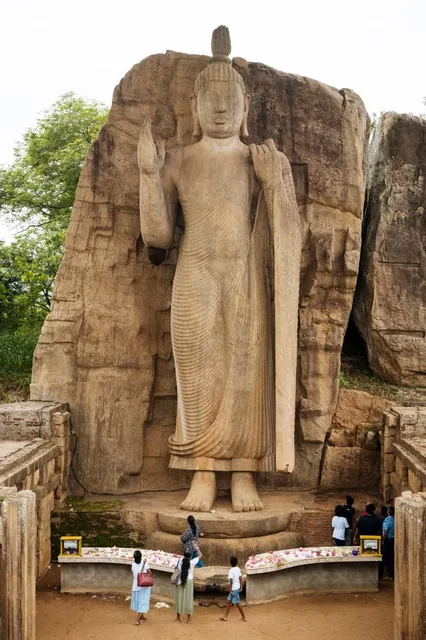
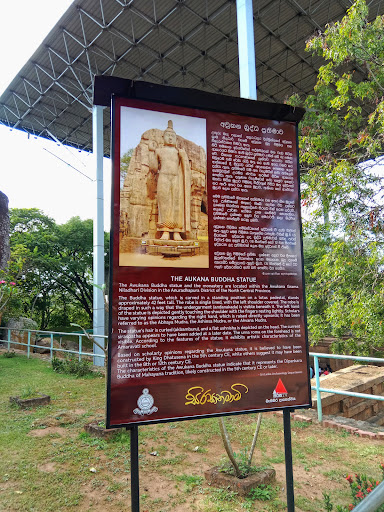
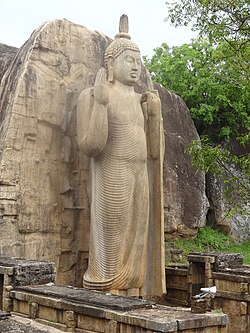
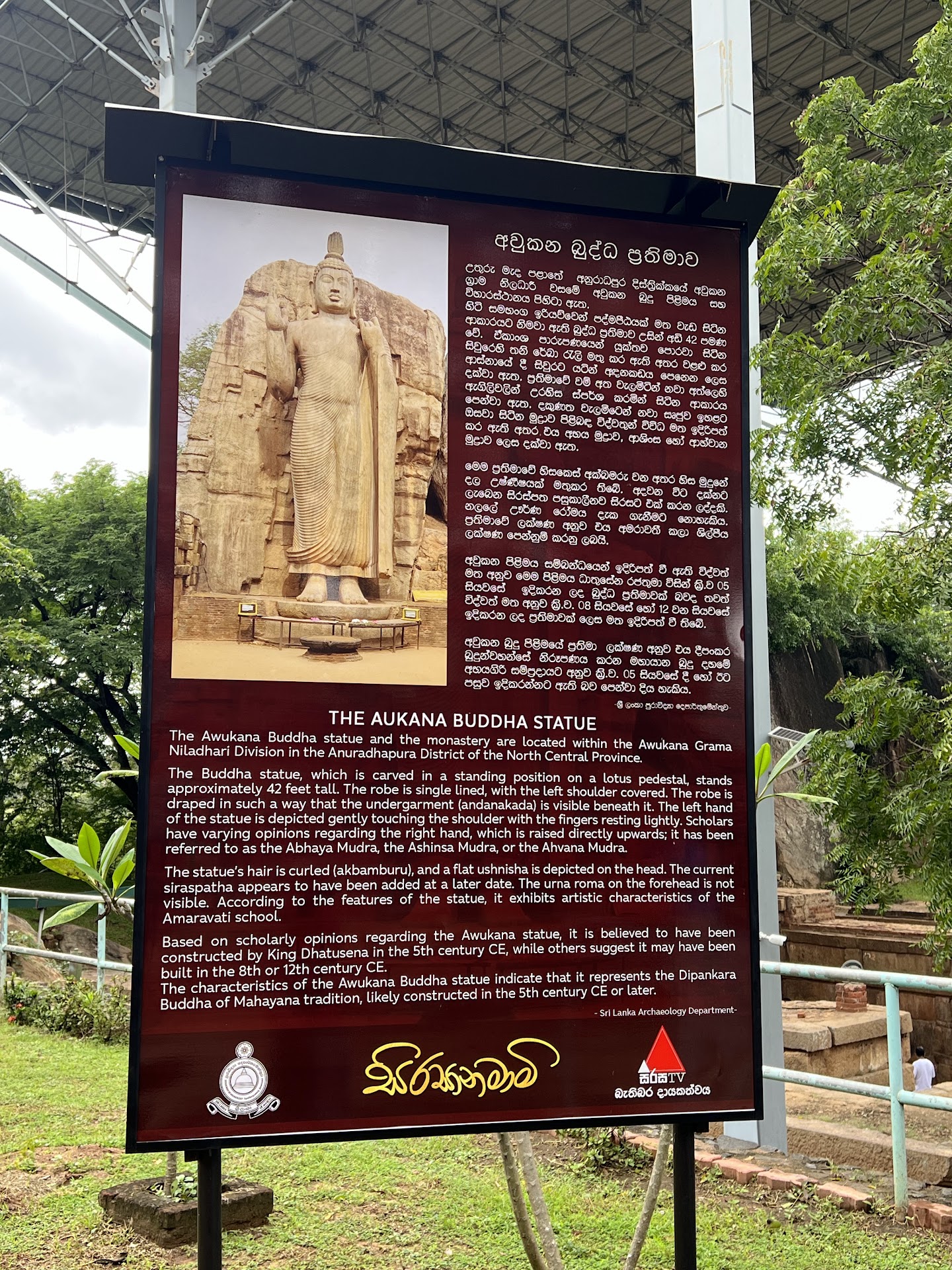
Aukana Buddha Statue in Sri Lanka that rise to a height off 11.36 meters, is the tallest ancient Buddha statue in Sri Lanka.
The posture of the statue
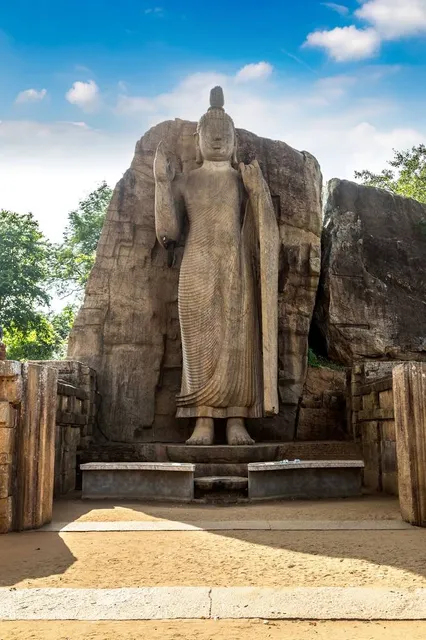
Aukana Buddha Statue in Asisa Mudra or the “posture of blessing” is carved out of a rock boulder. The statue is carved in the round connected to the back to the rock boulder. The delicate and skillful carving of the Buddha’s robe humanizes and chastely reveals the underlying form of his body, while the face’s impassive expression projects an aura of spiritual supremacy.
It is said that the degree of alignment of the statue is such that raindrop on the nose would drop straight down to small depression carved between the toes. Aukana Buddha Statue is a masterpiece of a colossal Buddha Statue by an unknown sculptor: the serene expression of the statue, the gracefully carved robe with neat pleats brings in delicateness that could hardly be moulded into a rock. The impassive expression of the face reflects the supreme spirituality.
The sculpture in proportion
Aukana Buddha Statue is carved alone the proportion of nine faces: the body height is nine times the length of the face. The proportion of nine faces is the iconometry followed by the sculptors in the eight century AC of Sri Lanka.
Sirasapata
Sirasapata is the symbol placed on the top of the Buddha images in Sri Lanka. The sirasapata found on the head of Aukana Buddha statue is believed to be a modern addition in the year 1870. The discovery of a fragment of a sirasapata in the premises of the site suggests there had been a sirasapata on the head of the statue nearly a century before 1870. This turn of events have lead to study whether sirasapata had existed from the very beginning in the 8th century AD. According to the Buddhist literature sirasapata have existed in the all four previous Buddhas. Introduction and existence of sirasapata have been consistent in Sri Lanka since second half of the fifth century A.D. with several exceptions. Hence it is believed Aukana Buddha Statue too was adorned with a sirasapata.
Drapery
Drapery, the art of draping the statues in folds is prominent in the Aukana Buddha statue. The robe in single groves is draped over the left shoulder to fall over the left shoulder up to the ankle. The right shoulder is left bare.
Pedestal
Aukana Buddha statuestand on a pedestal, the front of which is carved off a slab off stone in the form of a double petal lotus flower called Padmasana meaning the Lotus seat.
School of Art
Iconography, the study of characteristics of statues, the Avukana Buddha, particularly the sirasapata, pedestal and the style shows Aukana Buddha statue belongs to Anuradhapura school of art.
Dating Aukana Statue
The difference in opinion of the experts of the dating of Aukana Buddha statues was finally resolved following the discovery in the year 1952, of an inscription on a granite slab built onto the northern wall of the shrine. The statue was sculpted in the second half of the 8th century AD when Mahayana Buddhism threatened to take root...
Read moreThe Avukana statue is located in the village of Avukana (also spelled Aukana) near Kekirawa. It is close to the Kala Wewa reservoir, and faces it. It was carved out of a large granite rock face, but is not completely separated. A narrow strip of rock has been left at the back of the statue, connecting it to the rock face and supporting it. However, the pedestal on which the Buddha stands, which is carved in the form of a lotus flower, was carved separately and positioned under the statue. The statue alone is 38 feet 10 inches (11.84 m) in height, and with the pedestal the total height of the Avukana statue reaches 42 feet (13 m). The statue had been located within a large image house or shrine, of which parts of the walls still remain. The structure was made of brick and stone, and was 74 feet (23 m) long and 63 feet (19 m) wide.
Avukana Buddha statue The Avukana statue is widely believed to have been constructed in the 5th century during the reign of King Dhatusena and under his orders. However, another theory is that it was done by an individual named Barana. There is another nearby standing statue of the Buddha, quite similar to the Avukana statue, at Sasseruwa. According to legend, the two statues are the result of a competition between a stone sculpting guru (master) and gola (pupil). The story goes that the master constructed the Avukana statue, while the pupil made the statue at Sasseruwa. The first to complete his statue had to notify the other by ringing a bell. The master managed to complete his statue first and won the competition. This is said to be why the Sasseruwa statue is unfinished. The Avukana statue is considered to be the better of the two, and similarities between them have led historians to believe that the story is actually true. However, that is a mere legend as the Sasseruwa stature was built nearly four hundred years prior to the Avukana Buddha image. Reswehera Rajamaha Vihara is an ancient temple which was built by the king Devanampiya Tissa (307-267 BC).
The Avukana statue is considered to be one of the best examples of a standing statue of the Buddha from ancient Sri Lanka.The Avukana statue shows some influence of the Gandhara school of art, as well as the Amaravati school of art of India. The robe is worn tightly, clearly outlining the shape of the body, and its pleats are carved clearly and delicately. It is worn over the left shoulder, and the right shoulder is bare, as is the tradition in Buddha statues of Sri Lanka. The Buddha's body is straight, and the left hand clutches the robe at the left shoulder. The right hand is raised up to the right shoulder, with the palm facing left. This position is known as the Asisa mudra, a variation of the...
Read moreA Must-Visit Historical Masterpiece –Avukana Buddha Statue!
The Avukana Buddha Statue stands as one of the most magnificent and best-preserved ancient sculptures in Sri Lanka. Located near Kala Wewa in the Anuradhapura District, this extraordinary granite statue is believed to have been crafted during the reign of King Dhatusena (455–473 AD), though local legends credit Baratha, the chief engineer of Kala Wewa, as its creator.
Standing at 11.36 meters tall, this serene and graceful figure of the Buddha, displaying the Abhaya Mudra (gesture of reassurance and fearlessness), is an iconic example of Anuradhapura-era craftsmanship and spiritual devotion. The detailed robe draping, the balance of the posture, and the unique finishing reflect the advanced artistry of ancient Sri Lanka.
Unique Craftsmanship Secrets:
Unlike typical carvings, the Avukana Buddha Statue was not created by simply cutting the stone. Historical knowledge suggests that a secret technique was used to soften the rock, allowing it to be sculpted with extraordinary precision during the Anuradhapura period.
Moreover, it is believed that the delicate tools used for the statue's creation were hidden within the statue itself. To this day, three hidden spots remain visible on the lower edge of the robe on the statue’s right side.
Another remarkable feature is the statue's perfect vertical alignment. It is said that if water were poured from the top of the Buddha’s head, it would flow straight down along the nose and fall precisely between both feet. The small groove formed by this water flow is still visible today.
Preservation: In recent times, to protect the statue from environmental damage such as acid rain, a roof has been constructed over it, ensuring its preservation for future generations.
Historically, during the last years of the Anuradhapura Kingdom, the statue was safeguarded from Chola invasions by local villagers who buried it beneath soil. Thanks to their efforts, the statue remained unharmed for centuries until its rediscovery during the British colonial era by archaeologist A.C.P. Bell.
Getting There: Situated on the Anuradhapura–Kurunegala road. About 65 km from Kurunegala. Easily accessible via Avukana Railway Station.
For those who are passionate about ancient architecture, spirituality, and Sri Lankan heritage, the Avukana Buddha Statue is an unforgettable destination. Its history, craftsmanship, and the stories of those who protected it make this site a true treasure...
Read more