The Polonnaruwa Vatadage is an ancient structure dating back to the Kingdom of Polonnaruwa of Sri Lanka. It is believed to have been built during the reign of Parakramabahu I to hold the Relic of the tooth of the Buddha or during the reign of Nissanka Malla of Polonnaruwa to hold the alms bowl used by the Buddha. Both these venerated relics would have given the structure a great significance and importance at the time. Located within the ancient city of Polonnaruwa, it is the best preserved example of a vatadage in the country, and has been described as the "ultimate development" of this type of architecture. Abandoned for several centuries, excavation work at the Polonnaruwa Vatadage began in 1903.
Built for the protection of a small stupa, the structure has two stone platforms decorated with elaborate stone carvings. The lower platform is entered through a single entrance facing the north, while the second platform can be accessed through four doorways facing the four cardinal points. The upper platform, surrounded by a brick wall, contains the stupa. Four Buddha statues are seated around it, each facing one of the entrances. Three concentric rows of stone columns had also been positioned here, presumably to support a wooden roof. The entire structure is decorated with stone carvings. Some of the carvings at the Polonnaruwa Vatadage, such as its sandakada pahanas, are considered to be the best examples of such architectural features. Although some archaeologists have suggested that it also had a wooden roof, this theory is disputed by others.
Theories vary among archaeologists and historians regarding who built the Polonnaruwa Vatadage, and when. One such theory suggests that it was built by Parakramabahu I during his reign in the 12th century.
The Culavamsa, an ancient chronicle, mentions that he built a circular stone shrine to hold the tooth relic of the Buddha. Archaeologist Harry Charles Purvis Bell believed that this shrine is the Polonnaruwa Vatadage. This is contradicted by several ancient sources of the island, including Rajavaliya and Poojavaliya, which mention that it was built by Nissanka Malla. However, according to the studies of Arthur Maurice Hocart, Nissanka Malla only renovated an already existing building and made some additions such as the entrance and outer porch. Wilhelm Geiger, who translated the ancient Mahavamsa, and historian H. W. Codrington both agree with this theory.
A nearby stone inscription set by Nissanka Malla lists the Vatadage among his constructions. In this, he claims that it was built by one of his generals under his own direction.
A unique feature of architecture of ancient Sri Lanka,
vatadages were built for the protection of small stupas that had an important relic enshrined in them or were built on hallowed ground.
If the Polonnaruwa Vatadage is the shrine built by Parakramabahu I, the relic of the tooth of the Buddha would have been enshrined within it.
Another possibility is that the alms bowl used by the Buddha may have been enshrined here.
Both these relics were important objects in ancient Sri Lankan culture, and would have made the Polonnaruwa Vatadage one of the most significant and venerated buildings in the country.
Polonnaruwa was abandoned in 1215 following an invasion from the Eastern Ganga Dynasty invader Kalinga Magha.
The Polonnaruwa Vatadage appears to have been abandoned with the fall of the kingdom, and there is no mention of it in the chronicles in later periods. It was not until 1903 that the Department of Archaeology began excavation work at the site under Bell, who noted that it was "only a mound of earth" at the time.
The Polonnaruwa Vatadage is located in a quadrangular area known as the Dalada Maluva in the ancient city of Polonnaruwa. The Dalada Maluva contains some of the oldest and most sacred monuments of the city.
The Polonnaruwa Vatadage, which occupies most of the south western area of it, is a prominent structure among them. It is the best preserved example of a Vatadage in...
Read moreMedirigiriya Vatadage: An Architectural Jewel of Ancient Sri Lanka
A remarkable archaeological site located amidst the dry zone forests of Sri Lanka. This ancient structure, with its roots tracing back to pre-Christian times, is an exemplary representation of early Sri Lankan architecture and craftsmanship. The Vatadage is known for its unique circular design that once housed a stupa, surrounded by intricately carved stone pillars and other ruins that reflect the grandeur of the Anuradhapura and later periods.
Historical Background The earliest references to Medirigiriya Vatadage can be found in the chronicles dating back to the reign of King Kanittha Tissa (192-194 AD) during the Anuradhapura Era. It was later developed by various kings, including King Aggabodhi VI (733–772 AD), who is credited with building the Vatadage in the 7th century, according to the Culawansa (the lesser chronicle of Sri Lanka).
However, after the devastating invasion of King Maga in the 13th century, the site was abandoned as the Sinhalese people migrated to the southern regions to escape the ensuing hardships. The site remained lost to history until it was rediscovered in 1897 by Mr. H.C.P. Bell, who recognized its significance and described it as an "architectural jewel."
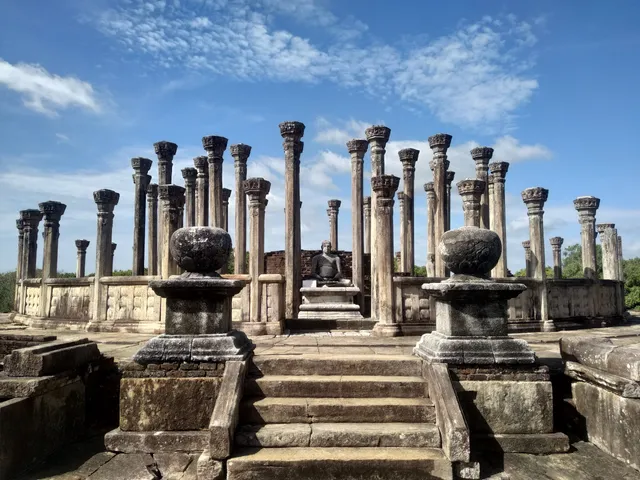
Architectural Design and Structure The Medirigiriya Vatadage is constructed on a small rock pedestal, with the entrance located on the northern side. The approach to the Vatadage involves climbing 27 stone steps leading to a resting area, followed by four more steps to reach the central stupa house. The Vatadage is surrounded by a stone wall, approximately one meter in height, which encloses the stupa and four beautifully carved seated Buddha statues on each side.
Pillars and Roof Design:
The roof of the Vatadage was supported by three concentric circles of stone pillars. The inner circle, consisting of 16 pillars, stands 17 feet tall, while the middle and outer circles have 16 and 9 feet tall pillars, respectively, with 20 and 32 pillars in each circle.
Despite various theories, there is still some debate among archaeologists regarding whether the structure ever had a roof due to the arrangement and size of the pillars.
Additional Structures:
Stupa House: The central stupa, now in ruins, was once the focal point of the Vatadage.
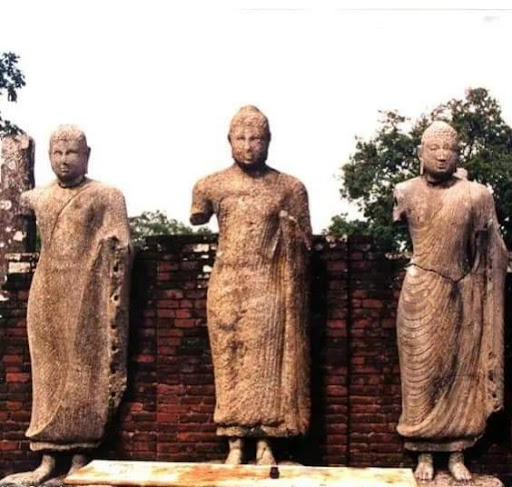
Image Houses: There are three image houses around the Vatadage, each containing Buddha statues in different postures. One notable image house, measuring 57 x 36 feet, houses a 33-foot-long reclining Buddha statue.
Pichcha-mal Viharaya: Two smaller image houses are located further away, locally known as Pichcha-mal Viharaya, each measuring 20 x 20 feet. These contain five Buddha statues—three standing and two seated.
Small Stupa: Opposite the pathway leading to the Vatadage entrance is a small stupa on a rock, offering a fantastic view of the Vatadage.
Other Notable Features
Ponds: There are two ponds in the vicinity, likely used by the monks who resided at the site.
Cave: Near the entrance to the Vatadage area there is a cave that may have been used in recent times or could be a natural formation.
Hospital: The remains of an advanced hospital are located nearby, characterized by two square layouts with 33 and 20 stone pillars, respectively. The site also features a well-preserved medicine boat, a common feature in ancient hospitals.
Stone Inscriptions: Unfortunately, many of the stone inscriptions have been destroyed by treasure hunters and local villagers. Only three remain today, with two related to the management and provisioning of the hospital and the third inscribed in Tamil.
Toilet: A stone, once the top of a toilet pit, can be found near the main entrance, indicative of the advanced sanitation practices...
Read moreMadirigiriya Watadageya: A Mystical Sanctuary in Sri Lanka
Introduction: Sri Lanka, renowned for its rich historical and cultural heritage, boasts a plethora of ancient architectural marvels, many of which have deep spiritual significance. Among these, the Madirigiriya Watadageya, located in Sri Lanka, is a remarkable monument that encapsulates the island's historical and religious importance. This essay explores the history, architecture, spiritual symbolism, and cultural significance of the Madirigiriya Watadageya.
Historical Background: Madirigiriya Watadageya, often simply referred to as Madirigiriya, is situated in the Polonnaruwa district of Sri Lanka. Its origins can be traced back to the Anuradhapura period (3rd century BC to 10th century AD). The word "watadageya" is used to describe a relic house or a shrine that enshrines sacred Buddhist relics. This historical site played an essential role in Sri Lanka's Buddhist traditions.
Architectural Grandeur: The Madirigiriya Watadageya is an exquisite example of ancient Sri Lankan architecture. It is characterized by its unique and intricate design, which includes a circular stupa or shrine surrounded by a circular stone wall. The stupa is ornately adorned with intricate carvings of lotus flowers, lions, elephants, and various other decorative elements. The relic house's exterior is a testament to the skilled craftsmanship of ancient Sri Lankan artisans.
Spiritual Significance: Madirigiriya Watadageya is primarily a sacred Buddhist site. It was constructed to house Buddhist relics and serve as a place for meditation, worship, and spiritual reflection. Pilgrims and devotees visit this ancient monument to pay homage to Lord Buddha, seek spiritual solace, and participate in religious ceremonies. The serene ambiance of the site, surrounded by lush greenery, adds to its spiritual appeal.
Cultural Importance: In addition to its religious significance, Madirigiriya Watadageya holds cultural importance for Sri Lanka. It reflects the architectural and artistic achievements of the ancient civilization. The intricate carvings and the site's overall layout are not only a testament to the skill of ancient craftsmen but also a window into the culture and beliefs of the time. It serves as a reminder of the rich heritage that has been passed down through generations.
Preservation and Conservation: Preservation efforts are crucial to protect this ancient monument and ensure its legacy for future generations. Sri Lankan authorities, in collaboration with heritage conservation organizations, have undertaken measures to safeguard Madirigiriya Watadageya. Conservation efforts include restoration of the site's structural integrity, protection from environmental damage, and the promotion of responsible tourism.
Conclusion: Madirigiriya Watadageya, with its historical roots, exquisite architecture, spiritual significance, and cultural importance, stands as a symbol of Sri Lanka's enduring connection to its ancient Buddhist traditions and artistic achievements. Visiting this sacred site not only provides a glimpse into the island's rich past but also offers a profound spiritual experience in the heart of the Polonnaruwa district. It reminds us of the timeless beauty and spiritual significance of Sri Lanka's cultural heritage, serving as a source of inspiration and reverence for all who have the privilege to explore its...
Read more