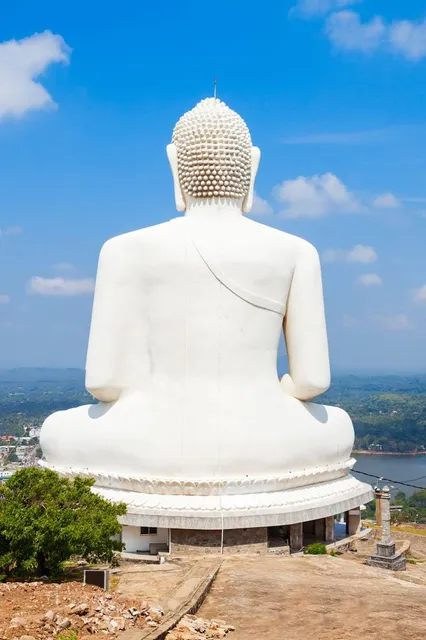
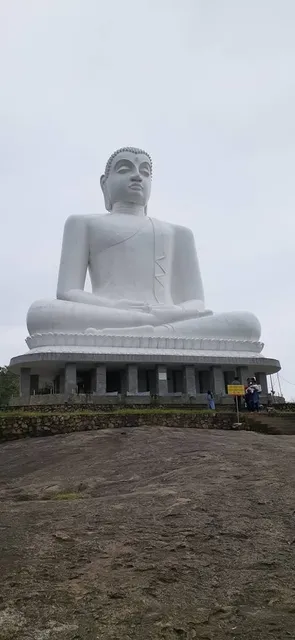
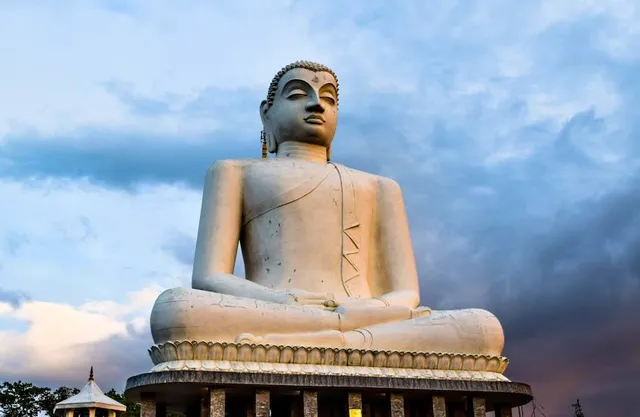
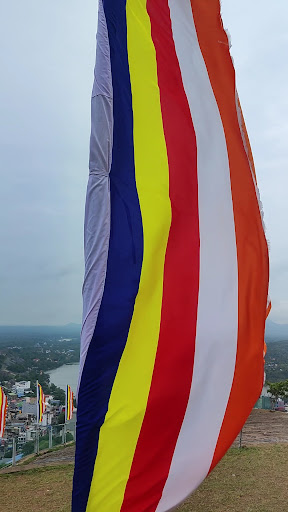
This statue is located on the Ethagala rock(height 1100 feet) in the heart of Kurunegala City, Kurunegala District in the North Western Province or Wayamba, traditionally called Sathkorale. The city is encircled by a series of rocks namely Athagala, Ibbagala, Andagala, Kuruminiyagala etc., the most prominent being Athagala, this rock bearing a resemblance to a majestic elephant, hence the names Athagala or Hasthisailapura.
Kurunegala has the third highest population of the 22 districts with 1.58 million of which 91.2% are Buddhists(census 2012). It is 93 km from Colombo and has direct roads to Kandy 42 km, Puttalam 87 km, Dambulla 55 km and Negombo km. A large volume of traffic from Colombo proceeding to Jaffna, Trincomalee, Batticaloa, Anuradhapura and Polonnaruwa pass through the city and the statue which is a symbol of Kurunegala is visible to all.
*** History *
Sathkorale had been inhabited from the earliest times as proved by Pre-Christian rock inscriptions in many parts of the district. The people were engaged in paddy cultivation and the largest number of small irrigation tanks are found here. Coconut is another important crop and Kurunegala is one apex of the coconut triangle. Sathkorale came into prominence in the 12th to 14th centuries as 4 capitals were located here. Parakramabahu ruled as sub king at Panduwasnuwara in Dakkinadesa before ascending the throne at Polonnaruwa in 1153. The world’s first peace treaty between him and king Gajabahu II of Polonnaruwa carved on a rock can be seen near Gokarella, about 15 km from Kurunegala.
When Rajarata was being devastated by the invading Magha of Kalinga, his advance to the south was halted by the leaders of Sathkorale. The kingdom of Dambadeniya was established by Vijayabahu III in 1232. His son Parakramabahu II(1236-1270) restored temples, improved the living standards of the people and ushered in Sinhala literature. His forces expelled Magha and his army from the country. King Buwanaikabahu I (1272-1284) of Yapahuwa built an exquisitively carved stone Temple of the Tooth and engaged in diplomatic relations with foreign countries, even sending an ambassador to the Caliph of Egypt. King Parakramabahu IV (1302-1326) contributed much to Sinhala literature. The kings who succeeded him ruled until 1326 after which the capital...
Read moreAwesome place to Visit. This is situated in Kurunegala District and town area. If you have a vehicle , then it will be easy to visit this place since roads are ok.
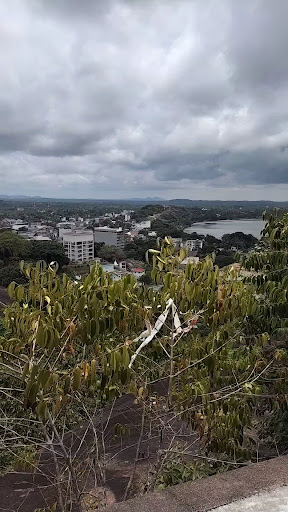
Ideal with the site for panoramic views of Kurunegala city. I do have many ancient ruins and old temples to visit. no restaurants or lodging close to this place. recommend to travel with some snacks and drinks. do have road access and separate foot path to the top of this rock.
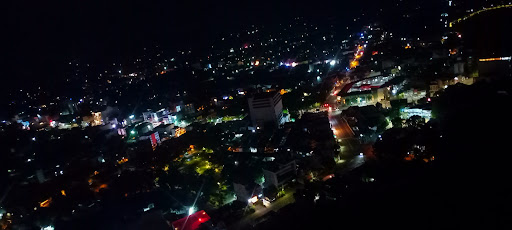
Whenever I stayed at Kurunegala or passed through it in the last 15 years or so, I admired the iconic, landmark statue in pure white sitting on top of the Ethagala rock and visible from almost anywhere in Kurunegala city. Ethagala takes its name from the elephant shape of the rock. (Etha in Sinhala means elephant). Finally, on the evening of 5th January 2018, my wife and I drove along the narrow steep road leading up to the top of the hill. There were people trekking up the hill too. We parked the car at the little parking lot below the communication tower and walked up about 100 metres to the statue. There were a few little shops along the road selling flowers and other knickknacks for visitors. The top of Ethagala is 700 metres above the city. From this vantage point, the panoramic view of the city and beyond was a treat to the eyes. Since we were there in the evening the views of the sky were breath-taking and spectacular. The Samadhi statue, in the posture of meditation, painted in pure white, sits on its own at the very top of the rock overlooking the Kurunegala city. We walked a little away and lower along the almost flat hilltop and the 21 metre tall statue looks awe-inspiring. The statue sits on a 9 metre tall platform. Under the platform is a museum and a temple for the devotees. There were monkeys too playing around the statue and on the hill. On our way down, we gave a lift to a lady running one of the shops. She said that there were many visitors both hiking up and driving up to see the statue as well as the new temple that had come up adjoining the statue and the communication tower. If you are in Kurunegala town this is an enjoyable and a pleasant trip that will take you a little more than an hour in the evening. Unlike many other statues, this had been constructed in recent times having been...
Read moreThe Elephant Rock is synonymous with the city of Kurunegala. The unique value of the Kurunegala town is Elephant Rock (325Mtrs.). It resembles an elephant. Legend has it that during periods of severe drought, the animals threatened the city's water supply, they were magically turned into stone. Situated at the foot of the 325km black rock Ethugala is an excellent view of the city and the Kurunegala Lake, from the Top. "It brings back happy memories of the good times we had growing up in the sixties with close friends and family in Kurunegala and climbing up the Elephant Rock with sandwiches and other pastries made by our parents. This was an annual outing in the olden days and how much we enjoyed it," says Upali Obeyesekere, editor of The Times of Sri Lanka website. This writer has posted a photograph of a close family friend (Malcolm Livera) atop Elephant Rock with the sprawling city of Kurunegala in the background. The development that has taken place in the city, the last few decades is quite impressive.
Kurunegala was the royal capital (from the end of the 13th century to the start of the 13th century )and also important cross town linking many ways to visit various towns from the Kurunegala. Puttalam Road, Dambulla Road, Negombo Road, Kandy Road, Colombo Road are some of the important cross roads. The city of Kurunegala is situated at a high altitude. Most of the city is plain land except the surrounding rocks. The city observes a tropical and temperate climate although the year. The precipitation range is 1800 millimeter per year. Three capitals of ancient times are situated near the city: Panduvasnuwara, Dambadeniya, and Yapahuwa. Ruins of old monuments are still found in Panduvasnuwara.
Kurunegala houses many reputed educational institutions. Some of them are: Maliyadeva College, Maliyadeva Balika Maha Vidyalaya, St. Anne's College, Holy Family Convent, Sir John Kotelawala Maha Vidyalaya and so on. Many well known politicians in parliament (old and present) hail from Kurunegala. Well known politicians associated with Kurunegala are Sir John Kotelawala, H. Sri Nissanka, U.B. Wanninayaka, D.B. Welagedera, D.P. Wickramasinghe, D.B. Monnekulame, Bertram Markus, Ariya B. Rekawa, Rohitha Bogollagama, Johnston Fernando, and many...
Read more