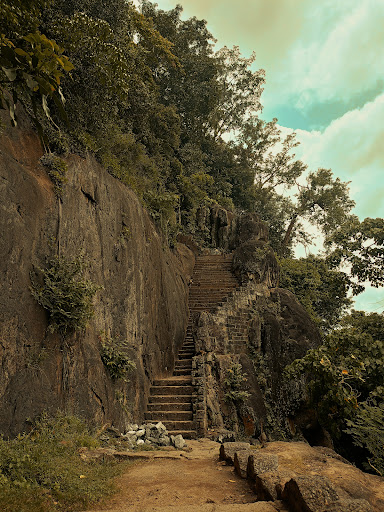
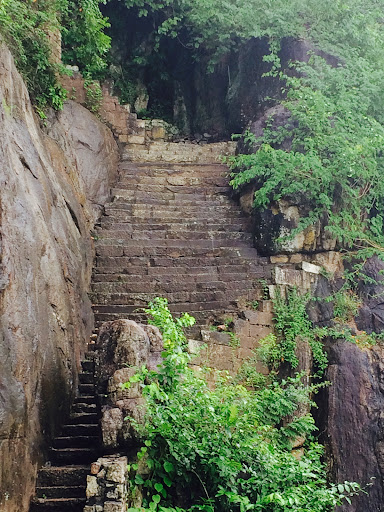
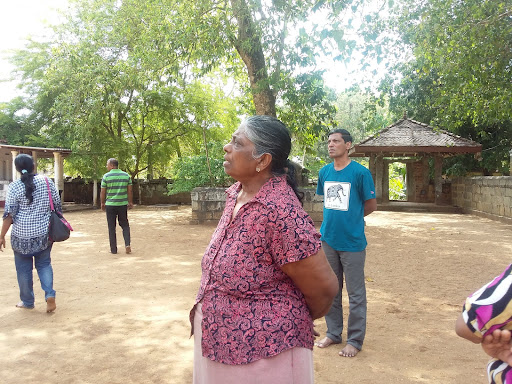
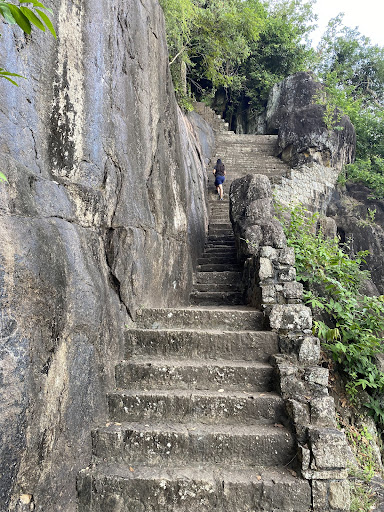
Back to the 13th Century! On a recent trip to Kurunegala we decided to explore the 13th century kingdom, Dambadeniya, situated close to Giriulla on Negombo – Kurunegala road. We first visited the Archaeology Department offices next to the ancient temple Vijayasunderaramaya. An officer from the Department explained the history and the significance of Dambadeniya, the capital city of Sri Lanka for about 50 years during the 13th Century. The temple had been established by the king during this period to keep the Buddha’s tooth relic. The temple had been restored during the 18th century. The building where the tooth relic had been kept stands today as an image house venerated by Buddhists who visit the temple. To one side of the image house is a small stupa housed within a building. Within the inner temple complex you can see a bo-tree surrounded by a gold plated fence. On either side of the two entrances leading to the bo-tree area are sculptures of beautifully carved elephants. The surround wall itself had been built out of stone blocks and the top of the wall had been protected with a specially designed stone block. The Archaeology offices houses a small museum of ruins excavated from the site. No photographs using cameras were allowed within the temple premises although there were no objections when I used my cell phone to capture some images. The king had his fortress and the palace about a kilometre away from the temple on a steep hill. Access to the top of the hill is along a steep path built with stone blocks and fortified all round with a wall built with blocks of rock cut into shape. At one point along this path, only one person could pass through making it impossible for the enemy to rush up to the palace. This place is also fortified by large rocks that could be pushed not only to block the way but also to cause severe injury to the enemy. The ruins of the central opening of the palace compound lies at the top. The larger portion of the palace is still being excavated by the Department of Archaeology. We met some post graduate students carrying out excavations in this area. The ponds used for bathing and drinking can still be seen from the area of the palace ruins. The steps and the palace and council chamber areas at the top of the hill are swept daily and kept clean. There are some 300 steep steps from the bottom of the hill to the top of the fortress. Along the steep sections, there is a wall built of stone blocks on one side of the steps that made my climb somewhat easier. From the main road we also saw another steep hill where prisoners had been kept. All in all we spent about three interesting hours exploring the temple and climbing up to the palace complex. I liked to imagine that we were in the 13th century while exploring these ruins and imagining what it would have been like...
Read moreAs you climb the worn steps of Dambadeniya Raja Maliga Gala, the air shifts. The whisper of breeze and distant birdsong blends with your heartbeat, guiding you upward, stone by stone. Each footstep echoes centuries of kings, queens, and courtiers who once walked this royal fortress high above green plains.
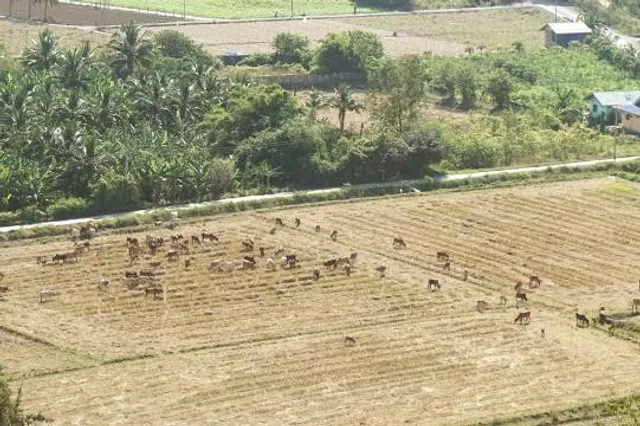
At the summit, remnants of the ancient palace emerge—crumbling foundations, the faint outlines of throne halls, glistening pools that once reflected royal grandeur. You pause, letting your gaze sweep across the patchwork of fields and forest below—a landscape unchanged, a kingdom still present in spirit.
There’s something almost magical in the breeze that whistles through the stone ruins, as if the wind carries soft echoes of council meetings or distant drums of warriors returning with the sacred Tooth relic.
Nearby, the royal temple—Vijayasundararamaya—stands quietly sacred. The ancient wooden shrine and its stone pillars hold fragrance of incense and murals painted by hand, reminding you that worship and politics once intertwined here.
In that moment, perched atop the rock, surrounded by silent grandeur, you sense the heartbeat of a medieval capital. The air tastes of history, of resilience, of culture that flourished despite invasions and turmoil. The view fills you with a quiet pride—a connection to Sri Lanka’s soul.
Visiting here is more than sightseeing. It’s a pilgrimage into endurance, identity, and beauty. A sacred stillness lingers that you carry long after you descend.
Tips for your visit:
Go early morning or late afternoon for golden light and cool air.
Wear sturdy shoes—stones and roots make the climb feel ancient underfoot.
Hire a local guide to bring those stone walls and ponds alive with history.
In short: Dambadeniya Raja Maliga Gala doesn’t just tell history—it lets you breathe it. Time slows, you listen, and Sri Lanka’s medieval heart reveals itself in the stones, the...
Read moreAfter many invasions from South India, By the 13th century Polonnaruwa was dislodged as the nation's capital. One infamous Kalinga Magha made sure of that where no ruler after him chose the northern part of the country as a capital.
By the mid 13th century, Dambadeniya became prominent in the island. King Vijayabahu III who was able to bring unity among Sangha, chose Dambadeniya as the capital of the island. On the summit of the Dambadeniya rock he built fortifications and sturdy walls and gates. The city was made secure by a moat, a marsh and ramparts around the royal palace.
One of the most famous kings, Prakramabahu II ascended to the throne next. During his reign Dambadeniya reached the zenith of its glory. King Parakramabahu II's immaculate Poetic masterpieces "Kavisilumina" and "Visuddi Marga Sannasa" gave a turning point to Sinhalese literature.
There is much yet to be discovered at Dambadeniya. And it is a place you must visit. More details can be found at Vijayasundararamaya where you can find wall paintings from 18th century and before. Vijayasundararamaya is identified as one of the earliest temple of the tooth in Sri Lanka too.
#SriLanka #Travel #TravelingThatMatters #History #Beauty #Ancient...
Read more