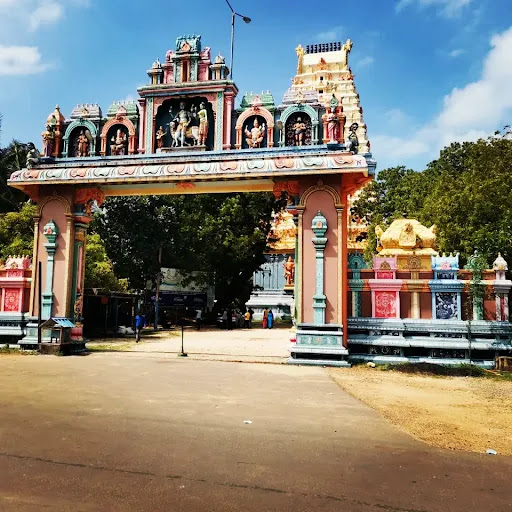
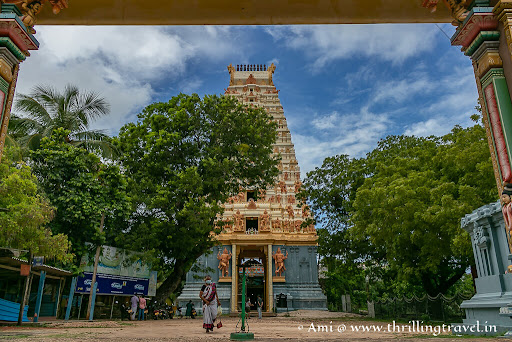
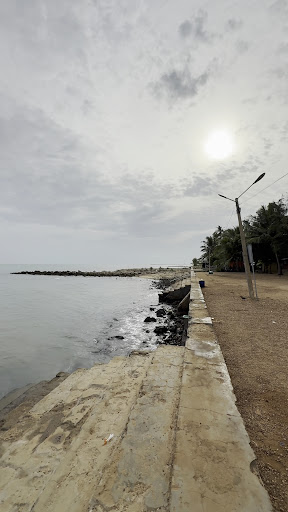
The ancient Hindu Temple Naguleswaram with its healing waters, is located in Sri Lanka,
Keerimalai Naguleswaram temple (Tamil: கீரிமலை நகுலேஸ்வரம் கோயில்), historically known also as the Thirutambaleswaram Kovil of Keerimalai, is a famous Hindu temple in Keerimalai, located north of Jaffna, Northern Province, Sri Lanka in the suburb of Kankesanthurai. One of the oldest shrines of the region, it is the northernmost of the island's Pancha Ishwarams of Lord Siva, venerated by Hindus across the world from classical antiquity. Hindus believe its adjacent water tank, the Keerimalai Springs, to have curative properties, which irrigation studies attribute to high mineral content sourced from underground. Keerimalai is 50 feet above sea level, and situated west of Palaly. Hindus flock in large numbers on Aadi Amaavaasai day which falls during the Tamil month of Aadi, to carry out rituals for their forefathers and bathe in the natural springs. Carried out largely by men, “Keerimalai” is particularly famous for this festival. The temple was largely damaged following the Portuguese conquest of the Jaffna kingdom, restored by Arumuka Navalar in 1894, was occupied by the Sri Lankan Army in 1983 and bombed by the Sri Lankan Air Force in 1993. After nearly twenty years, a major expansion and reopening of the temple occurred in 2012. Keeri in Tamil and nagula in Sanskrit mean "mongoose". Keeri-malai in Tamil means "Mongoose-Hill". The temple is situated adjacent to the mineral water springs. The legendary sage Nagula Muni, shrunk by age and austerity while meditating at a cave in Keerimalai was likened to mongooses that frequented the area. The sage bathed in the springs and was cured of his mongoose face. In gratitude, Nagula Muni constructed a small shrine and worshipped the Lingam enshrined there. This became known as the Thirutambaleswaram Kovil of Keerimalai and also the Naguleswaram Kovil of Keerimalai alluding to the sage.
🌺🙏🔥
Naguleswaram temple of Kankesanthurai was restored during the reign of Prince Vijaya of Vanga (543-505 BCE). One of the oldest shrines of the region, it is the northernmost shrine on the island of the Pancha Ishwarams of Lord Siva, venerated by Hindus across the world from classical antiquity. Its adjacent water tank, the Keerimalai Springs attribution to curative properties has been related in irrigation scientific studies to its high mineral content, sourced from underground Keerimalai Springs, Kankesanthurai. The Pandyan-Cholan princess Maruthapura Veeravalli built the Maviddapuram Kandaswamy Temple two miles from Naguleswaram in 785 CE after she was cured of her facial disfigurement at the Keerimalai springs, and later married the King Ukkira Singhan a scion of Vijaya's dynasty, at the temple's springs. Eliandurvan, one of the four brothers of the Mukkuvar king Vedi Arasan ruled at Keerimalai. "Maasi Magam" and "Aadi Amaavaasai" festival days, the latter falling during the Tamil month of "Aadi" (mid July-mid August) brings Hindu pilgrims to the town to carry out rituals for their forefathers and take a divine dip in the natural springs. These rituals are usually carried out by men. Keerimalai is particularly famous for this festival. The new moon or Amaavasai is a significant day, and according to Tamil astrologers, in the month of Aadi, the moon is in the ascendant in Kataka rasi, which is occupied by the Sun; this concurrence is reminiscent of Siva and Sakthi in Hinduism. Hence, there is special significance of Aadi Amavaasai as a day when children remember their departed parents, notably their late fathers. It is customary for them to perform ablutions, offer prayers to the departed souls with the help of a priest (Dharpanam) and attend a temple of Siva. In Sri Lanka, Keerimalai Naguleswaram temple continues as the foremost shrine for...
Read more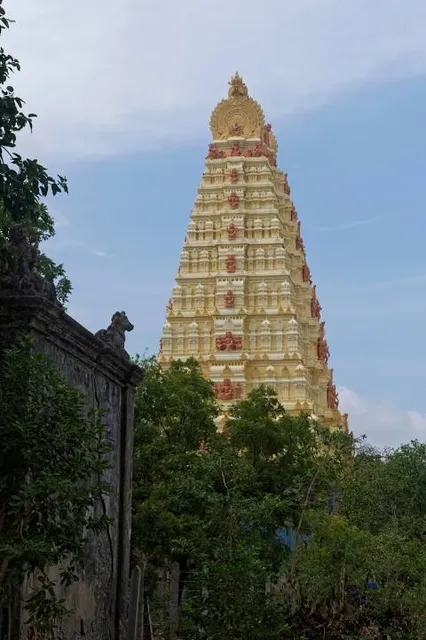
 Learn more insights from Wanderboat AI.