HTML SitemapExplore
logo
Find Things to DoFind The Best Restaurants

Nainativu Nagapooshani Amman Kovil — Attraction in Northern Province

Name
Nainativu Nagapooshani Amman Kovil
Description
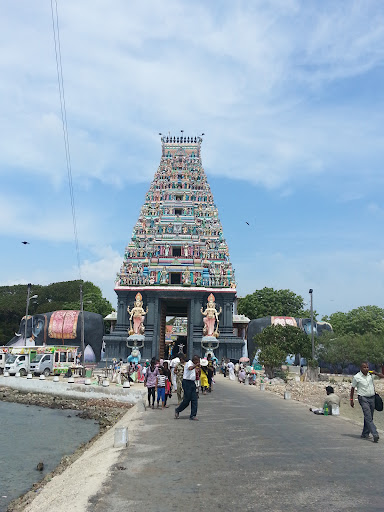
Nainativu Nagapooshani Amman Temple [Tamil: நயினாதீவு நாகபூசணி அம்மன் கோயில், romanized: Nayiṉātīvu Nākapūcaṇi Am'maṉ Kōyil - Meaning: Nainativu; Nagapooshani; Amman ] is an ancient and historic Hindu temple located amidst the Palk Strait on the island of Nainativu, Sri Lanka.
Nearby attractions
Nearby restaurants
Nearby hotels
Related posts
Keywords
Nainativu Nagapooshani Amman Kovil tourism.Nainativu Nagapooshani Amman Kovil hotels.Nainativu Nagapooshani Amman Kovil bed and breakfast. flights to Nainativu Nagapooshani Amman Kovil.Nainativu Nagapooshani Amman Kovil attractions.Nainativu Nagapooshani Amman Kovil restaurants.Nainativu Nagapooshani Amman Kovil travel.Nainativu Nagapooshani Amman Kovil travel guide.Nainativu Nagapooshani Amman Kovil travel blog.Nainativu Nagapooshani Amman Kovil pictures.Nainativu Nagapooshani Amman Kovil photos.Nainativu Nagapooshani Amman Kovil travel tips.Nainativu Nagapooshani Amman Kovil maps.Nainativu Nagapooshani Amman Kovil things to do.
Nainativu Nagapooshani Amman Kovil things to do, attractions, restaurants, events info and trip planning
Nainativu Nagapooshani Amman Kovil
Sri LankaNorthern ProvinceNainativu Nagapooshani Amman Kovil

Basic Info

Nainativu Nagapooshani Amman Kovil

Main St, Nainativu, Sri Lanka
4.7(550)
Open until 1:30 PM
Save
spot

Ratings & Description

Info

Nainativu Nagapooshani Amman Temple [Tamil: நயினாதீவு நாகபூசணி அம்மன் கோயில், romanized: Nayiṉātīvu Nākapūcaṇi Am'maṉ Kōyil - Meaning: Nainativu; Nagapooshani; Amman ] is an ancient and historic Hindu temple located amidst the Palk Strait on the island of Nainativu, Sri Lanka.

Cultural
Family friendly
Accessibility
attractions: , restaurants:
logoLearn more insights from Wanderboat AI.
Phone
+94 213 207 785
Website
nainathivu.com
Open hoursSee all hours
Tue6 AM - 1:30 PM, 4:30 - 6 PMOpen

Plan your stay

hotel
Pet-friendly Hotels in Northern Province
Find a cozy hotel nearby and make it a full experience.
hotel
Affordable Hotels in Northern Province
Find a cozy hotel nearby and make it a full experience.
hotel
The Coolest Hotels You Haven't Heard Of (Yet)
Find a cozy hotel nearby and make it a full experience.
hotel
Trending Stays Worth the Hype in Northern Province
Find a cozy hotel nearby and make it a full experience.

Reviews

Get the Appoverlay
Get the AppOne tap to find yournext favorite spots!
Wanderboat LogoWanderboat

Your everyday Al companion for getaway ideas

CompanyAbout Us
InformationAI Trip PlannerSitemap
SocialXInstagramTiktokLinkedin
LegalTerms of ServicePrivacy Policy

Get the app

© 2025 Wanderboat. All rights reserved.
logo

Posts

Sanjayan SharmaSanjayan Sharma
Nainativu Nagapoosani Amman Temple is an ancient and historic Hindu temple located 36 km from the ancient capital of the Jaffna kingdom, Nallur, Sri Lanka It is dedicated to Parvati, who is known as Nagapooshani or Bhuvaneswari, and her consort, Shiva,who is named here as Rakshaseshwar (Nayanair). It is believed to be the place where the silambu (anklets) of Gauri had fallen. Anklets have been given immense importance in the worship of Shakti since time and memorial. This ornament is also referred to in the famous Tamil epic Silapathikaram – where the story begins and ends with an anklet. Bhuvaneshwari means the Qqueenor ruler of the universe. She is the Divine Mother as the Queen of all the worlds. The entire universeis her body and all beings are ornaments on her infinite being. She carries all the worlds as a flowering of her own Self-nature. She is thus related to Sundari and to Rajarajeshwari, the supreme Lady of the Universe. In Hinduism, Bhuvaneshvari is the fourth of the ten Mahavidya goddesses and an aspect of Devi, as elements of the physical cosmos, in giving shape to the creation of the World”. Also,Bhuvaneswari is considered as the supreme ggoddesswho creates everything and destroys all the unnecessary evils of thorld. She is also considered as the Motmotherddess of Kali, Lakshmi, an saraswati, and Gayatri. In Hindu mythology, she is considered the most powerful goddess in the universe. Parvati is Sagun Roop of Goddess Bhuvaneswari. Her bija mantra is “Hreem.” She is also known as Adi Shakti, i.e., one of the earliest forms of Shakti. She is capable of turning situations according to her wish. It is considered that even the navagrahas and trimurtis can not stop her from doing anything. She can order the Trimurtis to do anything she wants. The Nainativu Nagapoosani Amman Temple is believed to be originally established by Lord Indra while seeking alleviation from the curse of Gautama Maharishi. The Sanskrit epic Mahabharata records that Lord Indra was overcome by his sexual desires for Ahalya, the wife of Gautama Maharishi. Indra disguised himself as the saint and proceeded to seduce and make love to Ahalya. When the saint came to know, he cursed Indra to have a thousand marks resembling the yoni (female reproductive organ) all over his body. Indra was ridiculed and referred to as Sa-yoni. Unable to face the humiliation, he went into exile to the island of Manidweepa (Nainativu). There, he is believed to have created, consecrated,and worshiped the moolasthana murti of the Goddess to atone for his sins. The Queen of the Universe, Bhuvaneswari Amman, satisfied with Indra’s utmost devotion, repentance, and remorse ,ppeared before him and transformed they yonis on his body into eyes. She then took on the name of “Indrakshi” (Indra Eyed). Another legend states that, many centuries later, a cobra (Nagam) was swimming across the sea towards Nainativu from the nearby island of Puliyantivu with a lotus flower in its mouth, for the worship of Bhuvaneswari Amman (who had already been consecrated by Indra). An eagle (Garuda) spotted the cobra and attempted to attack it and kill it. Fearing harm from the eagle, the cobra wound itself around a rock (referred to in Tamil as; Paambu Sutriya Kal “the Rock around which the Snake wound itself”) in the sea about half a kilometer from the Nainativu coast, and the eagle stood on another rock (Garudan Kal “the Rock of the Eagle”) some distance away. A merchant by the name of Maanikan from the Chola kingdom; who was himself a devotee of Sri Bhuvaneswari Amman, was sailing across the Palk Strait to trade with the ancient Naka Nadu noticed the eagle and the cobra perched upon said rocks. He pleaded with the eagle to let the cobra go on its way without any harm. The eagle agreed with one condition that the merchant should construct a beautiful temple for Sri Bhuvaneswari Amman on the island of Nainativu and that he shall propagate her worship in the form of Sri Nagapooshani Amman for universal peace, prosperity and humanity. He agreed and built a beautiful temple accordingly.
Harshan ErangaHarshan Eranga
Nagapooshani Amman Temple... Home Explore Sri Lanka Nagapooshani Amman Temple... nagapooshani-amman-temple-ramayana-historical-places-in-sri-lanka-ceylon-expeditions-travel-agent-sri-lanka Nagapooshani Amman Temple Nainativu Island Jaffna, Sri Lanka Nagapooshani Amman Temple is most visited historic Hindu Temple located in 36 KM away from Northern Province capital city of Jaffna in Nainativu Island Sri Lanka. Shree Nagapooshani Amman kovil is one of 64 Shakthi Peeth in the region. Nagapooshani Amman Temple is dedicated to Goddess Parvati who is known as Bhuvaneswari or Nagapooshani an Avatar of Durga. The Island of Nagadeepa also known as Nainativu is home for the important Buddhist Shrine called Nagadeepa Purana Viharaya and one of the country’s holiest Hindu Temple Nagapooshani Amman Kovil. Therefore the island of Nainativu or Nagadeepa is the center of one of the most sacred Buddhist & Hindu sites of the country attracting over a thousand visitors a daily. The annual festival of 16 days called Mahostavam (Thiruvizha) held in June & July attracting more than 100,000 pilgrims. Special Features of Nagapooshani Amman Temple This Kovil consist of four glorious Gopurams, the Raja raja Gopuram, rising to a height of 108 feet, East Gopuram, South East Gopuram and South Gopuram. Most of the devotees pay visit to the Kovil, especially during the Mahostavam thiruvilla, which is celebrated during June and July of every year. It is believed that the statue of Goddess Nagapoosani with Lingam and King Ravana’s ten headed staute at the bottom is special to this Temple and is not to be found elsewhere. History of Nagapooshani Amman Temple Present structure of this massive Temple complex having been built between 1720 and 1790 after the Portuguese destroyed the original Nagapooshani Amman kovil in somewhere in 1620. Nainativu itself has been important to both South Indian and Sri Lankan Tamils as well as to the Sinhalese, especially as part of the foreign trade route that existed during the medieval era. As per the inscriptions date back to the 12th Century AD explain that, plenty of international traders stop at the Island of Kayts also made a detour at Nainativu. Also during King Parakramabahu I period, he had made large-scale international trade the north with his shipyards and numerous harbors around the island including Jaffna. Nagadeepa Buddhist temple in Nainativu Island Jaffna Nagadeepa Buddhist Temple, is one of the most visited important Buddhist Temples in Sri Lanka located close to Nagapooshani Amman Kovil in same island of Nainativu Jaffna. It is believed that the Buddha’s second visit to the island Is to Nagadeepa in the 6th century B.C. According to the Mahavamsa Buddha, during this visit pacified two Naga kings of Nagadipa who were arrayed in battle over a gem-set throne. In the ancient chronicles the pre-historic Naga tribes are represented as non-human beings enriched with an advanced civilization. The ancient temple encompasses the image houses and the stupa in which the gem-set throne was enshrined before it was destroyed. Legends of Nagapooshani Amman Kovil Goddess Parvati who is locally known as Nagapushani and her consort Shiva who is named as Nayinar in Sri Lanka. Ramayana proof depicts that this historical place was identified as one of the 64 Shakti Pithas, by India’s great 9th century Vedanta philosopher, Adi Shankara. The temple’s fame is accredited to Adi Shankaracharya, a 9th century Hindu philosopher, for identifying it as one of the prominent 64 Shakthi Peethams in Shakthi Peetha Stortram and its mentioned in the Brahmandapurana. Nagapooshani Amman Temple also consider as one of the Sri Lanka Ramayana Tour related sites.
Gayan FonsekaGayan Fonseka
The Nagapooshani Amman Temple on the island of Nainativu is an ancient Hindu temple. According to folklore, this temple was originally built many millennia ago by the Nagas, a prehistoric race of people in Sri Lanka. The temple was originally erected and dedicated for the worship of the Serpent God called “Nayinar” by the Nagas. In the Nainativu temple, the object of worship in the sanctum sanctorum is a stone figure of a five-headed cobra. The festival of the Sri Nagapooshani Amman Kovil is generally held in the Tamil month of Aani (June/July) each year for fifteen days. During the festive season, many childless couples come on pilgrimages to the Kovil to receive the blessings of the Nagapooshani Amman, the patron Mother Goddess of the Kovil. The devotees, whose wishes are bestowed, too come with their newborn babies to fulfil their vows. As such, the Sri Nagapooshani Amman Kovil becomes a place of high activity during the festive season. Nainativu is a unique islet that houses the religious places belonging to all main religions practised in Sri Lanka, namely Buddhism, Hinduism, Christianity, and Islam. The famous Buddhist temple, “Nagadeepa Vihara”, is also located on the same island near the Sri Nagapooshani Amman Kovil, symbolizing religious coexistence among peace-loving citizens in the country irrespective of their ethnic differences. One important artefact that defines the ancient ruling powers of the Janffna Peninsula is found at this temple. A slab inscription by the king Parakramabahu the Great ( Parakramabahu I) who ruled from Polonnaruwa from 1153 to 1186. This is the earliest Tamil inscription by a Sinhalese king found in Jaffna District. This inscription is 3 feet 8 inches wide and 3 feet wide and contains certain trade regulations concerning wreckages off the port of Uratturai i.e. present-day Kayts in 23 lines of text. In the words of Dr. Karthigesu Indrapala, Professor of History at the University of Jaffna, “The fact that this edict was issued not by any subordinate official, but by the king himself shows that the monarch was in supreme control of the northernmost region of the island.” The translation of this inscription is   “Foreigners must land and remain at Uraturai (Kayts) and they must be protected. If foreigners land at new ports they should be at this port. If ships laden with elephants and horses are wrecked, one-fourth of the share shall be taken by the Treasury and the other three parts shall be given to the owner.  If merchant vessels are wrecked half of the share shall be taken by the Treasury and the other half given to the the owner. These edicts are inscribed on stone and copper. This edict shall last as long as the Sun and the Moon. These edicts are promulgated by Sakala Sinhala Chakrawarthi Deva Parakrama Bhuja“ Today part of the the inscription is broken and missing. Most of the text is illegible due to the workers at the kovil using this slab to sharpen knives at the kovil. The remains of this artefact now lie inside the kovil left to the main entrance.
See more posts
See more posts
hotel
Find your stay

Pet-friendly Hotels in Northern Province

Find a cozy hotel nearby and make it a full experience.

Nainativu Nagapoosani Amman Temple is an ancient and historic Hindu temple located 36 km from the ancient capital of the Jaffna kingdom, Nallur, Sri Lanka It is dedicated to Parvati, who is known as Nagapooshani or Bhuvaneswari, and her consort, Shiva,who is named here as Rakshaseshwar (Nayanair). It is believed to be the place where the silambu (anklets) of Gauri had fallen. Anklets have been given immense importance in the worship of Shakti since time and memorial. This ornament is also referred to in the famous Tamil epic Silapathikaram – where the story begins and ends with an anklet. Bhuvaneshwari means the Qqueenor ruler of the universe. She is the Divine Mother as the Queen of all the worlds. The entire universeis her body and all beings are ornaments on her infinite being. She carries all the worlds as a flowering of her own Self-nature. She is thus related to Sundari and to Rajarajeshwari, the supreme Lady of the Universe. In Hinduism, Bhuvaneshvari is the fourth of the ten Mahavidya goddesses and an aspect of Devi, as elements of the physical cosmos, in giving shape to the creation of the World”. Also,Bhuvaneswari is considered as the supreme ggoddesswho creates everything and destroys all the unnecessary evils of thorld. She is also considered as the Motmotherddess of Kali, Lakshmi, an saraswati, and Gayatri. In Hindu mythology, she is considered the most powerful goddess in the universe. Parvati is Sagun Roop of Goddess Bhuvaneswari. Her bija mantra is “Hreem.” She is also known as Adi Shakti, i.e., one of the earliest forms of Shakti. She is capable of turning situations according to her wish. It is considered that even the navagrahas and trimurtis can not stop her from doing anything. She can order the Trimurtis to do anything she wants. The Nainativu Nagapoosani Amman Temple is believed to be originally established by Lord Indra while seeking alleviation from the curse of Gautama Maharishi. The Sanskrit epic Mahabharata records that Lord Indra was overcome by his sexual desires for Ahalya, the wife of Gautama Maharishi. Indra disguised himself as the saint and proceeded to seduce and make love to Ahalya. When the saint came to know, he cursed Indra to have a thousand marks resembling the yoni (female reproductive organ) all over his body. Indra was ridiculed and referred to as Sa-yoni. Unable to face the humiliation, he went into exile to the island of Manidweepa (Nainativu). There, he is believed to have created, consecrated,and worshiped the moolasthana murti of the Goddess to atone for his sins. The Queen of the Universe, Bhuvaneswari Amman, satisfied with Indra’s utmost devotion, repentance, and remorse ,ppeared before him and transformed they yonis on his body into eyes. She then took on the name of “Indrakshi” (Indra Eyed). Another legend states that, many centuries later, a cobra (Nagam) was swimming across the sea towards Nainativu from the nearby island of Puliyantivu with a lotus flower in its mouth, for the worship of Bhuvaneswari Amman (who had already been consecrated by Indra). An eagle (Garuda) spotted the cobra and attempted to attack it and kill it. Fearing harm from the eagle, the cobra wound itself around a rock (referred to in Tamil as; Paambu Sutriya Kal “the Rock around which the Snake wound itself”) in the sea about half a kilometer from the Nainativu coast, and the eagle stood on another rock (Garudan Kal “the Rock of the Eagle”) some distance away. A merchant by the name of Maanikan from the Chola kingdom; who was himself a devotee of Sri Bhuvaneswari Amman, was sailing across the Palk Strait to trade with the ancient Naka Nadu noticed the eagle and the cobra perched upon said rocks. He pleaded with the eagle to let the cobra go on its way without any harm. The eagle agreed with one condition that the merchant should construct a beautiful temple for Sri Bhuvaneswari Amman on the island of Nainativu and that he shall propagate her worship in the form of Sri Nagapooshani Amman for universal peace, prosperity and humanity. He agreed and built a beautiful temple accordingly.
Sanjayan Sharma

Sanjayan Sharma

hotel
Find your stay

Affordable Hotels in Northern Province

Find a cozy hotel nearby and make it a full experience.

Get the Appoverlay
Get the AppOne tap to find yournext favorite spots!
Nagapooshani Amman Temple... Home Explore Sri Lanka Nagapooshani Amman Temple... nagapooshani-amman-temple-ramayana-historical-places-in-sri-lanka-ceylon-expeditions-travel-agent-sri-lanka Nagapooshani Amman Temple Nainativu Island Jaffna, Sri Lanka Nagapooshani Amman Temple is most visited historic Hindu Temple located in 36 KM away from Northern Province capital city of Jaffna in Nainativu Island Sri Lanka. Shree Nagapooshani Amman kovil is one of 64 Shakthi Peeth in the region. Nagapooshani Amman Temple is dedicated to Goddess Parvati who is known as Bhuvaneswari or Nagapooshani an Avatar of Durga. The Island of Nagadeepa also known as Nainativu is home for the important Buddhist Shrine called Nagadeepa Purana Viharaya and one of the country’s holiest Hindu Temple Nagapooshani Amman Kovil. Therefore the island of Nainativu or Nagadeepa is the center of one of the most sacred Buddhist & Hindu sites of the country attracting over a thousand visitors a daily. The annual festival of 16 days called Mahostavam (Thiruvizha) held in June & July attracting more than 100,000 pilgrims. Special Features of Nagapooshani Amman Temple This Kovil consist of four glorious Gopurams, the Raja raja Gopuram, rising to a height of 108 feet, East Gopuram, South East Gopuram and South Gopuram. Most of the devotees pay visit to the Kovil, especially during the Mahostavam thiruvilla, which is celebrated during June and July of every year. It is believed that the statue of Goddess Nagapoosani with Lingam and King Ravana’s ten headed staute at the bottom is special to this Temple and is not to be found elsewhere. History of Nagapooshani Amman Temple Present structure of this massive Temple complex having been built between 1720 and 1790 after the Portuguese destroyed the original Nagapooshani Amman kovil in somewhere in 1620. Nainativu itself has been important to both South Indian and Sri Lankan Tamils as well as to the Sinhalese, especially as part of the foreign trade route that existed during the medieval era. As per the inscriptions date back to the 12th Century AD explain that, plenty of international traders stop at the Island of Kayts also made a detour at Nainativu. Also during King Parakramabahu I period, he had made large-scale international trade the north with his shipyards and numerous harbors around the island including Jaffna. Nagadeepa Buddhist temple in Nainativu Island Jaffna Nagadeepa Buddhist Temple, is one of the most visited important Buddhist Temples in Sri Lanka located close to Nagapooshani Amman Kovil in same island of Nainativu Jaffna. It is believed that the Buddha’s second visit to the island Is to Nagadeepa in the 6th century B.C. According to the Mahavamsa Buddha, during this visit pacified two Naga kings of Nagadipa who were arrayed in battle over a gem-set throne. In the ancient chronicles the pre-historic Naga tribes are represented as non-human beings enriched with an advanced civilization. The ancient temple encompasses the image houses and the stupa in which the gem-set throne was enshrined before it was destroyed. Legends of Nagapooshani Amman Kovil Goddess Parvati who is locally known as Nagapushani and her consort Shiva who is named as Nayinar in Sri Lanka. Ramayana proof depicts that this historical place was identified as one of the 64 Shakti Pithas, by India’s great 9th century Vedanta philosopher, Adi Shankara. The temple’s fame is accredited to Adi Shankaracharya, a 9th century Hindu philosopher, for identifying it as one of the prominent 64 Shakthi Peethams in Shakthi Peetha Stortram and its mentioned in the Brahmandapurana. Nagapooshani Amman Temple also consider as one of the Sri Lanka Ramayana Tour related sites.
Harshan Eranga

Harshan Eranga

hotel
Find your stay

The Coolest Hotels You Haven't Heard Of (Yet)

Find a cozy hotel nearby and make it a full experience.

hotel
Find your stay

Trending Stays Worth the Hype in Northern Province

Find a cozy hotel nearby and make it a full experience.

The Nagapooshani Amman Temple on the island of Nainativu is an ancient Hindu temple. According to folklore, this temple was originally built many millennia ago by the Nagas, a prehistoric race of people in Sri Lanka. The temple was originally erected and dedicated for the worship of the Serpent God called “Nayinar” by the Nagas. In the Nainativu temple, the object of worship in the sanctum sanctorum is a stone figure of a five-headed cobra. The festival of the Sri Nagapooshani Amman Kovil is generally held in the Tamil month of Aani (June/July) each year for fifteen days. During the festive season, many childless couples come on pilgrimages to the Kovil to receive the blessings of the Nagapooshani Amman, the patron Mother Goddess of the Kovil. The devotees, whose wishes are bestowed, too come with their newborn babies to fulfil their vows. As such, the Sri Nagapooshani Amman Kovil becomes a place of high activity during the festive season. Nainativu is a unique islet that houses the religious places belonging to all main religions practised in Sri Lanka, namely Buddhism, Hinduism, Christianity, and Islam. The famous Buddhist temple, “Nagadeepa Vihara”, is also located on the same island near the Sri Nagapooshani Amman Kovil, symbolizing religious coexistence among peace-loving citizens in the country irrespective of their ethnic differences. One important artefact that defines the ancient ruling powers of the Janffna Peninsula is found at this temple. A slab inscription by the king Parakramabahu the Great ( Parakramabahu I) who ruled from Polonnaruwa from 1153 to 1186. This is the earliest Tamil inscription by a Sinhalese king found in Jaffna District. This inscription is 3 feet 8 inches wide and 3 feet wide and contains certain trade regulations concerning wreckages off the port of Uratturai i.e. present-day Kayts in 23 lines of text. In the words of Dr. Karthigesu Indrapala, Professor of History at the University of Jaffna, “The fact that this edict was issued not by any subordinate official, but by the king himself shows that the monarch was in supreme control of the northernmost region of the island.” The translation of this inscription is   “Foreigners must land and remain at Uraturai (Kayts) and they must be protected. If foreigners land at new ports they should be at this port. If ships laden with elephants and horses are wrecked, one-fourth of the share shall be taken by the Treasury and the other three parts shall be given to the owner.  If merchant vessels are wrecked half of the share shall be taken by the Treasury and the other half given to the the owner. These edicts are inscribed on stone and copper. This edict shall last as long as the Sun and the Moon. These edicts are promulgated by Sakala Sinhala Chakrawarthi Deva Parakrama Bhuja“ Today part of the the inscription is broken and missing. Most of the text is illegible due to the workers at the kovil using this slab to sharpen knives at the kovil. The remains of this artefact now lie inside the kovil left to the main entrance.
Gayan Fonseka

Gayan Fonseka

See more posts
See more posts

Reviews of Nainativu Nagapooshani Amman Kovil

4.7
(550)
avatar
5.0
33w

Nainativu Nagapoosani Amman Temple is an ancient and historic Hindu temple located 36 km from the ancient capital of the Jaffna kingdom, Nallur, Sri Lanka It is dedicated to Parvati, who is known as Nagapooshani or Bhuvaneswari, and her consort, Shiva,who is named here as Rakshaseshwar (Nayanair).

It is believed to be the place where the silambu (anklets) of Gauri had fallen. Anklets have been given immense importance in the worship of Shakti since time and memorial. This ornament is also referred to in the famous Tamil epic Silapathikaram – where the story begins and ends with an anklet.

Bhuvaneshwari means the Qqueenor ruler of the universe. She is the Divine Mother as the Queen of all the worlds. The entire universeis her body and all beings are ornaments on her infinite being. She carries all the worlds as a flowering of her own Self-nature. She is thus related to Sundari and to Rajarajeshwari, the supreme Lady of the Universe.

In Hinduism, Bhuvaneshvari is the fourth of the ten Mahavidya goddesses and an aspect of Devi, as elements of the physical cosmos, in giving shape to the creation of the World”. Also,Bhuvaneswari is considered as the supreme ggoddesswho creates everything and destroys all the unnecessary evils of thorld. She is also considered as the Motmotherddess of Kali, Lakshmi, an saraswati, and Gayatri. In Hindu mythology, she is considered the most powerful goddess in the universe. Parvati is Sagun Roop of Goddess Bhuvaneswari. Her bija mantra is “Hreem.”

She is also known as Adi Shakti, i.e., one of the earliest forms of Shakti. She is capable of turning situations according to her wish. It is considered that even the navagrahas and trimurtis can not stop her from doing anything. She can order the Trimurtis to do anything she wants.

The Nainativu Nagapoosani Amman Temple is believed to be originally established by Lord Indra while seeking alleviation from the curse of Gautama Maharishi. The Sanskrit epic Mahabharata records that Lord Indra was overcome by his sexual desires for Ahalya, the wife of Gautama Maharishi. Indra disguised himself as the saint and proceeded to seduce and make love to Ahalya. When the saint came to know, he cursed Indra to have a thousand marks resembling the yoni (female reproductive organ) all over his body. Indra was ridiculed and referred to as Sa-yoni. Unable to face the humiliation, he went into exile to the island of Manidweepa (Nainativu). There, he is believed to have created, consecrated,and worshiped the moolasthana murti of the Goddess to atone for his sins. The Queen of the Universe, Bhuvaneswari Amman, satisfied with Indra’s utmost devotion, repentance, and remorse ,ppeared before him and transformed they yonis on his body into eyes. She then took on the name of “Indrakshi” (Indra Eyed).

Another legend states that, many centuries later, a cobra (Nagam) was swimming across the sea towards Nainativu from the nearby island of Puliyantivu with a lotus flower in its mouth, for the worship of Bhuvaneswari Amman (who had already been consecrated by Indra). An eagle (Garuda) spotted the cobra and attempted to attack it and kill it. Fearing harm from the eagle, the cobra wound itself around a rock (referred to in Tamil as; Paambu Sutriya Kal “the Rock around which the Snake wound itself”) in the sea about half a kilometer from the Nainativu coast, and the eagle stood on another rock (Garudan Kal “the Rock of the Eagle”) some distance away. A merchant by the name of Maanikan from the Chola kingdom; who was himself a devotee of Sri Bhuvaneswari Amman, was sailing across the Palk Strait to trade with the ancient Naka Nadu noticed the eagle and the cobra perched upon said rocks. He pleaded with the eagle to let the cobra go on its way without any harm. The eagle agreed with one condition that the merchant should construct a beautiful temple for Sri Bhuvaneswari Amman on the island of Nainativu and that he shall propagate her worship in the form of Sri Nagapooshani Amman for universal peace, prosperity and humanity. He agreed and built a beautiful temple...

   Read more

avatar
5.0
2y

Nagapooshani Amman Temple... Home Explore Sri Lanka Nagapooshani Amman Temple... nagapooshani-amman-temple-ramayana-historical-places-in-sri-lanka-ceylon-expeditions-travel-agent-sri-lanka Nagapooshani Amman Temple Nainativu Island Jaffna, Sri Lanka Nagapooshani Amman Temple is most visited historic Hindu Temple located in 36 KM away from Northern Province capital city of Jaffna in Nainativu Island Sri Lanka. Shree Nagapooshani Amman kovil is one of 64 Shakthi Peeth in the region. Nagapooshani Amman Temple is dedicated to Goddess Parvati who is known as Bhuvaneswari or Nagapooshani an Avatar of Durga. The Island of Nagadeepa also known as Nainativu is home for the important Buddhist Shrine called Nagadeepa Purana Viharaya and one of the country’s holiest Hindu Temple Nagapooshani Amman Kovil. Therefore the island of Nainativu or Nagadeepa is the center of one of the most sacred Buddhist & Hindu sites of the country attracting over a thousand visitors a daily. The annual festival of 16 days called Mahostavam (Thiruvizha) held in June & July attracting more than 100,000 pilgrims.

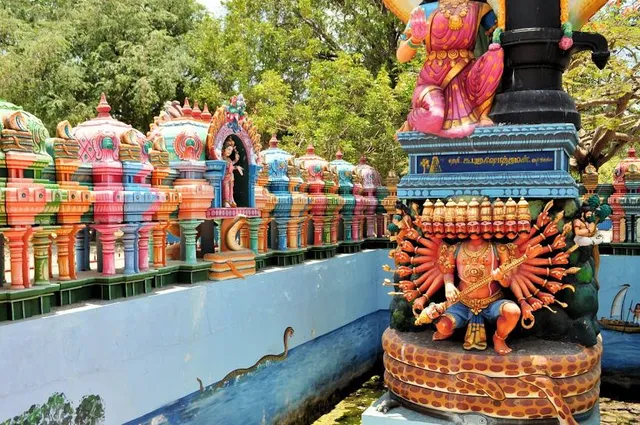
Special Features of Nagapooshani Amman Temple This Kovil consist of four glorious Gopurams, the Raja raja Gopuram, rising to a height of 108 feet, East Gopuram, South East Gopuram and South Gopuram. Most of the devotees pay visit to the Kovil, especially during the Mahostavam thiruvilla, which is celebrated during June and July of every year. It is believed that the statue of Goddess Nagapoosani with Lingam and King Ravana’s ten headed staute at the bottom is special to this Temple and is not to be found elsewhere.

History of Nagapooshani Amman Temple Present structure of this massive Temple complex having been built between 1720 and 1790 after the Portuguese destroyed the original Nagapooshani Amman kovil in somewhere in 1620.

Nainativu itself has been important to both South Indian and Sri Lankan Tamils as well as to the Sinhalese, especially as part of the foreign trade route that existed during the medieval era. As per the inscriptions date back to the 12th Century AD explain that, plenty of international traders stop at the Island of Kayts also made a detour at Nainativu. Also during King Parakramabahu I period, he had made large-scale international trade the north with his shipyards and numerous harbors around the island including Jaffna.

Nagadeepa Buddhist temple in Nainativu Island Jaffna Nagadeepa Buddhist Temple, is one of the most visited important Buddhist Temples in Sri Lanka located close to Nagapooshani Amman Kovil in same island of Nainativu Jaffna. It is believed that the Buddha’s second visit to the island Is to Nagadeepa in the 6th century B.C. According to the Mahavamsa Buddha, during this visit pacified two Naga kings of Nagadipa who were arrayed in battle over a gem-set throne. In the ancient chronicles the pre-historic Naga tribes are represented as non-human beings enriched with an advanced civilization. The ancient temple encompasses the image houses and the stupa in which the gem-set throne was enshrined before it was destroyed.

Legends of Nagapooshani Amman Kovil Goddess Parvati who is locally known as Nagapushani and her consort Shiva who is named as Nayinar in Sri Lanka. Ramayana proof depicts that this historical place was identified as one of the 64 Shakti Pithas, by India’s great 9th century Vedanta philosopher, Adi Shankara. The temple’s fame is accredited to Adi Shankaracharya, a 9th century Hindu philosopher, for identifying it as one of the prominent 64 Shakthi Peethams in Shakthi Peetha Stortram and its mentioned in the Brahmandapurana. Nagapooshani Amman Temple also consider as one of the Sri Lanka Ramayana Tour...

   Read more
avatar
5.0
1y

The Nagapooshani Amman Temple on the island of Nainativu is an ancient Hindu temple. According to folklore, this temple was originally built many millennia ago by the Nagas, a prehistoric race of people in Sri Lanka. The temple was originally erected and dedicated for the worship of the Serpent God called “Nayinar” by the Nagas. In the Nainativu temple, the object of worship in the sanctum sanctorum is a stone figure of a five-headed cobra. The festival of the Sri Nagapooshani Amman Kovil is generally held in the Tamil month of Aani (June/July) each year for fifteen days.

During the festive season, many childless couples come on pilgrimages to the Kovil to receive the blessings of the Nagapooshani Amman, the patron Mother Goddess of the Kovil. The devotees, whose wishes are bestowed, too come with their newborn babies to fulfil their vows. As such, the Sri Nagapooshani Amman Kovil becomes a place of high activity during the festive season. Nainativu is a unique islet that houses the religious places belonging to all main religions practised in Sri Lanka, namely Buddhism, Hinduism, Christianity, and Islam. The famous Buddhist temple, “Nagadeepa Vihara”, is also located on the same island near the Sri Nagapooshani Amman Kovil, symbolizing religious coexistence among peace-loving citizens in the country irrespective of their ethnic differences.

One important artefact that defines the ancient ruling powers of the Janffna Peninsula is found at this temple. A slab inscription by the king Parakramabahu the Great ( Parakramabahu I) who ruled from Polonnaruwa from 1153 to 1186. This is the earliest Tamil inscription by a Sinhalese king found in Jaffna District. This inscription is 3 feet 8 inches wide and 3 feet wide and contains certain trade regulations concerning wreckages off the port of Uratturai i.e. present-day Kayts in 23 lines of text.

In the words of Dr. Karthigesu Indrapala, Professor of History at the University of Jaffna, “The fact that this edict was issued not by any subordinate official, but by the king himself shows that the monarch was in supreme control of the northernmost region of the island.”

The translation of this inscription is   “Foreigners must land and remain at Uraturai (Kayts) and they must be protected. If foreigners land at new ports they should be at this port. If ships laden with elephants and horses are wrecked, one-fourth of the share shall be taken by the Treasury and the other three parts shall be given to the owner.  If merchant vessels are wrecked half of the share shall be taken by the Treasury and the other half given to the the owner. These edicts are inscribed on stone and copper. This edict shall last as long as the Sun and the Moon. These edicts are promulgated by Sakala Sinhala Chakrawarthi Deva Parakrama Bhuja“

Today part of the the inscription is broken and missing. Most of the text is illegible due to the workers at the kovil using this slab to sharpen knives at the kovil. The remains of this artefact now lie inside the kovil left to the...

   Read more
Page 1 of 7
Previous
Next