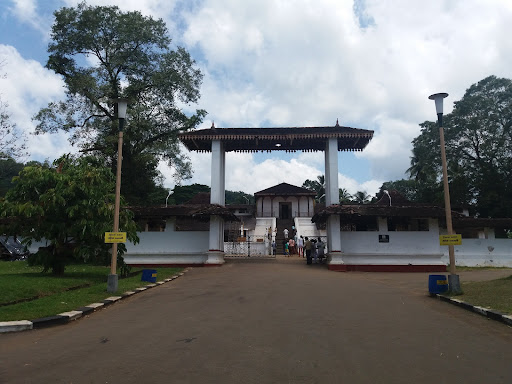
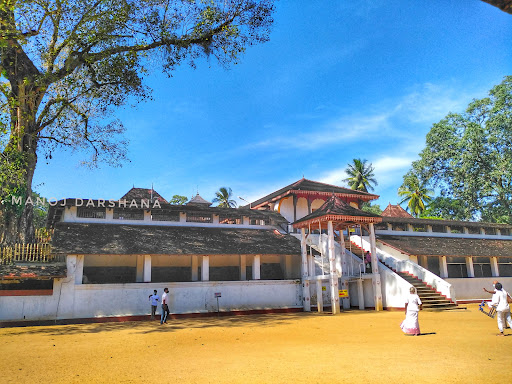
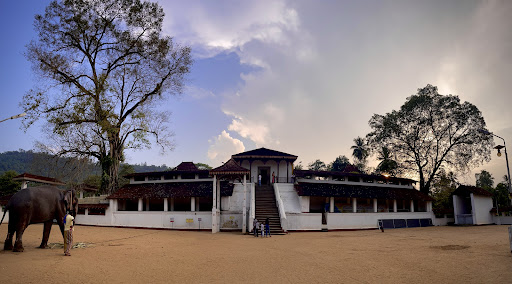
Maha Saman Devalaya or the Great Saman Temple (also called Sumana Saman Devalaya) is a shrine dedicated to deity Saman, situated at Ratnapura, Sri Lanka who is the presiding deity of the Sri Pada Mountain (Adam's Peak) which is also called Samanthakuta meaning the mountain of Saman which is believed to have the left foot impression of Lord Buddha which he kept in his visit to Sri Lanka. Saman Deviyo Considered as one of the guardian gods of Sri Lanka, Deity Saman is deeply venerated in the region of Rathnapura and related areas in the province of Sabaragamuwa of Sri Lanka, he is recorded to have been a district administrator of the region contemporary to Lord Buddha who he met on the former's visit to Sri Lanka.
According to the Mahavamsa the chronicle of ancient Sri Lanka, it is mentioned that the Administrator Saman, attained the first level of enlightenment Sotapanna at the end of the sermon of Lord Buddha. After the demise of Saman, the administrator of Deva Clan he has started to be venerated as a God or a deity.[4]
The Shrine It is believed after the demise of Saman, his clan of Deva started to venerate him by erecting a shrine for him. And it's believed there had been a Temple called Saparagama Viharaya, in the same premises in the Anuradhapura era of Sri Lanka, as it's mentioned in Mahavamsa that monks from the said temple attended to the opening ceremony of Ruwanwelisaya of King Dutugamunu.
It is mentioned in 'Saman Siritha' that a monk named Ven. Seelawansa on a pilgrimage to Sri Pada, saw a dream about a statue in the wild and later brought it to the above temple with the help of a minister named Pathirajadeva.[5]
Anyway, the present shrine is said to have built by a court minister in Dambadeniya era of Sri Lanka named Aryakamadeva, in the patronage of King Parakramabahu II, in 1270 AD, as a fulfillment of his vow to erect a shrine in the name of deity Saman, if his effort to find gems is successful. Later King Parakramabahu IV of Kotte Era of Sri Lanka patronized the shrine giving more resources.[6]
Later in the era of Portuguese colonization of Sri Lanka, the said shrine have been captured in 1618 then destroyed and a Portuguese Church have been built. But as King Rajasinghe II of Sitawaka acquired the area, he has rebuilt the shrine destroying the church in 17th century.
The shrine due to the lack of financial strength of King Rajasinghe was rebuilt with much simpler architecture than it used to be. And until to this day the shrine is made of Clay.
The Perahara(Procession) During the time that Tooth Relic of Lord Buddha was transferred to Delgamuwa Raja Maha Vihara, in a war time, during King Parakramabahu VIâs[7] period the Shrine held the Esala Perahara or the Procession of the Tooth Relic for 11 years.[4] Later under King Rajasinghe, the Saman Perahara joined to the Esala Perahara. Since then the Maha Saman Devalaya hoists the Esala Perahara in the month of AugustâSeptember annually.
Prior to the festivalâs commencement, age-old rituals like the Pirith ceremony (Chanting of Buddhist Sutras for protection, kap situveema (A symbolical wooden tower being planted) are held and the smaller processions called Kumbal and Dewele Peraheras are held. After that, the Perahara or the main procession takes place, and it concludes with Diya Kapeema (The symbolic water cutting ceremony) all of which are held for 13 days[8] under the supervision of the Chief incumbent(Basnayake Nilame) of the Shrine.
The procession is filled with cultural items and dancing from different regions of Sri Lanka as well as features many elephants decorated in different garments.[7]
The Perahara festival is visited by thousands of people from all over the Sri Lanka as well the world, and while the final perahara is telecasted, all peraharas are online broascasted...
   Read moreMaha Saman Devale
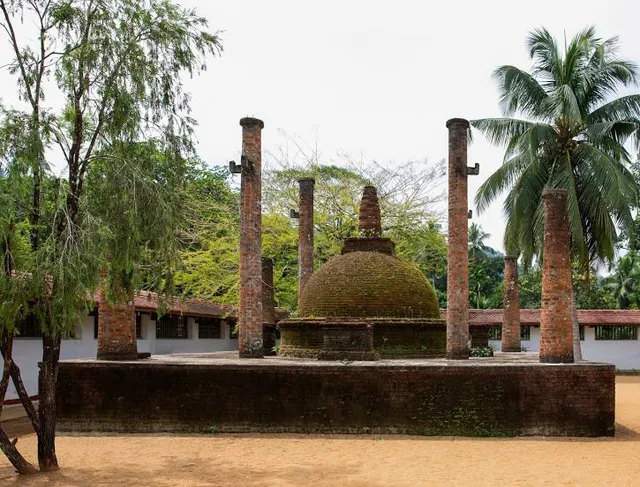
also known as Sri Sumana Saman Devalaya, is situated 2 km northwest of Ratnapura. The Sinhalese sanctuary of the regional deity protecting Ratnapura and Adamâs Peak is a typical Kandyan style temple. In fact, it is one of the largest Kandyan buildings, second only to the Temple of the Sacred Tooth Relic in Kandy. Perched on a mound, the Maha Saman Devale has a nice series of courtyards and whitewashed shrines with tiled roofs.
Originally built in the 13th century, the temple was destroyed by the Portuguese in the 16th century and rebuilt by the kings of Sitavaka. The current structures are from the late Kandyan period. The main sanctuary in the very centre of the complex is dedicated to Saman, a former demon converted to Buddhism and now the protector of the southwestern hillcountry and Sabaragamuwa province. Side shrines honouring the Buddha and the goddess Pattini can be seen in the adjacent courtyards. The annual temple festival is held in the month of Esala. It is one of the largest pageants of Sri Lanka, less known to tourists. Those travellers seeking an experience of a genuine Sri Lankan festival without crowds of other foreigners, should consider to visit the Ratnapura Perahera. It usually takes place in the first weeks of August.
God Saman (also called Sumana, Sumana Saman, Sinhala: āˇāˇāļ¸āļą āˇāļ¸āļąāˇ āļ¯āˇāˇāˇ) is a deity, subject to local and indigenous belief and worship in Sri Lanka. The name Saman means "the rising morning sun". His character is of historical significance for the Sinhalese people and veneration especially to all the Buddhists. God Maha Sumana Saman is depicted crowned and bejeweled, holding a lotus flower in his right or left hand and accompanied by a white elephant.
According to Mahavamsa, the early chronicle of Sri Lanka, Saman is considered one of the guardian deities of the island and Buddhism in the country.
Natha, Upulvan, Vibhishana and Kataragama are the other guardian deities. Nayakkar dynasty from South India introduced the goddess Pattini replacing god Saman, during the period of Kandyan Kingdom. Saman is the guardian (patron deity) or the presiding deity of Sabaragamuwa and the Sri Pada mountain. Accordingly, his main shrine or devalaya is at Ratnapura, where an annual festival is held in his honor. Another major shrine dedicated to god Saman is situated at Mahiyangana in Uva Province of Sri Lanka. Saman is known as Samantabhadra Bodhisattva in East Asia under the names PĮxiÃĄn PÃēsà  in Chinese, Fugen Bosatsu in Japanese, Bohyun Bosal in Korean, Kun-tu bzang-po in Tibetan and Pháģ Hiáģn Báģ TÃĄt in Vietnamese.
According to common belief, Saman may have been a king or a provincial ruler (Maha Sumana) of Sabaragamuwa from the Dewa (people) of Sri Lanka, one of the four main clans in ancient Sri Lanka. According to the tradition of Sammuti Deva (considered a deity by common acceptance), he is revered as a deity. Following his death, Prince Sumana Saman became a god, by the name of God Maha Sumana Saman. He is also thought to have been born as a Dewa of the heavens following his death due to his great past merit, who also became the presiding deity of Sri Pada. In the legendary history, Sumana Saman deviyo invited Buddha to the Samanala Kanda and on request Gautama Buddha left his foot print on the rock at the top of the mountain as a token of symbolic worship, in the absence of the Buddha. God Sumana Saman was there when Buddha visited the island for the first time. Saman became a stream-entrant (sotapanna) after listening to the Buddha, who gave him a handful of hairs with which he erected...
   Read moreConsidered as one of the guardian gods of Sri Lanka, Deity Saman is deeply venerated in the region of Rathnapura and related areas in the province of Sabaragamuwa of Sri Lanka, he is recorded to have been a district administrator of the region contemporary to Buddha who he met on the former's visit to Sri Lanka.
According to the Mahavamsa the chronicle of ancient Sri Lanka, it is mentioned that the Administrator Saman, attained the first level of enlightenment Sotapanna at the end of the sermon of Buddha. After the demise of Saman, the administrator of Dewa (people) he has started to be venerated as a God or a deity.[4]
It is believed after the demise of Saman, his clan of Deva started to venerate him by erecting a shrine for him. And it's believed there had been a Temple called Saparagama Viharaya, in the same premises in the Anuradhapura era of Sri Lanka, as it's mentioned in Mahavamsa that monks from the said temple attended to the opening ceremony of Ruwanwelisaya of King Dutugamunu.
It is mentioned in 'Saman Siritha' that a monk named Ven. Seelawansa on a pilgrimage to Sri Pada, saw a dream about a statue in the wild and later brought it to the above temple with the help of a minister named Pathirajadeva.[5]
Anyway, the present shrine is said to have built by a court minister in Dambadeniya era of Sri Lanka named Aryakamadeva, in the patronage of King Parakramabahu II, in 1270 AD, as a fulfillment of his vow to erect a shrine in the name of deity Saman, if his effort to find gems is successful. Later King Parakramabahu IV of Kotte Era of Sri Lanka patronized the shrine giving more resources.[6]
Later in the era of Portuguese colonization of Sri Lanka, the said shrine have been captured in 1618 then destroyed and a Portuguese Church have been built. But as King Rajasinghe II of Sitawaka acquired the area, he has rebuilt the shrine destroying the church in 17th century.
The shrine due to the lack of financial strength of King Rajasinghe was rebuilt with much simpler architecture than it used to be. And to this day ((when)) the shrine is made of clay.During the time that Tooth Relic of Buddha was transferred to Delgamuwa Raja Maha Vihara, in a war time, during King Parakramabahu VI's[7] period the Shrine held the Esala Perahara or the Procession of the Tooth Relic for 11 years.[4] Later under King Rajasinghe, the Saman Perahara joined to the Esala Perahara. Since then the Maha Saman Devalaya hoists the Esala Perahara in the month of AugustâSeptember annually.
Prior to the festival's commencement, age-old rituals like the Pirith ceremony (Chanting of Buddhist Sutras for protection, kap situveema (A symbolical wooden tower being planted) are held and the smaller processions called Kumbal and Dewele Peraheras are held. After that, the Perahara or the main procession takes place, and it concludes with Diya Kapeema (The symbolic water cutting ceremony) all of which are held for 13 days[8] under the supervision of the Chief incumbent(Basnayake Nilame) of the Shrine.
The procession is filled with cultural items and dancing from different regions of Sri Lanka as well as features many elephants decorated in different garments.[7]
The Perahara festival is visited by thousands of people from all over the Sri Lanka as well the world, and while the final perahara is telecasted, all peraharas are online broascasted...
   Read more