In Digamadulla or modern-day Ampara, there is no dearth of ancient shrines, many taken over by jungle tide, with giant sleeping Buddhas in caves, unidentified stupas and unread inscriptions and legends on rock and pillar.
The Buddhangala forest monastery however, has been revived from that state when leopard and bear used to roam the drip-ledged caves and is now once again the home of saffron-clad forest monks as it was an ancient sanctuary for the Arhants. We drove there, deeply grateful for the forest shade that engulfed the road running from Ampara like a dark soothing tunnel; we were within the arboreal shadow of the 5700-acre wildlife sanctuary the monastery grounds have today become.
The history of this monastery goes back to the 2nd Century BC when a princess of Digamadulla called Chitra donated the land, amply suited to a forest monastery, with solitary rock caves on high ground commanding panoramas of the jungle and plateau.
We walked up. Here we found the modern and the kitsch unfortunately cheek by jowl with all that is ancient and beautiful. It is sad that ornamentation should destroy the serenity of rock and forest and sky.
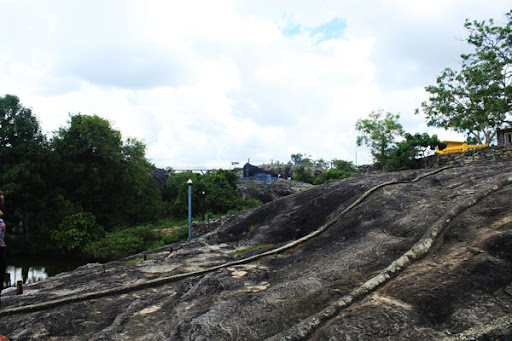
That apart, you can enjoy the place for what it is and what it once was. The stupa is located on a rock which gives you a breathtaking panorama of Digamadulla and beyond, up to the sea – with its variegated map of archaeological sites and pilgrim shrines. The abundance of ‘moonstones’, steps and korawakgal (balustrades) of stone strewn about, allows the visitor to imagine the erstwhile splendour of the place. On the rock plateau is a pond, and here one sees ruins of a janthaghara or a bath house.
A modern giant Buddha in white dominates the skyline.
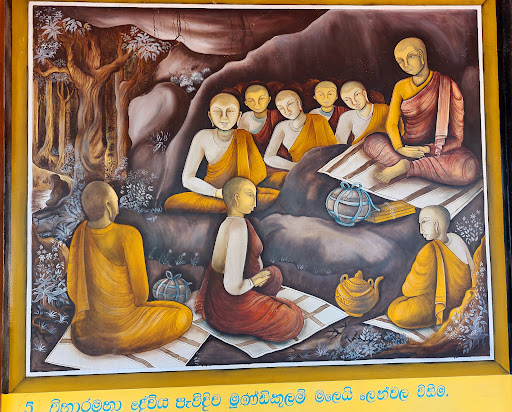
All this however was deep wilderness when in 1964, the pioneering monk Kalutara Dhammananda came here and revived what was originally a monastery centuries back. Monks had last lived here prior to the disastrous medieval invasion of Kalinga Magha- i.e. in the early 13th Century.
Among the archaeological treasures discovered in the wake of the intrepid Ven Dhammananda was a very rare round siripathul gal or stone depicting the Buddha’s sacred footprints. While square siripathulgal are quite common, these are unique in the island.
The ancient watada-ge or the relic chamber under excavation yielded a king’s ransom of artefacts, amongst which was a four-inch gold casket which once opened revealed three lotuses. The tallest gold lotus, the one in the middle, is said to have contained three relics of the Buddha while the other too had relics of his two chief disciples Sariputta and Mugalan.
While Buddhangala has not many archaeological curiosities, just a walk through its landscapes of forest and rock undulating as one great gal thalaawa is soothing to the soul.
Much of of Buddhangala’s past remains elusive. The modern name comes from the rock shaped like a giant reclining Buddha but what would have been its ancient identity? Was this the Karakdigala monastery recorded of yore?
The jungle tide in Digamadulla has much...
Read moreBuddhangala Monastery The Buddhangala Monastery which is located on a huge rock covered a large area in the Buddhangala forest reserve is about 6Km away from the Ampara town. How the name of Buddhangala was derived is not known, but it is believed that the name would have been derived because of the rock formation which looks like the Lord Buddha in lying position. It is said that the history of this monastery dates back to the period of the Digamadulla kingdom which was at 4th century BC. It was covered by the dense forest infested with the wild animals for over thousands of years and it had become a kingdom of the wild elephants. In 1964 Kalutara Dhammananda thero – then he was a young Buddhists monk – cleaned the area with the help of the Buddhists there and renovated the deserted monastery. The monastery became more prominent as the result of the discovery of the relics during the excavation of the ancient stupa. Among the discoveries, there was a four- inch-tall golden relic casket which contained three golden lotus flowers standing on its stems with carefully placed relics on each of them. The flower in the middle is the tallest and on the two Bo-leaves on the other stems had the names of “Sariputhta” and “Maha Moggalana” inscribed. A new stupa was built in 1974.but a proper attention was not given to this valuable hermitage and it was under the threat of the LTTE rebel over 30 years and the general public got the opportunity to visit and pay homage to this religious place once again after the defeat of the ruthless rebels. The early hours and the late hours of the day is the best time to visit this place because it is getting hotter and hotter with the sunrise. The road leading to the monastery lies through a thick jungle infested with the wild animals, but the branches of trees on either side are overhanging and provide the visitors with the shade. This is a calm place away from the hustle and bustle of the town, so it is nice place for our mental relief. This is really our national heritage, so it is our duty to protect this place of worship for our...
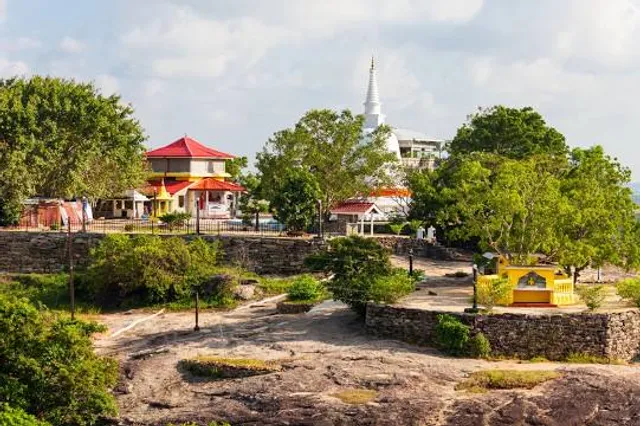
Read moreBuddangala Rock Monastery, located in the Ampara District of Sri Lanka, holds significant importance in Buddhist culture. The site features a dagoba (pagoda) that enshrines sacred relics of Lord Buddha, as well as the revered disciples Sariyuth and Mungalan Maha Thera. Surrounded by rocky terrain, the monastery offers a serene and spiritually uplifting atmosphere.
Key Information for Visitors: Best Time to Visit: Early morning or late afternoon is ideal due to the intense heat caused by the surrounding rocks. Avoid visiting after 5:00 PM, as wild animals may appear on the roads.
Dress Code: Modest clothing is required. Shorts and sleeveless tops are not allowed. Wear attire suitable for a temple visit, such as long pants or skirts and shirts with sleeves.
Footwear: Hats and slippers are not permitted inside the temple premises. Comfortable footwear is recommended for walking on rocky terrain.
Precautions: Be mindful of the heat and stay hydrated. Respect the sacred nature of the site and follow all temple rules.
Buddangala Rock Monastery is a unique and spiritually enriching destination, offering a glimpse into Sri Lanka's rich Buddhist heritage. Plan your visit accordingly to fully appreciate its beauty and...
Read more