Uva is amazing
Budduruwagala Temple
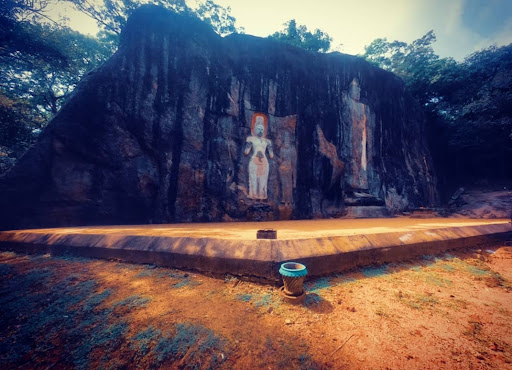
The Buduruwagala Buddha Statue is the tallest statue in the country. It stands 13 meters (46 ft) tall and is standing upright. There are six other statues lined up along the stone wall along with the statue. The stone wall is about 70 feet long.
Turn left at the 48th mile post on the Tissamaharama Road, Wellawaya and turn left for another 48km. The rock is found in a forest where there are about 4 people. Until recently, the area had been an isolated area of elephants.
The Buddha statue is a significant archaeological site, both historically and artistically. The name Buddhavagala is perhaps best known as the Buddha which has been immensely carved on a stone wall. But to date, the name of the ancient place and by whom it was done has not been confirmed.
Given the nature of the work of art, this is the AD. Archaeologists believe that it was an invention of the 8th to 9th centuries.
In the center of the wall of the stone wall are massive statues, half-erect. There are three inscriptions on each side of the Buddha.
Due to the size of the Buddha statue and the image of the other statues on either side, it is presumed to be a reflection of the Buddha. It seems that the Mahayana people thought that the statue of Buddha in the size of the statue would emerge.
Dr. Malinga Amarasinghe in his book 'Buduruwagala Telephone' states: When Eighty-sixth-century Mahayana architectural book, The Manju, refers to the eight Mahayana Bodhisattvas in the Srastha santramalala sambala. Therefore, the Bodhisattvas may have been aware of this society and perhaps their statues were taken. It is evident from the fact that large bodhisattva statues have been created in Ruhuna especially during this period, Mahayana Buddhism was very popular in Rohana.
To the right of the main Buddha statue is a statue of the Avalokiteshwar Bodhi. Its height is 7.16 meters. The statue of Tara Devi is about 5.98 meters high (about 25 feet) and is depicted on the left side of the statue. According to Mahayana, Taradeva was the wife of the Avalokiteshvara Bodhisattvas.
All the statues, except for the statue, are painted in a sarcastic manner, but the feminine image here is probably made of tricolor, which is supposed to represent the femininity better. The statue on the right hand side of the animal image is the Sudhan Kumara statue. According to Mahayana tradition, Sudana Kumara was also a Bodhisattva. Its height is about 6.53 meters. (About 23 feet)
The Maithree Bodhisattva statue in the center of the Buddha statue is shown on the left of the main Buddha statue. Its height is 7.3 meters. The statue on the left hand side of the Bodhisattva image (about 25 1/2 feet) is the Vajrapani Bosam statue. Its height is 6.4 meters. It is said that the Vajrapani bodhisattva (about 22.4 feet) symbolizes the sound of the Dhamma and its protection.
The statue of Manju Sri Bodhisattva on the right hand side of Maithree Bosath. This symbolizes great wisdom in the Mahayana tradition. It is the opinion of the Mahayana people that he is the adviser and advisor of the Maithree Bodhisattva.
Accordingly, the seven statues of Buduruwagala can be identified from left to right respectively. Sudhanakumara, Yogi Avalokiteshwara, Dhara, Deepankara Buddha, Manju Sri, Maithree and Vajrapani.
The statue's great stone wall is so hard that it seems the craftsmen have to work hard to carve all the statues. So all these statues have been taken using the natural turning of the stone in a semi-elevated manner.
It can be assumed that the craftsman has encountered this inconvenience when he carved the main Buddha statue. The mouth of the statue is square. Due to the shape of the robe, the wrinkles of the robe have not been properly highlighted. To compensate for the deficiency, the statue appears to have been properly coated with lime. The remains of the plaster are still visible, although they are not visible today.
The statues of Sudan Kumara and Maithree Boseat have...
Read moreBuduruwagala is located about 5 km from the Wellawaya on the Thanamalwila road. The name Buduruwagala means “the rock with the statue of Buddha” And this is exactly what it is. Seven figured are carved in this rock with a massive 51 foot Buddha statue in the Abhaya Mudra gesture at the centre. The rock it self has shape of a kneeling elephant with its head own. Although there is no documented information about this site in the ancient scriptures, Different historians have dated these statues from the 6th centuary to late Anuradhapura period. (between 8 – 10 Century). These carvings are of the Mahayana Buddhist style and belongs to the Pallawa- Sri Lankan art tradition and similar to the statues at Dova Temple. The tallest Buddha statue in the world was the Bamiyan Buddha statues in Afghanistan until the destruction of this ancient monument by the Taliban in March 2001. The Buduruwagala Buddha Statue is now considered the tallest in the world. The centre statue is flanked by two statues which each about 40 foot in height. These two again flanked by two figures, one female and the other male.
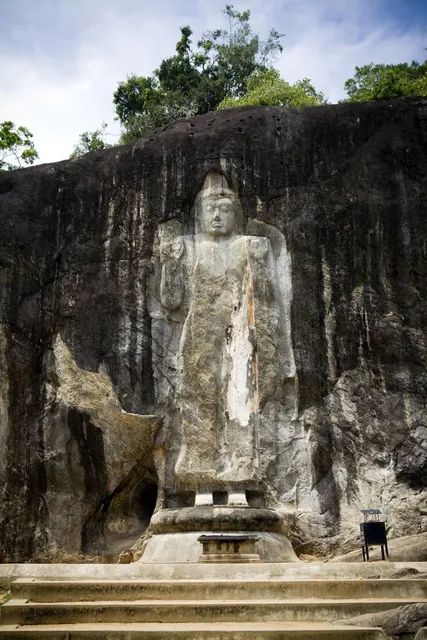
The centre figure on the left (as you stand in front) still has most of the plaster and some paint which has been applied by the ancients. This centre figure is thought to be of the figure of Avaloktheeshvara Bodhisattva (the manifestation of all the Buddha’s’ compassion in the Mahayana Buddhist teaching – In Theravada Buddhism Avaloktheeshvara is known as Lokesvara). He is identified by the small image of the meditating Buddha in the crown that he wares. This image can be clearly seen the carving. The bare breasted female figure on the right to this is thought be Thara Devi, the spritual consort of Avaloktheeshvara Bodhisattva. She is carved in a ‘thivanka’ position (bent in 3 places) and is wearing a tall head dress. The other is thought to be their son Prince Sudana. On the right is 3 similar figures. And the centre figure is thought to be the Maithri Bodhisattva. He is the fifth Buddha for this eon. On the left is the Vajirapani Bodhisattva ( Sanskrit Vajra : thunderbolt/diamond, Pani : lit in the hand). He is one of the earliest bodhisattvas of Mahayana Buddhism. He is generally represented with a diamond club in his hand)
How To Reach You can reach the site from either Wellawaya or from Thanamalwila depending on which route you take. You can reach Wellawaya in through many roads. If you are coming from Badulla or Bandarawela you must tale the Ella Road which lies between Badulla-Bandarawela Road. On the way you will also pass the beautiful Ravana Ella too on the way. If you are travelling from Colombo you can take the Rathnapura – Balangoda Road and turn off from Koslanda. Taking this route will take you through the 220 metre high waterfall Diyaluma. Koslanda lies between the Balangoda – Haputhale Road, 203 km from Colombo. If you are coming from down south, may be from Kataragama, you can either use Buttala Route or go through Thanamalwila. From Buttala town turn to Wellawaya Road. On this route, you will be also passing places such as Maligavila Statues, Dematamal Viharaya and Yudaganawa.
Form the Wellawaya town use the Thanamalwila Road and after traveling 5 km you will come to the turn off to the Buduruwagala. This place is marked by a board opposite to this road with picture of the rock and a arrow. If you traveling from Tissamaharama or a location west to it, use the Tissamaharama – Thanamalwila road. There is another route to Thanamalwila from the Udawalawe wildlife sanctuary too. From Thanamalwila You have to travel towards Wellawaya for about 30 km to reach the turn off to the site.
The by-road (turn off) form the Thanamalwila-Wellawaya is a tarred road which become a well maintained gravel road closer to the end. But this is motorable (van or car) most of the year. On the way you will also pass the beautiful Buduruwagala lake, ideal place to take a break, just before the entrance to the temple. The the distance to travel on this...
Read moreThe beautiful, 1000-year-old, rock-cut Buddha figures of Buduruwagala are the region's biggest attraction. The gigantic standing Buddha (at 15m, it is the tallest on the island) here still bears traces of its original stuccoed robe, and a long streak of orange suggests it was once brightly painted. It's surrounded by smaller carved figures. This remote site is located 9km south of Wellawaya, accessed by a scenic side road.Authorities generally date them to the 9th or 10th century. Buduruvagala does not have much historical records. Even its original name is unknown. It is thought to be a hermitage for monks. The sculptures of Buduruvagala also include many sculptures of bodhisatwa images including Mahayanatradition.
*left side three bodhisatwa and thara dewagana status
Buduruwagala is an ancient buddhist temple. The complex consists of seven statues and belongs to the Mahayana school of thought. The statues date back to the 10th century. The gigantic Buddha statue still bears traces of its original stuccoed robe and a long streak of orange suggests it was once brightly painted. The central of the three figures to the Buddha's right is thought to be the Buddhist mythological figure-the Bodhisattva Avalokitesvara. To the left of this white painted figure is a female figure in the thrice-bent posture, which is thought to be his consort-Tara.Avalokitesvara (the bodhisattva of compassion). To the left of this white-painted figure is a female figure thought to be his consort, Tara. Local legend says the third figure represents Prince Sudhana.
*grate buddha status
The gigantic standing Buddha – at 16m, it is the tallest on the island – in the centre still bears traces of its original stuccoed robe, and a long streak of orange suggests it was once brightly painted
*Right side status
The crowned figure at the centre of the group is thought to be Maitreya, the future Buddha. To his left stands Vajrapani, who holds a vajra (an hourglass-shaped thunderbolt symbol) – an unusual example of the Tantric side of Buddhism in Sri Lanka. The figure to the left may be either Vishnu or Sahampath Brahma. Several of the figures hold up their right hands with two fingers bent down to the palm – a beckoning gesture.
*Stone oil lamp
On the same rock where the sculptures are carved, there is a carved shape of about 3 feet (0.91 m) wide and 4 feet (1.2 m) heigh. It is of the shape of a flame. The inside wall of this carved shape is always wet of an oil that smells very much like mustrd oil. This oil comes to the carved shape with no explainable source or reason.
This plase is very nature.And shedy plase.and allso The road to this place has a beautiful environment. There is also a lovely view of the lakes, ponds and lakes. There are thousands of fish in lakeshore ponds. There are also numerous animals on both sides of the road along the road along the road. There are many different types of animals on either side of the road. You can go own vehicle.buduruwagala have juse bar and rest room and allso clean...
Read more