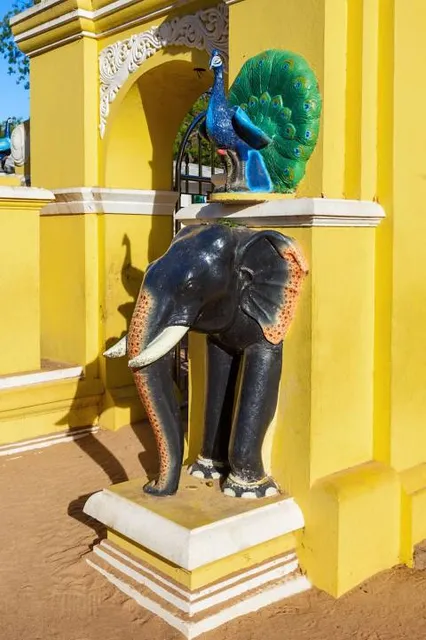
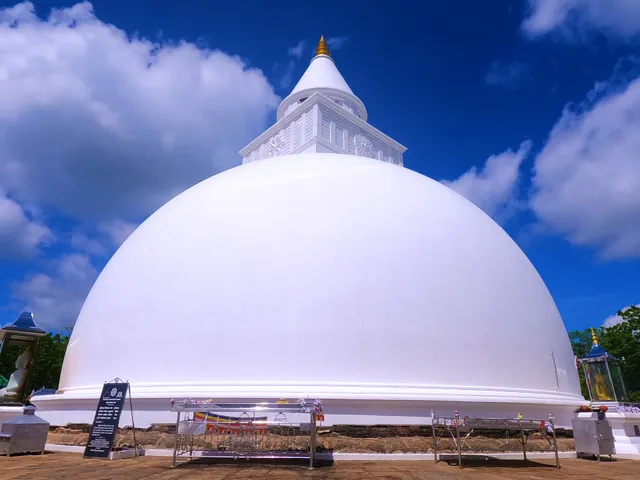
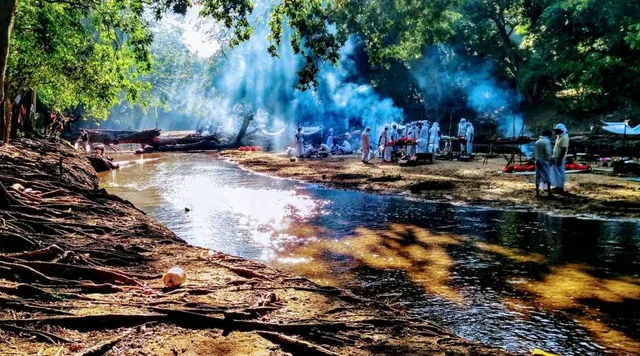
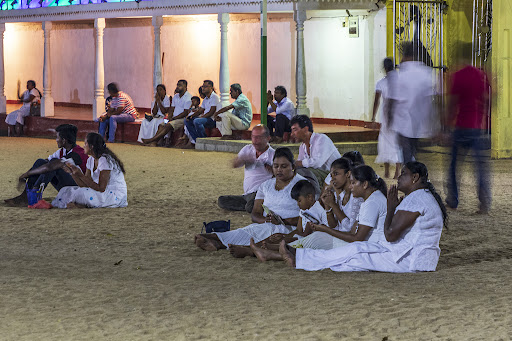
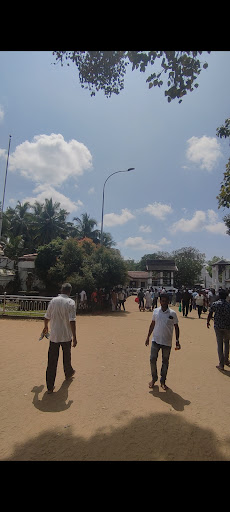
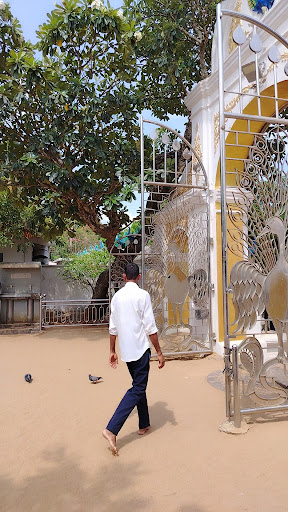
Not Grandoise – but GLORIOUS A group of six of us, after visiting Kirivehera, entered the historical Katharagama Devalaya from the northern entrance in the evening on 11th February 2019, after leaving our footwear with the caretaker. The most important in this temple complex is the main shrine dedicated to the guardian deity with six faces and twelwe arms sitting on a peacock, the “Katharagama Deviyo” also venerated by Hindus as “Murugan or Skanda”. This main shrine attracts Buddhist as well as Hindu pilgrims from all over Sri Lanka and from as far as South India. As we had adequate time before the pooja (offering) scheduled for 1900 hrs, we walked around the temple complex visiting the other subordinate shrines dedicated to deities Vishnu, Ganesha, Dedimunda, Paththini, Kali, Suniyam and Sumana Saman. The bo tree behind the main Katharagama shrine is said to be a sapling from the Anuradhapura bodhi tree planted in 3rd Century BCE. We could walk around leisurely and amongst the seated devotees since it was a weekday and not not so crowded. Weekends and full-moon days see throngs of people visiting the temple. Some of us, carrying our offerings of fruits in a tray, joined the queue with other devotees. The queue at the left was for those with tray offerings and the one on the right for others. Those with tray offerings keep clearly visible monetary offerings on top of the fruit tray demonstrating their piety and seeking divine intervention into or from whatever problems they may have. Others seek fulfilment of their wishes and aspirations. After the main official pooja, these trays are accepted by the priests chanting prayers interceding for devotees, part emptied and returned to the owners. At the exit, you may opt to have a dot placed on your forehead signifying obeisance and reverence. Unlike at other temples, the main shrine is a simple two roomed structure, not at all grand. The other surrounding shrines too are in simple one roomed buildings, some built from stone. I understand that they had not been altered since they were built as people are reluctant to carry out modifications. Furthermore, in all these shrine rooms, the deities are not represented by large statues, but by large drawings portraying their glory and power. Within the main shrine, in addition to the main drawing facing the entrance are few others on side walls too depicting the power of Katharagama deity. With the sounding of many bells at this sacred place, coupled with the chanting, the aura of the Katharagama guardian deity descended on me, overwhelming me, when within the shrine. The feelings each of us experience may of course vary depending on our beliefs and the environment. Almost as one enters through main entrance is the coconut breaking area situated right in front of the main Katharagama Devala. Devotees hold the coconut with both hands raised, make a prayer or a wish, and dash it on the stone basin, breaking it into pieces and spilling its water. They believe that this helps their wish and prayer to come true. Some do wish ill-will to their enemies when shattering the coconut. After exiting the temple through the main southern entrance around 8.00 pm, we walked along the road leading to and across the Menik river. We observed people bathing in the river even at this late hour. There is a saying among the locals that if you bathe in this river all your sins get...
Read moreKataragamam temple (Sinhalese Katharagama; Tamil Katirkāmam) in Kataragama, Sri Lanka, is a temple complex dedicated to Kataragama deviyo. It is one of the few religious sites in Sri Lanka that is venerated by the peopleTamil Hindu Sri Lankan Tamils, Sri Lankan Moors and the Vedda people. It is a collection of modest shrines, of which the one dedicated to Kataragama deviyo, is the most important. For most of the past millennia, it was a jungle shrine very difficult to access; today it is accessible by an all-weather road. Almost all the shrines— and the nearby Kiri Vehera— are managed by Buddhists, apart from shrines dedicated to Teyvāṉai and Shiva and mosques.
Up until the 1940s a majority of the pilgrims were Tamil Hindus from Sri Lanka and South India who undertook an arduous padayatra or "pilgrimage on foot". Since then most pilgrims tend to be Sinhala Buddhists and the cult of Kataragama deviyo has become the most popular amongst the Sinhalese people.
A number of legends and myths are associated with the deity and the location, differing by religion, ethnic affiliation and time. These legends are changing with the deity's burgeoning popularity with Buddhists, as the Buddhist ritual specialists and clergy try to accommodate the deity within Buddhist ideals of nontheism. With the change in devotees, the mode of worship and festivals has changed from that of Hindu orientation to one that accommodates Buddhist rituals and theology. It is difficult to reconstruct the factual history of the place and the reason for its popularity amongst Sri Lankans and Indians based on legends and available archeological and literary evidence alone, although the place seems to have a venerable history. The lack of clear historic records and resultant legends and myths fuel the conflict between Buddhists and Hindus as to the ownership and the mode of worship at Kataragama.
The priests of the temple are known as Kapuralas and are believed to be descended from Vedda people. Veddas, too, have a claim on the temple, a nearby mountain peak and locality through a number of legends. There is a mosque and a few tombs of Muslim pious men buried nearby. The temple complex is also connected to other similar temples in Eastern Province dedicated to Murugan which are along the path of pilgrimage from Jaffna in the north to Kataragama in the south of the island; Arunagirinathar traversed this pilgrimage route in the 15th century. The vicinity of the temple complex is used for secretive practices of sorcery and cursing peculiar to Sri Lanka. The entire temple complex was declared a holy place by the government of Sri Lanka in the 1950s; since then political leaders have contributed for its...
Read moreRuhunu Maha Kataragama Dewalaya, usually called Kataragama Temple, is a revered religious site located inside the metropolis of Kataragama in Sri Lanka. This sacred complicated is devoted to Lord Kataragama, a deity extensively worshipped inside the u . S ., believed to be a mum or dad of the island.
The temple holds sizable cultural and non secular importance, drawing pilgrims and devotees from various ethnic and religious backgrounds. Lord Kataragama is often recognized with Skanda or Murugan, the Hindu god of warfare and victory, however the temple also attracts followers of different faiths, inclusive of Buddhists and Muslims.
The records of the Kataragama Temple is intertwined with the rich tapestry of Sri Lanka's religious range. Legend has it that Lord Kataragama regarded in the area as a effective deity, and the temple turned into ultimately mounted to honor and worship him. Over the centuries, the temple complicated has gone through renovations and expansions, reflecting the enduring spiritual connection that people have with the deity.
The temple complex contains numerous structures, inclusive of shrines, prayer halls, and sacred ponds. The Maha Devale, committed to Lord Kataragama, is the primary sanctum within the complicated. Pilgrims take part in various rituals, ceremonies, and processions that replicate the vibrant and colourful traditions related to the temple.
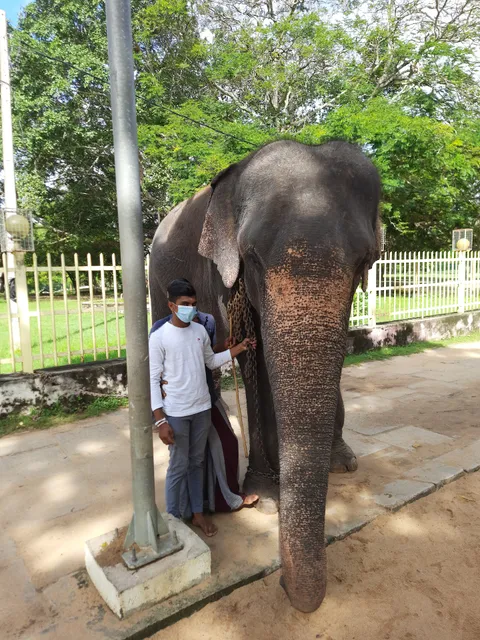
One of the exclusive features of the Kataragama Temple is the Esala Perahera, an annual festival that attracts thousands of pilgrims and tourists. This grand procession showcases conventional music, dance, and decorated elephants wearing sacred relics. The competition serves as a testament to the harmonious coexistence of different non secular groups in Sri Lanka.
The temple complex isn't only a site of spiritual importance however additionally a place wherein site visitors can revel in the country's cultural richness. The peaceful coexistence of numerous religious practices at Kataragama displays the pluralistic and tolerant ethos of Sri Lankan society.
In precis, the Ruhunu Maha Kataragama Dewalaya stands as a symbol of religious concord and cultural range in Sri Lanka. It continues to be a pilgrimage site in which human beings from diverse backgrounds come together to pay homage to Lord Kataragama, fostering unity and expertise among...
Read more