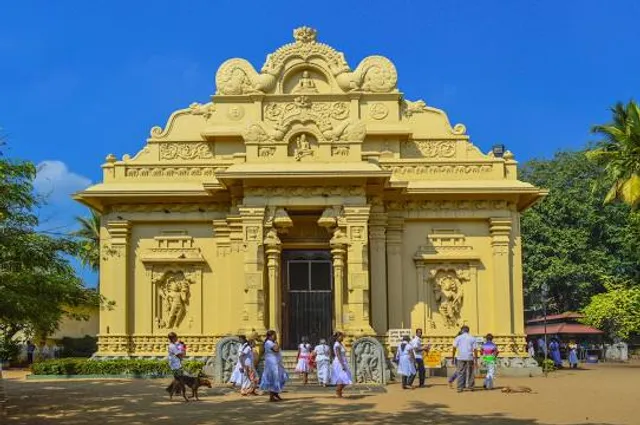
Bellanwila Rajamaha Viharaya is a Buddhist temple situated in Bellanwila, Colombo District, Sri Lanka.[2] Located around 12 km south to the Colombo city, near Dehiwala - Maharagama road, the temple attracts hundreds of devotees daily and is famous for its annual Esala Perehera festival which usually takes place in the month of August or September. One of the most venerated Buddhist temples in Sri Lanka, many devotees flock to worship the sacred Bo tree of Bellanwila Rajamaha Vihara, which is considered to be one of the first offshoots of Jaya Sri Maha Bodhi in Anuradhapura, Sri Lanka.[3] The present chief incumbent of Bellanwila Rajamaha Vihara is Ven. Bellanwila Dhammaratana Nayaka Thera.
There is literary evidence in ancient texts such as the Sinhala Bodhivamsaya which records that the Bodhi-tree in Bellanwila as one of the thirty two saplings that sprang from the sacred Jaya Sri Maha Bodhi at Anuradhapura planted in the 3rd century BC. Bellanwila is also mentioned in the literary works of the 15th century, when Kotte, which is located close to Bellanwila, became the capital of the country. In the Kotte period Buddhism rose to great heights with the royal patronage of King Parakramabahu VI (1412-1467), who was the last native sovereign to unify all of Sri Lanka under one rule before the European colonial invasions.
The story of the revival of Bellanwila Viharaya is closely linked with Attidiya, a village adjoining Bellanwila. This sacred place was abandoned after the Portuguese invasion of the country’s coastal areas. It was rediscovered by an adventurous monk known as Thengodagedara Hamuduruwo, who is said to be the founder of Galauda Viharaya. One day in 1850, when he was traveling by boat along the Katu-ela stream towards Pepiliyana, it is said that he heard the sound of drums from a nearby thicket.[5] Being inquisitive, he left the boat and walked towards the sounds. As he approached, the drum sounds faded away and he was surprised to see a Bodhi-tree. Subsequently, he came to discover that this was one of the thirty two saplings from the sacred Bodhi-tree at Anuradhapura. With the help of villagers, Thengodagedara thera cleared the land around the tree and built a modest shelter for monks. With this modest and mysterious beginning, Bellanwila began to attract the attention of Buddhist devotees in the neighborhood.
Since Thengodagedara thera rediscovered Bellanwila, the temple has had a succession of chief monks such as Udugampola Sri Ratanapala thera, Udugampola Sri Dammakkhandha thera, Abhidhammika Weboda Sri Sangharatana thera, Asgiriye Devarakkhita thera and Bellanwila Sri Somaratana thera.[6] It is Ven. Bellanwila Sri Somaratana thera, who became the chief incumbent of the temple in 1947 must be given the credit for raising Bellanwila Rajamaha Vihara to its present status. He began the task of developing the temple and he himself designed the structural concept of the temple complex taking the image house of Polonnaruwa as the model. After the demise of Bellanwila Sri Somaratana thera, his pupil prof. Bellanwila Wimalaratne Thera has continued the development work...
Read more
In the temple-studded paradise island of Sri Lanka, Bellanwila Rajamaha Vihara occupies a special place. This temple is considered so sacred that there is a long cherished belief that a child who treads the ground under the shade of its scared Bodhi-tree will never fail in life.
Situated in the outskirts of the city of Colombo, in the village of Bellanwila, just three kilometers from the city limits, Bellanwila temple has a long and hallowed history. The great sanctity attached to the temple is due to its sacred Bodhi-tree. There is authoritative literary evidence in ancient texts such as the Sinhala Bodhivamsaya which records that this Bodhi-tree is one of the thirty two saplings that sprang from the sacred Bodhi-tree at Anuradhapura planted in the 3rd century B.C.E. The recorded tradition is as follows: There were five twigs in the Bodhi-sapling that was brought from India to Sri Lanka and planted in the Mahameghavana at Anuradhapura. When the sapling had grown into a tree, eight new saplings sprang from its eastern side. These are called the astaphalaruka-Bodhi-trees and they were planted at eight different spots on the Island. From the other four original branches sprang thirty-two additional saplings which were also distributed throughout the Island. One such plant is the sacred Bodhi-tree at Bellanwila.
The reason why this particular spot at Bellanwila was selected is not clear. Scholars have forwarded various hypothesis. But what appears plausible is that even at such early times this particular spot had been recognized as a hallowed site, and further, that there may have already been a well established shrine here with resident holy monks.
The state of the shrine after the planting of the Bodhi-sapling is shrouded in the mists of history. Neither literary nor archaeological evidence is available to reconstruct its history. Bellanwila was far away from the then capital of the Island and as it had no significant role in the history of the Island, it did not find any mention in the chronicles or other historical documents.
In the 15th century, Bellanwila again is mentioned in literary works. This is when Kotte, which is in close proximity to Bellanwila, became the capital. In the Kotte period Buddhism rose to great heights with the royal patronage of King Parakramabahu VI (1412-1467). But even during this period, Bellanwila is cast in the shadow of Sunthradevi Pirivena, a shrine built by the king himself.
The subjugation of the maritime provinces by the Portuguese in the latter part of the 17th century and consequent loss of royal patronage, dealt a severe blow to Buddhism. As a result many places of worship were neglected. Bellanwila seems to have fallen on especially hard times, was abandoned and covered by a...
Read moreMiraculous and Marvelous temple referred to as the Bellanwila Rajamaha Viharaya, with a heritage of glorious history, stands out as the most historic and significant among the many temples in the island today.
Situated on the Dehiwela-Maharagama road about two kilometres away from the Colombo-Galle highway in a scenic location, originally surrounded by green fields, this powerful enchanting temple is among the oldest, dating back to the Anuradhapura period.
The earliest available documentary source for the history of the temple is one of the early chronicles – Bodhiwamsa. From what can be gathered the history of the temple dates back to the Anuradhapura period during which time Theri Sanghamitta brought with her a branch of the Sri Maha Bodhi under which the Buddha attained Buddhahood.
Bodhiwamsa speaks of 40 places where the Bo saplings from the original were planted and Bellanwila is clearly stated in the list, leading to a definite conclusion regarding the origin of this sacred temple. Whatever this may mean, it cannot be denied that this temple is a sacred place, as sacred as the place where Buddha attained his enlightenment.
When examining the history of the temple it has been classified into 3 phases. The period associated with the planting of the Sri Maha Bodhi during the Anuradhapura period, is the first phase. The second phase begins with the reign of Sri Sangabodhi Parakramabahu of Sri Jayawardenapura Kotte, a generous supporter of Buddhism, who patronised the temples of the area.
The third or the modern era begins with the re-discovery of the temple by the Thera Thengodagedasra after the dark ages subsequent to the Portuguese conquest.
There is difference of opinion regarding the name as expressed by researchers of repute. The general accepted view is that Bellanwila literally means a pond consisting of Bellan (a kind of snails) which is supported by a pond located in the centre of lush green paddy land in the east.
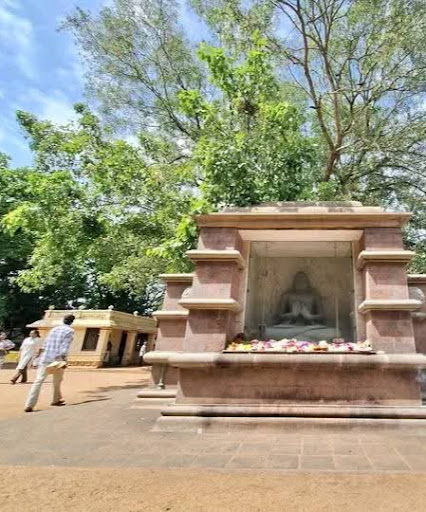
As you enter the temple premises on your right there is the building which house the dieties of Vishnu, Eeshwara and Ganeshwara. There is a small statue of Buddha too, very similar to the Mahamewna Samadhi Pilima.
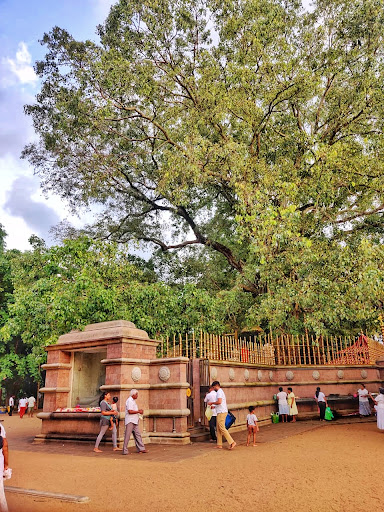
Behind this, is the most venerated, historic Bodhiya with its outspreading branches as if it is bestowing compassion, loving kindness and patience to its worshippers. Right round the Bodhiya are found the small Devalayas housing the symbolic images of gods such asKataragama, Saman, Vibheeshana, Huniam, Dedimunda, Natha and Paththini Matha, once again depicting the architecture of the Polonnaruwa period.
Early morning is the best time to worship in quiet serene surroundings and engage yourself in meditation, Pirith chanting and worship to your...
Read more