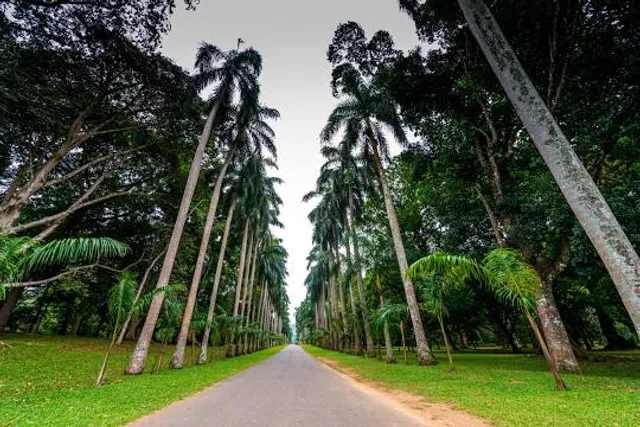
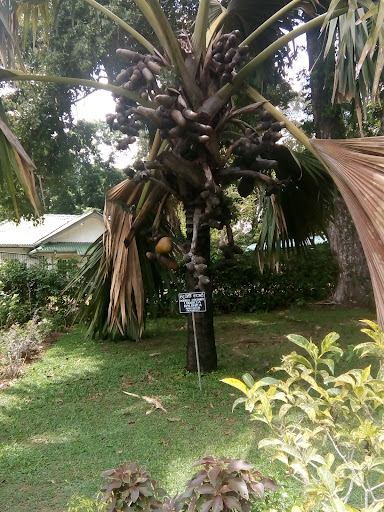
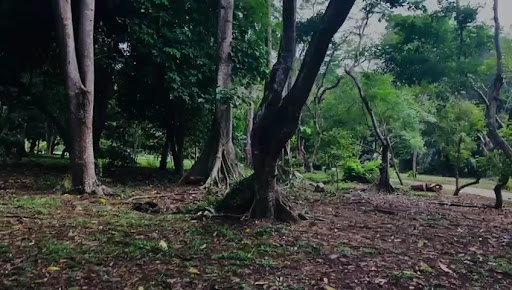
It is a very nice plase and thise plase have many plants and beautyfull flowers and also Henrathgoda botanical garden is one of the Gampaha's many landmarks to discover. It is situated about 5 km from Gampaha Sri Lanka. The botanical garden is constituted of a vast collection of tropical trees, sub tropical trees, wet zone trees and dry zone trees. Such as palm trees, orchids and flora are convinced that the garden is an accumulation of varieties. The botanical garden covers about 43 acres. It is bordered with Attangalle oya and Attangalla garden. To the south, east from the garden is the Ruhunu National park and to the south east the Wilpattu national park. It is believed that the garden is 128 years old now. Being a garden situated in low lands, the garden is well comprised with low land plantations. The most concerned feature is the remains of the first rubber tree of Sri Lanka.
. Though the first seedlings were introduced to South Asia, Sri Lanka was introduced with the Brazilian rubber plantation in 1876. By the way, there are so many varieties of trees. Some rare varieties are imported from far away countries. Therefore the garden is a symbol of colonial economy in Sri Lanka. Thus it is a home to over 80 varieties of birds. Wild life researchers say that 10 of them are endemic to Sri Lanka. Other than that 18 species of mammals are living together with the birds. Therefore it is not just a botanical garden, it is a place where animals live. The garden is famous among tourists and teenagers. The Henarathgoda botanical garden is open to the public every day. While in the botanical garden is the location to meet both locals and tourists alike. Almost the garden is brimming with people all day long. Due to the tropical climate in Gampaha, arid pockets can be found in the Garden. Sri Lanka, being a rich land of bio diversity is decent for so many plantations. People say that the garden becomes more beautiful during the monsoon as it gets more greenly. The botanical garden is a herbarium of anthuriams, beghonias, delias, Jeibras and much more. Even the flower seedlings from Jaffna and Ampara are well grown here addicting to the climate change. And be sure not to miss the medicinal garden at the same place. Honestly, it is a great spot to explore floriculture. The tourists can have boat rides at Attangalla oya. The garden is a great place to stroll and enjoy. Many youngsters visit the park in Holidays.i love thise...
Read moreWhile we were enjoying the beauty of the bloom and with the help of a way to add an educational value, we decided to select the Henarathgoda Botanical Garden this time, otherwise we know the Gampaha Malwatta. The Henarathgoda Botanic Gardens is located near the Gampaha Railway Station in Gampaha District, Western Province. At the beginning the Gampaha Railway Station was known as the Henarathgoda railway station. In later years it was Gampaha. Although it is called Gampaha, five villages together have become Gampaha. These villages are Ihalagama, Pahalagama, Medagama, Aluthgama and Pattiyagama.The easiest way to get to the Henarathgoda botanical garden is to turn to Colombo on the Colombo-Kandy road from Miriswatte junction and come to Gampaha. About a kilometer away from Gampaha - Minuwangoda Road there is a Malwatta Junction. From this junction, turn to the left and about 500 meters, we get the entrance of the Henarathgoda Botanical Gardens. The Henarathgoda botanical gardens, situated in between Aththanagalu Oya and Meedella canal. which is located up to 30 meters above sea level.The launching of the Henarathgoda Botanic Gardens is mainly due to the beginning of the rubber cultivation in Sri Lanka. The Henarathgoda Botanical Garden has begun to see the public as the third National Botanical Gardens in Sri Lanka. Today, there are flower beds, tall trees, student park, playgrounds, lawns and paddle boats. There is also a pubic and ornamental plants for sale, a restaurant for snack food and toilet facilities for sanitation. Also, the well maintained roads created by the management is added to the extra value.In order to enter the gardens, a local adult is charged Rs 60. In addition, for car parking, you can get an additional ticket. Especially should the park authorities not be permitted to filmography and photography without a license. Also, ticket sales are required to paddle boats. The Best time for filmography and photography is early morning and after 3 O’clock
Phone: 033 2 222316 Open: Mon - Sun: 8:30...
Read moreHenarathgoda Botanical Garden is one of the six botanical gardens in Sri Lanka. The botanical garden is situated in Gampaha-Minuwangoda main road, approximately 450 m away from Gampaha railway station. It is about 29 km from Sri Lanka's commercial capital of Colombo. History During the 19th Century British naturalists made various studies about Botany along with other sciences. One of their interests was the finding of possibility of establishing Rubber yielding plants in Asia. They have used various Rubber yielding plants both in India and Ceylon (Sri Lanka). Some of them are Para Rubber (Hevea brasiliensis), Gutta percha (Palaquium gutta), Panama Rubber (Castilea elastica), Balatta (Mimusops globesa) and Lagos (Funtumia elastica). The British naturalists concentrated their trials to Ceylon due to the failure of Rubber trials in India and discovered that Ceylon offers the same envirionmental condition as that of the Amazon.
1919 Rubber seedlings, collected from the Amazon forest, were imported from the Royal Botanic Gardens, Kew and were planted at the Henerathgoda gardens in 1876. These Rubber plants were bloomed for the first time in 1881 and seeds obtained from it were exported to South India, Malaysia, and Myanmar. In 1919 the world first Rubber exhibition was held at the Royal Botanical Gardens, Peradeniya.
At these times the garden was laid out and handled by Muhandiram A. De Zoysa under the supervision of the director of the Royal Botanic Gardens, Peradeniya. The first Rubber tree was collapsed due to rain storm in 1988 and the remainings were now preserved as a national monument of...
Read more