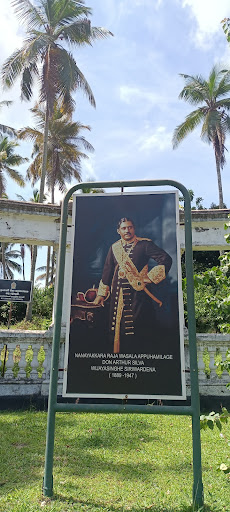
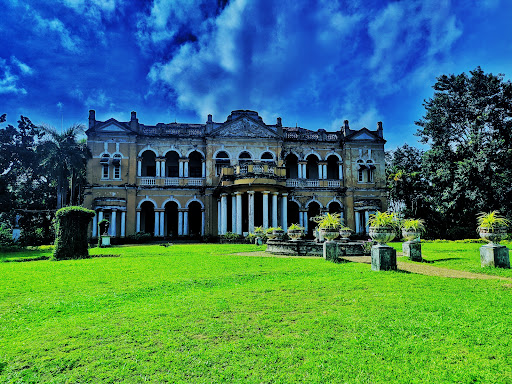
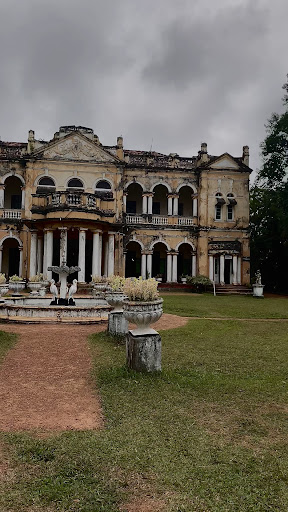
Richmond Castle (Palace) or the Walawwa is in Kalutara. A Traveller coming from Colombo will find St. John's Church after passing the Kalutara Bodhiya. There is a roundabout with Junction and a big clock tower in front of it. From there, if you go straight along the 'Riverside Road on the left, you will find the Palathota - Kethena road. Going straight on that road and passing Bhikku Vivekarama, you will find Richmond CastleThere is a story about this. The word Richmond comes from the English word " Rich man " The Europe-educated Maha Mudali Don Arthur de Silva Wijesinghe Siriwardena Mudali, who was incharge of Kalutara District, is building this Castle for his marriage. When there are proposals from rich and beautiful young women to come to Sri Lanka to study and get married, this young man prefers Matilda Sooriyabandara, the daughter of the Chief Judge of Kalutara District. But this young woman does not like this proposal because the young man who brought the proposal is not rich enough. Meanwhile, the young Arthur Silva goes to India for business. Most of them are "rendha businesses". The young Arthur Silva, who saw a palace of a Maha Raja in Ramnad in India, asked the Raja to make the plan of that palace. The plan was not given except for a scornful laugh. At that time Arthur Silva makes a bet with this great king that he will build the palace and show it off. So this young man walks to Sri Lanka and sends two talented House Builders to India and says that they will watch the palace from outside. Looking like that, he built this palace by building this bass. The palace is an acre. The land is 42 acres. After seeing this fort, the Kalutara District Magistrate expressed his wish to marry his daughter to Arthur Silva. The house open and the marriage take place on the same day. Arthur Silva invites the Maha Raja of Ramnad, who did not give him the plan, to open the palace. The architecture of this palace is magnificent. This palace is equipped with many things such as the natural air conditioning system that allows the wind from the Kalu Ganga to enter the hall from under the floor, the lion statues in the middle yard pouring water from the mouths. regular drainage of rainwater. In the end, since these two have no children, he handed over his wife to her housemates, and you also left and lived in Kandy for the last time of your life. Compensation is paid to the wife and the rest is used for the welfare of the children. His property is entrusted to the Department of Public Trust. Because of this, there is an Children Orphanage in...
Read moreRoman-Dutch architecture (believed to have been derived from the Baron’s Roman Catholic roots), as well a slight touch Greek design.
The mansions has two floors with 99 doors and 34 windows. The Venetian stained glass window panes are exquisitely designed depicting elegant grape vines. Records indicate that all the wooden balustrades and other wooden structures amounted to two shiploads of imported Burmese teak. The banquet hall, which at times doubled as a performance arena was designed with a ventilation system that directed the cool air flowing over the nearby Kalu River through ingenious underground passages that runs right through the foundation of the mansion. This naturally air conditioning kept the hall and its guests cool in the heat of the burning tropical climes of Ceylon. The hall also showcases 12 great Rangoon Teak pillars with intricate wooden carvings resembling those in the Embekke Temple in Kandy. They support six massive decorated arches that serve as roof beams.
The wide staircase in the lobby is a typical rich English mansion affair, set upon checkered marble floors, with intermingling western and local patterns embedded in it. The bedrooms on the upper floor are soundproofed using some wonderful techniques that are now visible due to the aged lime covered walls peeling off like crisp paper. The lime maintained a comfortable temperature within the mansion interior throughout the year.
The Castle today
Richmond Castle is now a historic site reminiscing the grand old times long gone. The Public Trustee Department runs an orphanage within the premises while also leaving portions of it open to the public. The large servants quarters which were previously in ruins are now renovated and painted for the use of young orphans, while some of the mansion’s rooms are designated study areas for them.
The master bedroom has undergone a massive change into becoming an exhibition room for old photographs dating from over a century ago. Included are photos of the grand wedding celebrations, the parties and banquets, the Mudaliyar’s gallant achievements and photos of his close relatives and preeminent acquaintances. Some of these photos were taken by the very first studio in Sri Lanka; Plate and Co.
Once a location of enormous pride and cheer; Richmond Castle remains a historical monument that commemorates a...
Read moreRichmond Castle was commissioned by the local landowner and philanthropist Padikara Mudali Nanayakkara Rajawasala Appuhamilage Don Arthur de Silva Wijesinghe Siriwardena (12 November 1889 – 8 July 1947). Educated in Britain, Siriwardena was conferred the honorary title of Mudaliyar by the King before returning to Ceylon to assume the role.
The design of the mansion was inspired by a castle in India belonging to Siriwardena’s schoolmate, Raja Rajeswara Sethupathi, the Raja of Ramnad. When Siriwardena requested the building plans, Sethupathi declined, claiming that Ceylonese were not capable of executing such a grand project. Determined to prove otherwise, Siriwardena travelled to India with two local architects, who secretly sketched the plans of the castle, laying the foundation for his dream home.
The result was Richmond Castle, a magnificent two-storey mansion featuring sixteen rooms, ninety-nine doors, and thirty-four windows. Almost all construction materials were imported: floor tiles from Italy, teak from Burma for the sweeping main staircase, stained glass window panes depicting grapevines from Scotland, and iron staircases and bathroom fittings from England.
Siriwardena moved into Richmond Castle in 1910, following his marriage to Clarice Matilda Maude Suriyabandara at St. Mary’s Church, Kalamulla. The couple spent 32 years together, though they remained childless. Wishing to leave a legacy of service, Siriwardena entrusted his properties to the Public Trustee, with instructions that Richmond Castle be transformed into a children’s home.
Following his death on 8 July 1947, the castle came under the care of the Public Trustee Department of Sri Lanka in 1956, ensuring that his vision of supporting...
Read more