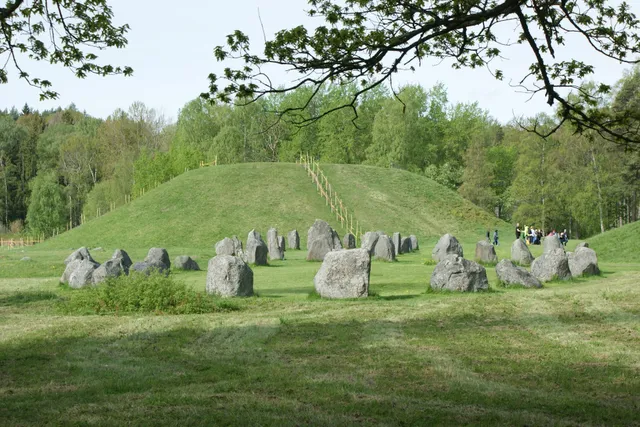
Anundshög (also Anundshögen and Anunds hög) is a tumulus near Västerås in Västmanland, the largest in Sweden. It has a diameter of 60 metres (200 ft) and is about 9 metres (30 ft) high.
Assessments of the era of the mound vary between the Bronze Age and the late Iron Age. A fireplace under it has been dated by radiocarbon dating to sometime between AD 210 and 540.
Some historians have associated the mound with the legendary King Anund, while others regard this as speculative. It is purported also that the name is taken from the large runestone at the site, (Vs 13) the central stone in a row of 15 alongside the mound, re-erected in the 1960s and apparently marking out the route of the Eriksgata.
At the foot of the mound are 2 large stone ships placed end to end, 51 metres (167 ft) and 54 metres (177 ft) long. The site was a thing-place and the ship settings may be associated with...
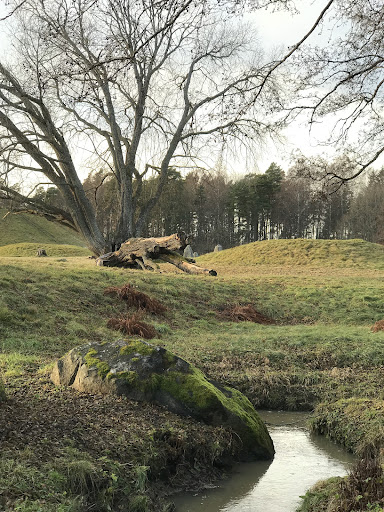
Read moreI found myself here after googling 'day trips from Stockholm' and am really glad I went. Especially in the off-season (December) I was the only person at this site and it allowed for me to take it all in. I went about an hour before sunset and the lighting was spectacular for photos (see below). In addition to visiting this site I also went to the nearby labyrinth (about a 15 minute walk - look at the map of the area that is at Anundshog and you'll see it) which was way different from any labyrinth I had conjured up in my head. Both Anundshog and the labyrinth are free to visit.
As I didn't have transportation, I took public transportation...the number 1 bus toward Bjurhovda from Vasteras Central. Get off at the last stop then walk about a mile on the sidewalk on the same side of the road where the bus dropped you off and you'll be at Anundshog. I did the reverse to get back...
Read moreДуже магічне і чудове місце з величною історією між бронзовою добою і добою вікінгів. Найбільший курган на території швеції який був пограбований 1788 р тому на ньому гребінь пошкодженийч Існують різні версії і припущення але точно ніхто незнає хто там захоронений. Назва кургану походить з середньовіччя як будинок суду. Датовані приблизні часи створення кургану 210-540рр нашої ери. Йохан Перінгшельд ідентифікував курган як гробницю короля казок Брет-Анунда, але це не більше ніж припущення. Оскільки ім'я також з'являється на рунічному камені інші вважають більш імовірним, що саме звідси походить назва. Прямо навпроти кургану стоїть кам'яний пам'ятник встановлено чудовий рунічний камінь, рунічні написи Вестманланда на згадку про «Хедена, брата Анунда», і також згадується, що той, хто зробив це, також спорудив усі інші камені на місці. Довгий ряд каменів, встановлених уздовж дороги, напевно, представляв дуже величне видовище для перехожих. Напис на рунічному камені повністю читає: «Фолквід спорудив усі ці камені для свого сина Хедена, брата Анунда . Вред вирізав руни » У 1788 році деякі рейдери з Вестеросу здійснили спробу пограбування. Ймовірно, вони працювали вночі, копали на вершині кургану та ховали викопану масу, кидаючи її між деревами, які чросли на кургані. Це було відновлено під час реставрації 1970р. У Скандинавії відомо приблизно 2000 корабельних могил більшість у південній Швеції, але також велика кількість у Данії та Норвегії. Окремі приклади також можна знайти в Німеччині та країнах Балтії. Будьласка піднімайтеся на курган по сходах неходіть стежками там стоять таблички бережіть величну історію і поважайте тих хто там захоронений....
Read more