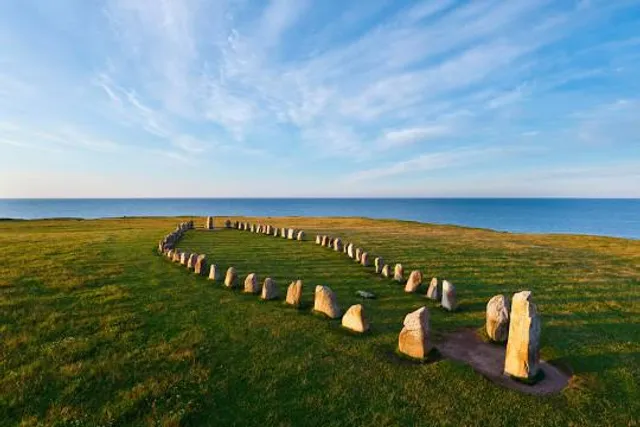
Ales Stenar (also known as Ale's Stones) is a prominent megalithic monument located in Scania, southern Sweden. Situated on a hill overlooking the Baltic Sea near the fishing village of Kåseberga, it is one of Sweden's largest and most enigmatic ancient sites. Here are some key facts and theories about Ales Stenar: Description: It is a "stone ship" formation, consisting of 59 large boulders arranged in an oval outline, resembling a ship. The monument is approximately 67 meters (220 feet) long and 19 meters wide, with the stones at each end being notably larger than the others, weighing up to 5 tonnes each. Dating: While various theories about its age exist, archaeological excavations and carbon-14 dating suggest that Ales Stenar was most likely constructed around 550 CE, placing it in the late Iron Age (Vendel Period). However, evidence of earlier human activity, including a hearth dating back 5,500 years, indicates the site was significant long before the stone ship was erected, possibly reusing stones from older burial sites. Purpose and Theories: The exact function of Ales Stenar remains a subject of debate among archaeologists and researchers. Several theories have been proposed: Burial Monument: This is a widely accepted theory. Archaeological findings within the ship setting include a decorated clay pot with burned human bones, suggesting a funerary purpose. The ship shape itself is often associated with Norse maritime culture and the idea of a vessel for the journey to the afterlife. Astronomical Calendar/Sun Cult Site: Many believe Ales Stenar served an astronomical purpose. Observations show that the stones are aligned with the sunset during the summer solstice and the sunrise during the winter solstice. This suggests it may have been used as a calendar for tracking agricultural seasons or for observing celestial events. Some theories even connect it to major and minor lunar standstills. Cult Center/Ritual Site: Given its potential astronomical alignments and the presence of hearths, it's also suggested that Ales Stenar was a significant cult or ritual site where ceremonies, possibly related to solar or lunar cycles, took place. Navigation Aid: Its prominent position overlooking the Baltic Sea has led to speculation that it might have served as a landmark or navigation aid for ancient seafarers. Historical Significance: Ales Stenar is often referred to as "Sweden's Stonehenge" due to its mysterious nature and monumental scale. It provides valuable insights into the advanced understanding of astronomy and the cultural practices of ancient Scandinavian peoples during the Iron Age. It is a protected archaeological site and a popular tourist attraction, drawing thousands of visitors annually. The ongoing research and various interpretations highlight the enduring mystery and fascination surrounding...
Read more🌅 Unveiling the Ancient Marvel: Ales Stenar – Sweden's Stonehenge 🇸🇪🗿
Nestled atop a gentle hill, the Swedish counterpart to Stonehenge awaits—Ales Stenar, a mystic arrangement of 52 stones, each weighing around 5 tons. As you embark on a brief walk up the hill, you are transported through time to an era over a millennium ago, leaving you in awe of the ancient marvel that stands before you.
The sheer magnitude of Ales Stenar invites contemplation about the extraordinary feat achieved by those who placed these colossal stones so many years ago. As you trace the outline of this archaeological wonder, you can't help but wonder about the craftsmanship and ingenuity required to position these stones with precision.
Each stone in Ales Stenar feels like a sentinel from the past, guarding the secrets of its creation. The alignment of the stones forms a ship-like structure, adding to the enigma that surrounds this historic site. The panoramic view from the hill enhances the mystical atmosphere, inviting visitors to connect with the ancient souls who once stood here.
The weight and arrangement of the stones evoke a sense of reverence for the ingenuity of our ancestors. How did they transport and place these stones, each weighing as much as a small elephant, without the modern machinery we have today? The mystery persists, adding layers of intrigue to the already captivating narrative of Ales Stenar.
Visiting Ales Stenar is not just a walk through history; it's an immersive journey into the unknown. As you stand amidst the stones, the whispers of the past echo in the wind, inviting you to contemplate the timeless wonder of this Swedish Stonehenge. 🌅🗿✨ #AlesStenarMysteries...
Read moreWe visited this place, just because we stayed in the South of Sweden for a few days. Even I knew and read about it, I didn't expect much.
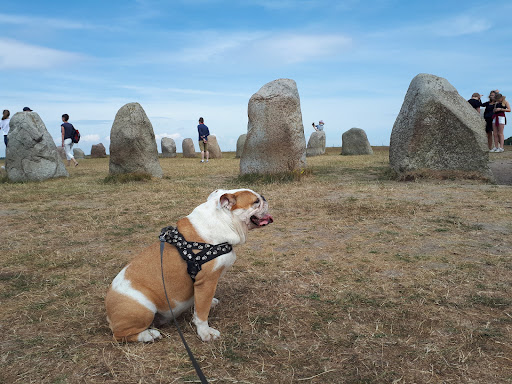
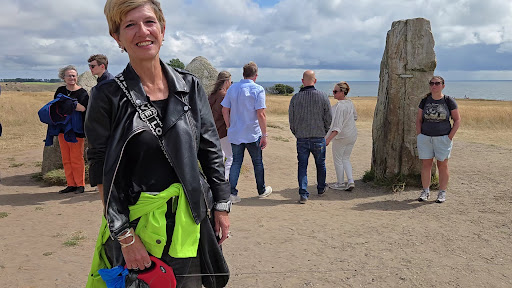
But then it started at the (free) parking lot, which was quite huge, a lot bigger than expected. Then I knew this is not just a roadside attraction. There's an easy stroll up to the Ales Stenar. But be aware: For some parts it's a bit difficult if you have a stroller and nearly impossible if you rely on a wheelchair. The Megalith formation lies on top of this small hill, offering wonderful views of the surrounding coast. And for that only it's already worth to visit. The Megalith formation consists of 59 stones, circled up in an oval (ship) formation. And it's quite an impressive sight. It's not as big or as impressive as Stonehenge (which DOES hold up to the hype btw), but it's quite a sight nonetheless. There's no entrance fee, no fences or anything. Which is quite surprising. I only wished that people (not only kids) wouldn't climb around on these stones so much. Can't be good on the long run. We loved it. Was pretty busy on this morning, but still quite alright. We were also happy that dogs are allowed (on leash). Enjoy it as long as it lasts as it is. I quite believe fees and further restrictions will...
Read more