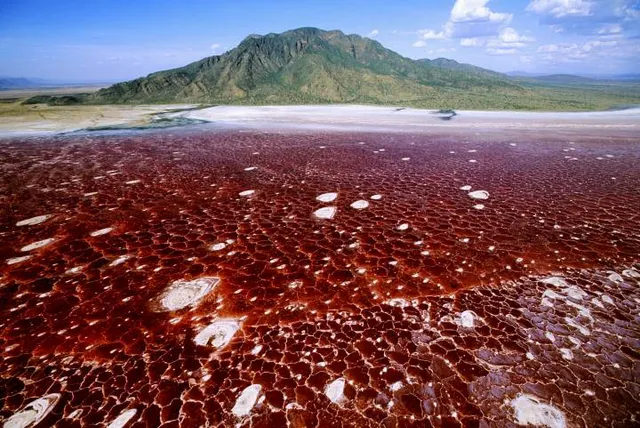
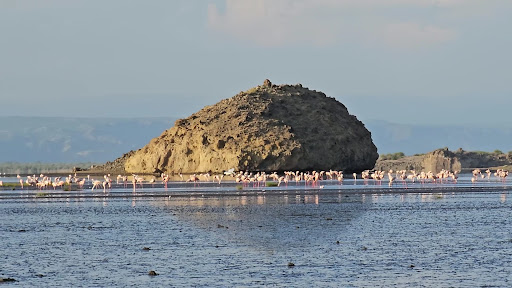
The lake is fed principally by the Southern Ewaso Ng'iro River, which rises in central Kenya, and by mineral-rich hot springs.[1] It is quite shallow, less than three metres (9.8 ft) deep, and varies in width depending on its water level. The lake is a maximum of 57 kilometres (35 mi) long and 22 kilometres (14 mi) wide.[1] The surrounding area receives irregular seasonal rainfall, mainly between December and May totalling 800 millimetres (31 in) per year.[1] Temperatures at the lake are frequently above 40 °C (104 °F).[1] High levels of evaporation have left behind natron (sodium carbonate decahydrate) and trona (sodium sesquicarbonate dihydrate). The alkalinity of the lake can reach a pH of greater than 12. The surrounding bedrock is composed of alkaline, sodium-dominated trachyte lavas that were laid down during the Pleistocene period. The lavas have significant amounts of carbonate but very low calcium and magnesium levels. This has allowed the lake to concentrate into a caustic alkaline brine.[3] The colour of the lake is characteristic of those where very high evaporation rates occur. As water evaporates during the dry season, salinity levels increase to the point that salt-loving microorganisms begin to thrive. Such halophile organisms include some cyanobacteria that make their own food with photosynthesis as plants do. The red accessory photosynthesizing pigment in the cyanobacteria produces the deep reds of the open water of the lake and the orange colours of the shallow parts of the lake. The alkali salt crust on the surface of the lake is also often coloured red or pink by the salt-loving microorganisms that live there. Salt marshes and freshwater wetlands around the edges of the lake do support a variety of plants.Most animals find the lake's high temperature (up to 60 °C [140 °F]) and its high and variable salt content inhospitable.[4] Nonetheless, Lake Natron is home to some endemic algae, invertebrates, and birds. In the slightly less salty water around its margins, some fish can also survive. The lake is the only regular breeding area in East Africa for the 2.5 million lesser flamingoes, whose status of "near threatened" results from their dependence on this one location. When salinity increases, so do cyanobacteria, and the lake can also support more nests. These flamingoes, the single large flock in East Africa, gather along nearby saline lakes to feed on Spirulina (a blue-green algae with red pigments). Lake Natron is a safe breeding location because its caustic environment is a barrier against predators trying to reach their nests on seasonally forming evaporite islands. Greater flamingoes also breed on the mud flats. The lake has inspired the nature documentary The Crimson Wing: Mystery of the Flamingos by Disneynature, for its close relationship with the Lesser flamingoes as their only regular breeding area. Two endemic fish species, the alkaline tilapias Alcolapia latilabris and A. ndalalani, also thrive in the waters at the edges of the hot spring inlets. A. alcalica is also present in the lake, but is...
Read moreSomewhat cool place, but the greediness of the fee structure really takes away from the experience. I visited in 9/2019 and was charged the following fees:
motorbike taxi from junction to the village: $35 gate fee: $35 wildlife fee: $35/day camping: $10/day mandatory guide: $20 (includes visit to hot spring, lake, foot prints, waterfall, and village) day hike to climb the volcano : $100(!) overnight trip to big waterfall (must have own tent): $40 motorbike (per activity): $20-$40 taking a photo of any local: $1 car back to junction: $15
As you can see, you essentially have to pay 3 entry fees and then must continue to pay for doing virtually anything. If you are like most visitors and are coming as part of a $5,000 private safari, I’m sure you don’t mind these fees, but as a traveler on a budget, I seriously resented how expensive doing anything here was, as well as the complete lack of transparency about how much it costs before I got there (I was told in Arusha that it costs $10 to enter). All in, a 2 day diy trip from Arusha costs north of $150. For these fees, you get to visit a park with practically no infrastructure and a bone-achingly painful 4x4 road connecting it to the closest town.
The lake was sort of cool, though there are many other places in other African countries where you can see as many flamingos for free. Unfortunately, I could not afford to do any other activities. The locals were quite nice and charged the most reasonable portion of the fees. If that was all there was, I would have enjoyed the lake quite a bit more. To me, the $35/day wildlife fee is the most egregious of all, since it means you can’t scale the entrance fee and actually spend some time getting to know the area without paying the equivalent of NYC rent.
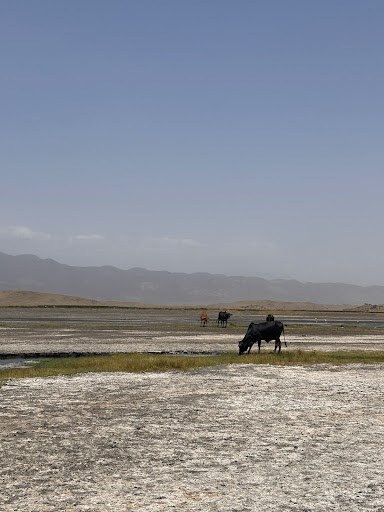
One more thing: the red water, which was the entire reason I went, is not viewable in the dry season and in the rainy season requires a 66 km motorbike ride which costs ~$40.
Essentially, I spent a total of 12 hours of painfully uncomfortable travel and $150 to see a lake with some flamingos far off in...
Read moreLake Natron, Tanzania
Lake Natron is a highly alkaline salt lake located in northern Tanzania, near the border with Kenya, within the East African Rift Valley. It lies at the base of the active Ol Doinyo Lengai volcano, which contributes unique volcanic minerals to the lake.
This shallow lake, with an average depth of less than 3 meters and covering up to 1,040 km² depending on seasonal rainfall, is known for its extreme chemistry. The waters have a pH as high as 10.5 and temperatures that can exceed 40°C (104°F). These conditions arise from the inflow of mineral-rich hot springs and volcanic ash containing sodium carbonate and sodium bicarbonate, which make the water strongly alkaline and caustic.
Key scientific features include:
High alkalinity and salinity: The lake’s waters are similar to caustic soda, capable of causing burns or severe irritation to skin and eyes after prolonged exposure.
Calcification effect: Dead animals that fall into or near the lake often become preserved, as mineral deposits coat their remains, creating natural “mummification.”
Unique biology: Despite its harshness, Lake Natron is an important ecosystem. It is the world’s primary breeding ground for lesser flamingos (Phoeniconaias minor), which feed on the lake’s cyanobacteria that thrive in alkaline conditions. Certain species of tilapia fish (Alcolapia spp.) are also adapted to survive in its waters.
Volcanic influence: The nearby Ol Doinyo Lengai volcano releases natrocarbonatite lava, which is rich in rare sodium carbonate minerals that directly influence the lake’s chemistry.
Scientifically, Lake Natron is significant as an extremophile habitat and as a natural laboratory for studying adaptations to highly alkaline, saline, and hot environments. Its conditions also make it a model for understanding possible extraterrestrial environments, such as ancient alkaline lakes on Mars.
However, for humans, Lake Natron is highly hazardous — its waters can burn skin, its surface crust can trap and entomb animals, and its surrounding mudflats are...
Read more