The Founding of Chiang Mai
Chiang Mai was purposefully created by King Mangrai in AD.1296 to be the political, economic, social and cultural center of his newly expanded and integrated kingdom of the Tai people, called "Lanna Kingdom" (kingdom of a million rice fields). It was designed to be located in the landlocked heartland of Southeast Asia, north of modern-day Thailand.
By the 13th century, the earlier empires of Southeast Asia such as Dvaravadi, Champa, and Angkor, had declined or disintegrated. The Yuan (Mongol) Dynasty of China had begun to expand southward where some Buddhist states had become prosperous, as well as the various states and townships of the ethnic and linguistic Tai peoples which had established themselves independently or in clusters.
Mangrai, whose mother was a Tai Lue princess from Chiang Rung, SipsongPanna (now in Kunming, south China), was the 25th king of the Lawachakaraj(Lao Chok) dynasty. He had, since 1261, succeeded his father as Ruler of Ngeonyang located near Chiangsaen, and had rapidly consolidated his kingdom by unifying, through diplomacy as well as through military leadership, many of the Tai towns and other states in the region. In 1292, after a long and cautious planning, he defeated, by ploys rather than force, the Mon kingdom of Haripunchai, a prosperous and ancient political center which included Lamphun and Lampang. Though he ruled from Lumphun only for 2 years, this civilized Mon kingdom, steeped in the Buddhist faith and rich in the Buddhist arts and architectural expressions, with a written code of legal system, seemed to have greatly inspired him in many ways.
Mangrai had frequently changed his capital before the founding of Chiang Mai, which literarily means "the new city". His previous administrative center had included Ngeonyang, Chiangrai, Fang, Lamphun, Chiang khong, Chiangtung or Kengtung (now in the Shan state, Myanmar), and finally Wiang Khumkham. Whenever he moved on to a new city, he appointed one of his sons and other trusted noblemen to rule the previous city for him.
By the time he discovered the site appropriate for Chiang Mai, he had already been living for 5 years at Wiang Khum Kham(see map below), a walled city he had built on the bank of the Ping River in the Chiang Mai valley, now an excavated and completely restored archaeological site located in Sarapee district, south of modern Chiang Mai.
Site Surveys and Selection of the "Chaiya Phum"
At age 57 and having been an energetic ruler for almost 40 years, Mangrai oftentravelled around in the vast valley region, accompanied by his troops and advisors, searching for a perfect location to build his permanent capital. Whenever he found an attractive and peaceful site, he would stop to sleep overnight to make further survey and to look for what he called "auspicious signs" and "good omens", according to traditional concepts and beliefs, and according to his policy.
One day in 1291, he came across an ideal location at the foothills of Doi Suthep which sloped down from the west to the great river basin in the east. In the middle of this vast open valley, there was idyllic and picturesque grassland where he sighted some rare species of animals unafraid of his troops, and found some unique auspicious plants, especially a giant fig tree. He especially observed a crystal-clear waterfall, flowing from Doi Suthep into streams, surrounding the area; and on the eastern edge of this vast plain, there was a wide and long river called River Ping which meandered down from...
Read moreThis place exceeded expections. Very well laid out in beautiful surroundings. The “jaguar trail” - the walking path around the lake indeed had some great collection of animals. The tram safari was good too. The shows were alright. Need to reach 15 minutes before the scheduled start to get a seat. We went in the christmas peak season
A few useful tips for anyone planning a visit...
Dont pay the full price of 800 per adult and 400 per child. I had booked through Klook and paid under 1400 baht for 2 adults and a child. And this included hotel pickup and drop off from chiang mai Choosing 3.30-8.30 pm is a better idea than the 5.30-9.30 one as latter would give insufficient time for all experiences and possibly encounter heavier traffic too on the roads
Go through the timings of the safaris and shows and plan the sray beforehand in order to not miss anything and also orient oneself with the locationd of each of the activities
There is free wifi inside the zoo. Can scan QR code abd visit website of the zoo. There are no paper maps available at the site, a good environmental friendly initiative
A good plan that I would suggest is ( we went on a saturday. Tiger show is only on fri & sat if i remember right)
4- 5 pm Jaguar trail walking zone 5.20 Night predator show (night predator building outside of the entrance) 6 pm Tiger show at Tiger world 6.50 Pm English safari tram - 1 hr 8 pm dance show - open space just past the entry 8.10 Musical Fountain water screen- middle of Swan lake
One has to buy cash cards ( load it with money) to buy foodstuff from the zoo kiosks, returnable and balance refunded But most of the stalls inside near the open space ( kind of like a street market food stalls look) accepted cash only. And a bit overpriced.
Didnt try the giraffe restaurant, so cant comment on that
Toilets were clean
This place is suitable for visiting in afternoon/evenings only. If want to visit zoo in the morning, there is another zoo at chiang mai, at the base of the doi suthep hill and has giant pandas but no...
Read moreThe Chiang Mai Night Safari is a must-visit for animal lovers and kids. It’s especially fun if you’re looking for a bit of adventure that you won’t find in traditional zoos. This well-maintained area is a perfect tourist destination, located about 12 km from the city center. We did our pre-booking through the Klook app, and the barcode on the e-ticket allowed for smooth entry and exit. The staff provides a paper ticket that mentions the timing of each activity, such as the Savannah tram ride, Predator Prowl tram ride, dancing light show, Tiger show, and Dance show. There’s a 5-minute gap between each activity, assuming you don’t waste time between them.
The tram takes you through an enclosed jungle-like area and stops at locations where the animals dwell. Getting a close look at giraffes and zebras was really fun. There’s a 40 Baht fruit basket available near the tram entrance that can be used to feed the animals (only during the Savannah ride where herbivores dwell). The Predator Prowl was thrilling, with superb sights of tigers, hyenas, lions, jaguars, and jackals. The tram felt reasonably safe, though it wasn’t fully enclosed with bars.
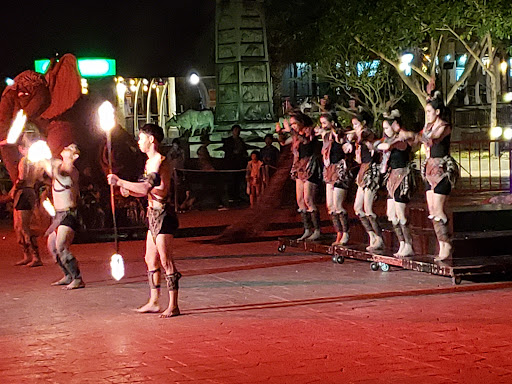
The time management of the entire show was impeccable. The Dance show and dancing light show were fine, but a bit childish and not exceptional. The Tiger show was fully packed, leaving us without seats in the heavy rain. It was more like a circus, with tigers and lions being tricked with slabs of meat hung on hooks. You get to see white tigers as well, with a combination of white and orange tigers in the performance. I didn’t enjoy it; I felt sad watching them being made to perform unnatural poses and movements.
There are two small snack shops inside where you can get pork sticks and flavored cream buns. The toilets were clean. However, note that credit cards aren’t accepted anywhere here.
Overall, I would recommend this if you are going with your kids, or your partner if both of you are into...
Read more