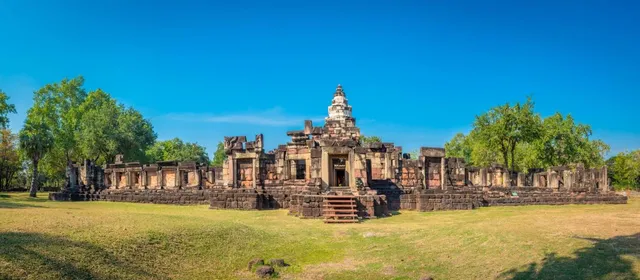
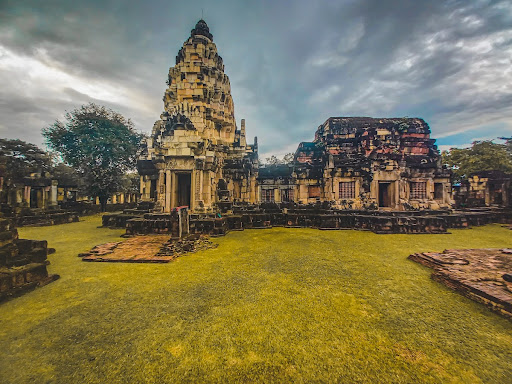
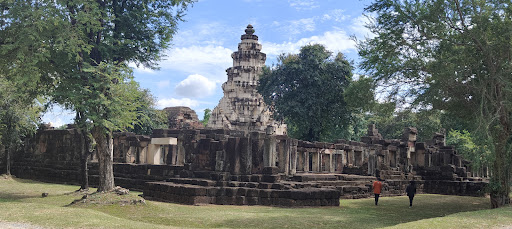
An impressed ancient religious place was built up about 15th-17th Buddhist century (around 800-1000 years ago). The tipical points of focussing on it are not only the assembling from a huge number of regional stones brought from around 100 kms. away sources, but also the founding of the evidents that shown transforming from Khom culture which followed to Hindu values to be Buddhist faithful culture in the following period. These shown the influences of Khom in this vast regional area before the in coming of Buddhist culture which was fundamentally established firmly and stands still until nowaday. The Prasat (Castle in English, which does not represent directly to the suitable meaning in foreign word), itself, indeed, closes to the meaning of the word:Temple, was the place for King or hi-ranking peoples in those age to do respectation to the Prophet in those era. You will be appreciated with those impressive physical scenes after visiting the hall of information(recommended) that will make you understand deeply in its historic story from the in-place explainer there.The Prasat is along the main highway and seperates to local road in short distance and situates in the mid of villeageous area. You should prepare for walking around in those ruins about 2 hrs., with your cap or umbrella that will help you a lot to meet the appreciation of old...
Read moreInfra Red photography at Prasat Hin Phanomwan. Camera: Nikon D70s (unconverted regular camera) Filter Hoya & Tianya Infra red filters 720nm Lens Nikon 18-70mm, Tripod. Camera settings: All images shot in RAW mode with Preset WB on patch of sunny green grass. ISO 200, focal length f11, lens 18-70mm. Exposures times: Hoya R72 = 1.6secs Tianya 720 = 1 secs Post processing conducted in Nikon Capture NXD & Gimp 2.8.
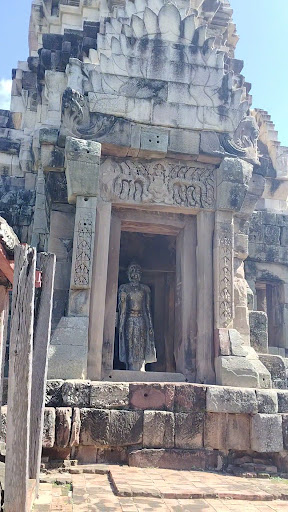
It is believed that Prasat Phanom Wan was built in the 15th Buddhist century and was renovated during 18th and 19th century. The place was the Hindu religion and later became a Buddhist ritual site. Although most of the place was ruined, the main pagoda and a tiered pagoda are still remaining. Surrounded with sandstone walkway and laterite wall around the sanctuary, the southwest area is a sandstone pagoda called Prang Noi with the large Buddha statue inside. Outside the area comprises of Gopura (a sanctuary doorway or porch) situated in the form of tall tower in four directions. The east side of the sanctuary features the trace of a moat and hill called “Noen Oraphim”.
Getting there:The place is located in Ban Makha, Tambon Pho. Tourists are able to drive from the Nakhon Ratchasima-Khon Kaen road for 15 kilometers and proceed for another 5...
Read moreBiglietto di entrata 50 Bath.
E' un importante monumento Khmer che mostra prove di un uso continuato per almeno cinquecento anni. Il sito era in uso almeno dal IX secolo, e forse già dal VII secolo. Le fondamenta di un certo numero di torri in mattoni - e una porzione superstite di una torre nel cortile sud-ovest - attestano una sostanziale presenza precoce nel sito, così come un'iscrizione sanscrita datata all'891 che menziona due dei primi re Khmer, Indravarman I (867-889) e Yasovarman I (889-910). Iscrizioni successive trovate sul sito, datate al 1055 e al 1082, menzionano il tempio di Phimai e ci forniscono la prova che Phnom Wan era in uso come tempio di Shiva in quel momento della storia. Dopo la caduta dell'impero Khmer il sito è stato riproposto come tempio buddista, con tracce di statuaria buddista risalenti a quell'epoca. In tempi moderni il tempio, è ancora in uso come luogo di devozione buddista. La pianta generale del tempio è simile a quella di Phimai, anche se su scala molto più piccola. Il santuario principale è un edificio che comprende un prang (torre) a ovest, collegato a un mandapa tramite un lungo e stretto antarala (camera di collegamento). I gopura nord e sud delle gallerie circostanti non sono centrati sul prang, come è consuetudine, ma sul santuario centrale nel suo insieme. Il motivo di questo layout unico non è noto. I recenti lavori di restauro hanno previsto la ricostruzione integrale del prang, crollato in tempi antichi. E' stato utilizzato una tonalità volutamente pallida di arenaria per differenziare chiaramente la pietra moderna dall'originale. La ricostruzione di buon gusto consente ai visitatori di apprezzare le dimensioni del progetto originale, rendendo comunque facile distinguere quali parti del tempio sono originali e quali sono ricostruite. Anche se non più operativo, il sito era circondato da un fossato che è appena visibile nelle foto aeree. A est del tempio si trovano i resti di un baray (serbatoio) che conserva...
Read more