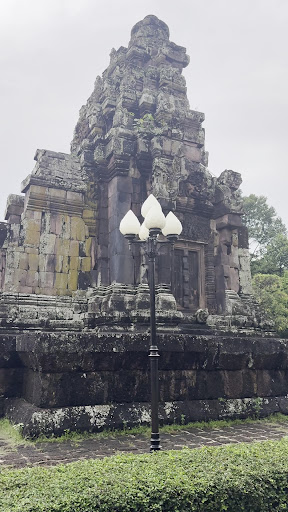
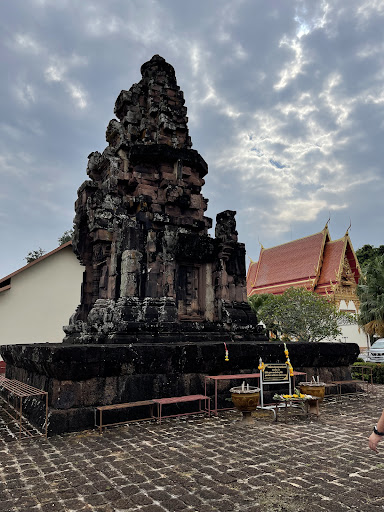
This khmer sanctuary is 5 kilometres from town on the way to Udon Thani.
Thought to hail from 11th-12th centuries, the roughly 12-metre-high sandstone spire rises from a laterite base and looks unremarkable from far away. Unlike many of Thailand’s lesser-known Khmer ruins, Narai Cheng Weng is not rimmed by cloisters, minor prangs or moats. It consists of only the one single tower and was most likely an outlying sanctuary used for religious ceremonies.
Another legend holds that Phra That Narai Cheng Weng was constructed by women as part of a temple-building battle of the sexes. The male team produced a roofless sanctuary, Phra That Phu Phek, which can still be seen atop a mountain in Phanna Nikhom district. It was left unfinished when the female team tricked the men into thinking they saw Venus by raising a flaming balloon over the horizon — like sounding a fake buzzer in a ball game when there’s still time on the clock. Needless to say, the ladies won!
Judging by a few marvelous lintels that remain over some of the four upper doorways on Phra That Narai Cheng Weng, the female side probably would have prevailed regardless. The most interesting of these shows Krishna clutching the back legs of a lion that appears to strangely enjoy this attack from the rear.
Krishna was the eighth incarnation of Vishnu, or Narai as this revered Hindu god is known to the Thais. Another beautifully preserved lintel shows Vishnu lounging on his side while nagas look on and the now-headless consort, Lakshmi, massages his thigh. Further down near the base of the prang, smaller carvings appear to depict Rishi, a hermit often depicted at the base of 11th and 12th century columns.
See the photos of the lintels and exquisite carvings.
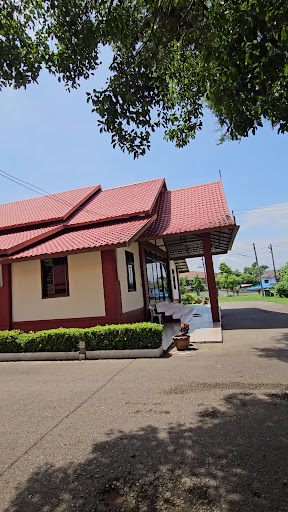
The only negative comments about the site being the way the Thais have added the coloured lighting dressing the temple like a Christmas tree this spoils the site. Why was a building allowed to be built so close the site once again spoils the...
Read moreA Thousand-Year-Old Sanctuary and the Legend of its Amazing Women Builders!
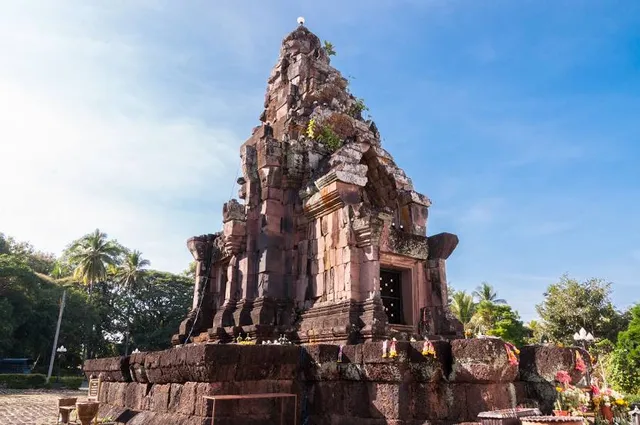
A must-visit for anyone in Sakon Nakhon! This isn't just an ancient site; it has a fascinating story. Phra That Narai Cheng Weng is an ancient Khmer-style sandstone sanctuary, over 900 years old, dating back to the 11th-12th centuries.
The highlight is the local legend, which tells of a construction competition between a group of women here and a group of men building Phra That Phu Phek. The women played a clever trick by hanging a lantern high in a treetop. This made the men think the morning star had risen and dawn was breaking, causing them to give up. The women’s cheers of victory are said to be the origin of the name "Cheng Weng."
Although the sanctuary is small, it is remarkably complete. Don't miss the lintel depicting Vishnu reclining on a Naga, which is still beautifully clear and detailed. The atmosphere is shady and peaceful, perfect for admiring history and learning about local culture. It's truly a special place that I hope everyone helps to preserve for a long time to come.
ใครมาสกลนครต้องแวะเลยครับ! ที่นี่ไม่ใช่แค่โบราณสถานเก่าแก่ แต่มีเรื่องราวซ่อนอยู่ พระธาตุนารายณ์เจงเวงเป็นปราสาทหินทรายศิลปะขอมโบราณ อายุกว่า 900 ปี (ราวพุทธศตวรรษที่ 16-17)
ที่พีคคือตำนานพื้นบ้านที่เล่าว่า เหล่าผู้หญิงสร้างแข่งกับผู้ชายที่ไปสร้างพระธาตุภูเพ็ก แต่ฝ่ายหญิงออกอุบายเอาโคมไฟไปแขวนบนยอดไม้ ทำให้ฝ่ายชายคิดว่าดาวประกายพรึกขึ้นแล้ว (ใกล้เช้า) เลยยอมแพ้ไปก่อน เสียงผู้หญิงโห่ร้องดีใจนี่แหละครับคือที่มาของชื่อ "เจงเวง"
ตัวปราสาทแม้จะเล็กแต่สมบูรณ์มากครับ โดยเฉพาะทับหลังรูป "พระนารายณ์บรรทมสินธุ์" ที่ยังสวยคมชัด บรรยากาศร่มรื่น เงียบสงบ เหมาะกับการมาเดินชมความงามของประวัติศาสตร์และเรียนรู้วัฒนธรรมท้องถิ่นจริงๆ ครับ...
Read moreAncient temple 🛕
PHRA THAT NARAT CHENGWENG This is a sandstone monument with a terrace extending out from it a short distance. There is only one entrance, situated on the terrace; the other three doorways are false, •A stone lintel depicting Krisna fighting with a lion was found together with the gable board on which is represented Siva, Lord of Dance, and Vishnu. From this evidence it can be deduced that the monument was influenced by the Bapuan period of Khmer history, and that it dates to the - Joth...
Read more