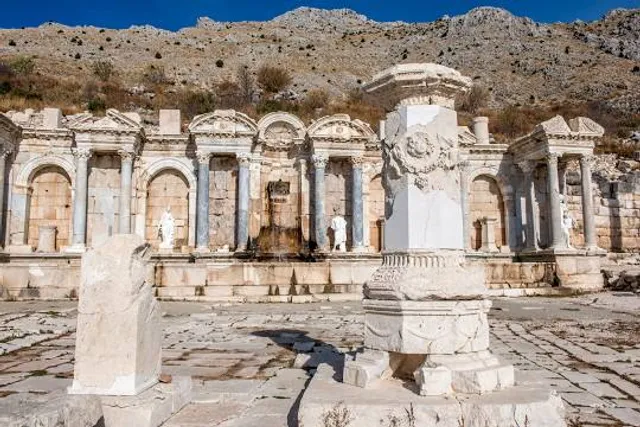
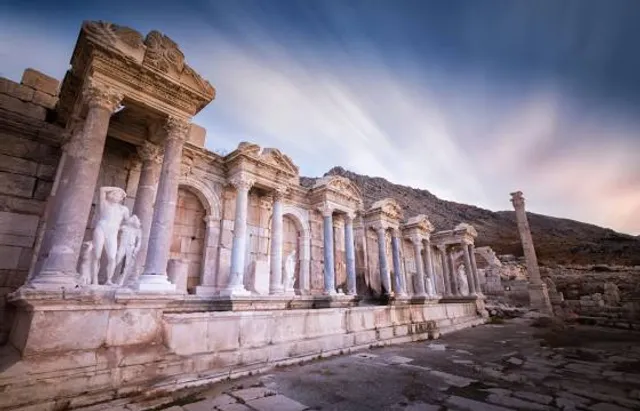
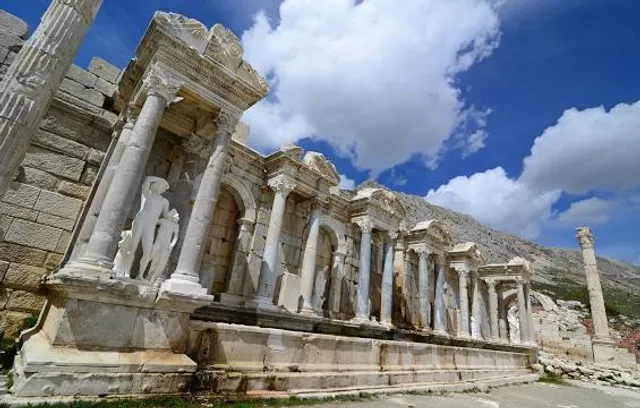
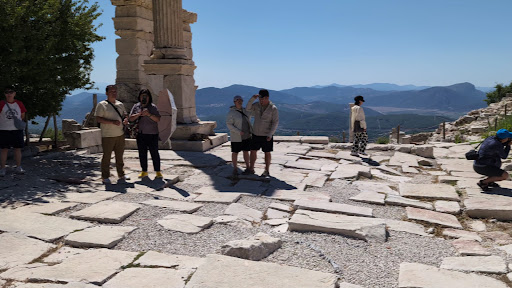
Sagalassos ancient city The ancient city of sagalassos, which is located in the aglasun district of burdur, is located in the region known as pisidia in ancient times. The ancient city of Sagalassos, where the first settlement traces date back to 12,000 years ago, has survived until today with its monumental structures where almost all of the original building blocks can be found. The plan of the city is quite remarkable considering the terraced structure on which it was founded. Sagalassos, with its 1000-year-old pottery production, is the longest pottery production center in ancient times. One of the most striking structures of the ancient city, which is included in the temporary list of UNESCO world heritage sites, is its theater and fountain of antonins. antonins fountain ms. It was built between 161-180 in the time of Roman Emperor Marcus Aurelius and dedicated to the god Dionysus. Alexander the Great in 333 in a bloody war. sagalassos changed hands many times later, first seleucid, then the kingdom of bergama, roman republic, galat king amyntas'ın passes into the hands. Thanks to the emperor Augustus, he joins the Roman Empire again. The city suffered a major earthquake in 518 and was plagued by plague in 542. During the excavations in 2016, during the excavations in the ancient city of Sagalassos, where scientific excavations have been carried out since 1989, Ms. The sarcophagus dating to the 2nd century, cremation urn and vaulted burial chamber were found. prof. d. jeroen poblome'un excavations carried out under the direction of ms. A well-preserved sarcophagus dating to the 2nd century was found just below the vaulted chamber with a cremation urn and the bones of the second cremation Sagalassos antik kenti burdur'un ağlasun ilçesinde bulunan sagalassos antik kenti, antik dönemde pisidia olarak bilinen bölgede yer almaktadır. ilk yerleşim izleri günümüzden 12.000 yıl öncesine kadar gittiği sagalassos antik kenti, orijinal yapı taşlarının neredeyse tamaminin bulunabildiği anitsal yapıları ile iyi korunarak günümüze kadar gelmiştir. kentin plani, üzerinde kurulmuş olduğu terasli yapı düşünüldüğünde oldukça dikkat çekicidir. 1000 yıllik seramik üretimi ile sagalassos, antik dönemlerdeki en uzun süre seramik üretimi yapan bir merkezdir. unesco dünya mirası geçici listesi'nde yer alan antik kentin en göze çarpan yapilarindan biri tiyatrosu ve antoninler çeşmesi'dir. antoninler çeşmesi ms. 161-180 yılları arasında roma imparatoru marcus aurelius zamaninda yapılmiş ve tanrı dionysos'a ithaf edilmiştir büyük iskender'in bölgeyi kendi topraklarına katmak istemesiyle ilk kez adını duyuran kent, mö. 333 yılında kanlı bir savaşla büyük iskender'in eline geçer. daha sonra birçok kez el değiştiren sagalassos, önce seleukoslarin, sonra bergama kralliğıi'nın, roma cumhuriyeti'nin, galat kralı amyntas'ın eline geçer. imparator augustus sayesinde tekrar roma imparatorluğu'na katılır. 518 yılinda büyük bir deprem geçiren kent, 542 yılnda veba salginiyla boğuşur. 1989 yılından beri bilimsel kazı çalışmalarınin yürütüldüğü sagalassos antik kenti'nde 2016 yıl kazi çalışmaları sırasında ms. 2. yüzyıla tarihlenen lahit, kremasyon (yakarak gömme) urnesi ve tonozlu mezar odası bulundu. prof. dr. jeroen poblome'un başkanlığında gerçekleştirilen kazılarda, ms. 2. yüzyıla tarihlenen ve iyi korunmuş durumda bulunan lahdin hemen altinda, içerisinde bir kremasyon urnesi ve ikinci kremasyonun kemiklerini içeren tonozlu bir oda da...
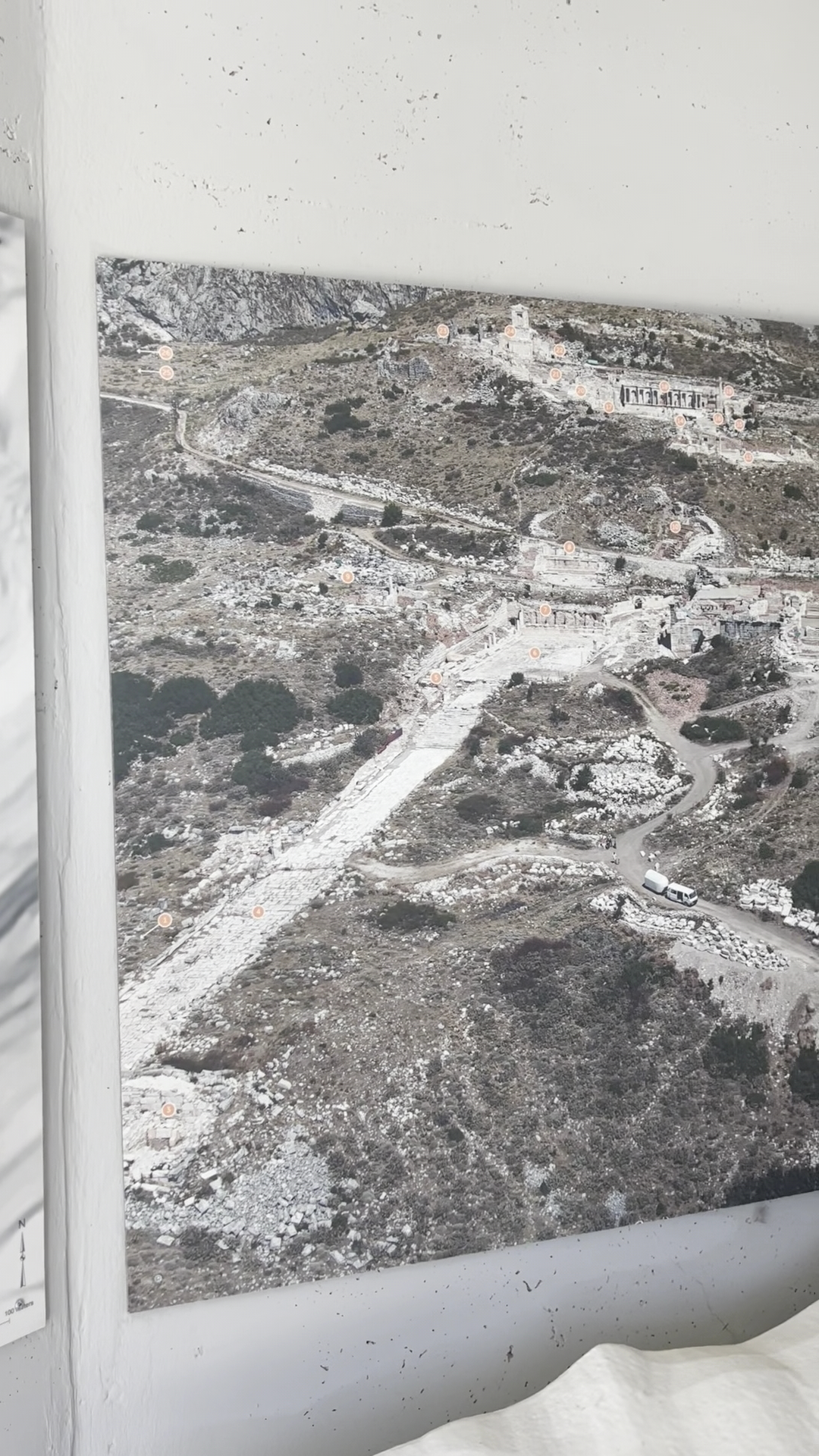
Read moreThe urban site was laid out on various terraces at an altitude between 1400 and 1600 m. After suffering from a major earthquake in the early sixth century CE, the town managed to recover, but a cocktail of epidemics, water shortages, a general lack of security and stability, a failing economy and finally another devastating earthquake around the middle of the seventh century forced the inhabitants to abandon their town and resettle in the valley. Large-scale excavations started in 1990 under the direction of Marc Waelkens of the Katholieke Universiteit Leuven. A large number of buildings, monuments and other archaeological remains have been exposed, documenting the monumental aspect of the Hellenistic, Roman and early Byzantine history of this town. Human settlement in the area goes back to 8000 BCE, before the actual site was occupied. Hittite documents refer to a mountain site of Salawassa in the fourteenth century BCE and the town spread during the Phrygian and Lydian cultures. Sagalassos was part of the region of Pisidia in the western part of the Taurus Mountains. During the Persian period, Pisidia became known for its warlike factions. Sagalassos was one of the wealthiest cities in Pisidia when Alexander the Great conquered it in 333 BCE on his way to Persia. It had a population of a few thousand. After Alexander's death, the region became part of the territories of Antigonus Monophthalmus, possibly Lysimachus of Thrace, the Seleucids of Syria and the Attalids of Pergamon. The archeological record indicates that locals rapidly adopted Hellenic culture. The Roman Empire absorbed Pisidia after the Attalids and it became part of the province of Asia. In 39 BCE it was handed out to Galatian client king Amyntas, but after he was killed in 25 BCE Rome turned Pisidia into the province of Galatia. Under the Roman Empire, Sagalassos became the important urban center of Pisidia, particularly favoured by the Emperor Hadrian, who named it the "first city" of the province and the center of the imperial cult. Contemporary buildings have a fully Roman character. Around 400 CE Sagalassos was fortified for defence. An earthquake devastated it in 518 and a plague circa 541–543 halved the local population. Arab raids threatened the town around 640 and after another earthquake destroyed the town in the middle of the seventh century, the site was abandoned. The populace probably resettled in the valley. Excavations have found only signs of a fortified monastery—possibly a religious community, which was destroyed in the twelfth century. Sagalassos disappeared from the records. In the following centuries, erosion covered the ruins of Sagalassos. It was not looted to a significant extent, possibly because of its location. Explorer Paul Lucas, who was traveling in Turkey on a mission for the court of Louis XIV of France, visited the ruins in 1706. After 1824, when Francis Vyvyan Jago Arundell (1780–1846), the British chaplain at Smyrna and an antiquarian, visited the site and deciphered its name in inscriptions,[3] Western travelers began to visit the ruins. Polish historian of art, count K. Lanckoroński produced the first map of Sagalassos. However, the city did not attract much archaeological attention until 1985, when an Anglo-Belgian team led by Stephen Mitchell began a major survey...
Read moreSagalassos, also known as Selgessos is an archaeological site in southwestern Turkey.
The ancient ruins of Sagalassos are 7 km from Ağlasun (as well as being its namesake) in the province of Burdur, on Mount Akdağ, in the Western Taurus mountains range, at an altitude of 1450–1700 metres. In Roman Imperial times, the town was known as the "first city of Pisidia", a region in the western Taurus mountains, currently known as the Turkish Lakes Region. During the Hellenistic period it was already one of the major Pisidian towns.
From 1990 Sagalassos, a major tourist site, has become a major excavation project led by Marc Waelkens of the Catholic University of Leuven in Belgium. The monumental city center is now exposed; four major restoration projects are (nearly) completed. The project also undertakes an intensive urban and geophysical survey, excavations in the domestic and industrial areas, and an intensive survey of the territory. The first survey documents a thousand years of occupation—from Alexander the Great to the seventh century—while the latter has established the changing settlement patterns, the vegetation history and farming practices, the landscape formation and climatic changes during the last 10,000 years.
National Museum card is valid at this unrevealed ancient civilization.
The entire site can be covered in a two-hour tour. For a thorough walkthrough you might need more. The site is kept very clean, tidy, organized, and the displays and infographics were very informative and enough to discover the historic development of the site.
The entrance fee is very reasonable, there is enough parking for visitors. It was low season around mid October 2022 when we visited the site. The weather was so fresh due high altitude, you might need a raincoat, or a sweatshirt...
Read more