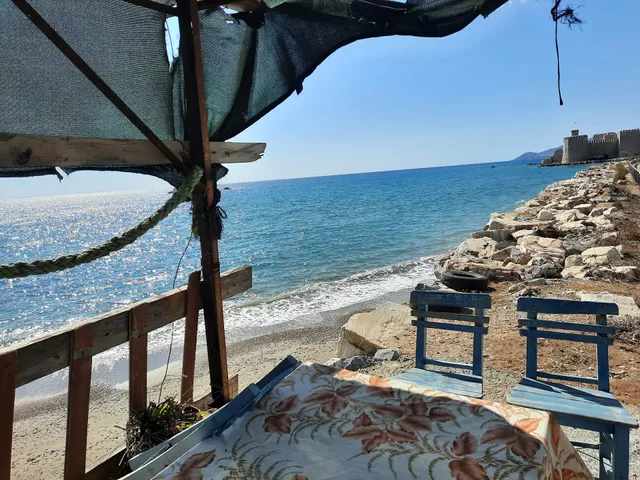
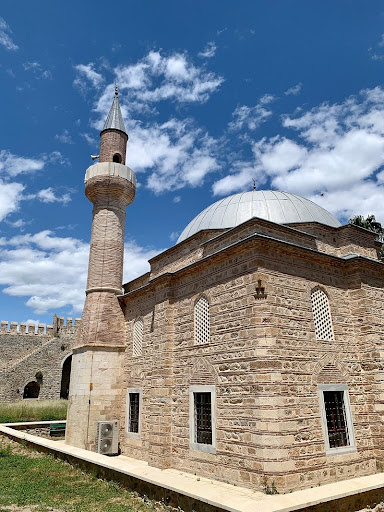
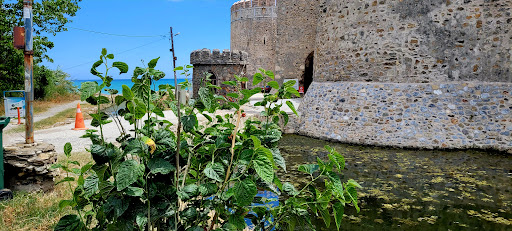
Mamure Castle is located at the Mediterranean Sea side, on the Antalya-Mersin Highway, 6 km south-east of Anamur and 216 km west of Mersin. The castle, covering an area of 23.500 m2, is one of the biggest and well-protected castles of Turkey. Although the exact construction date of the castle is uncertain, it is believed to have been built by the Romans either in the 3rd or the 4th century, due to the excavations conducted in 1988 by the Directorate of Anamur Museum. These excavations revealed archaeological remains that have mosaic floor covering which belong to a Late Roman city (3rd-4th c. A.D.) called “Ryg Monai”, a city not prominent in that period. On the other hand, it is also known as the outer protective castle of the Anamurium Antique City. The Castle was later on enlarged and used by the Byzantine Empire and the Crusades. When Anatolian Seljuk Sultan Aleaddin Keykubat I captured the ruins of the castle in 1221, he built a larger castle partially using the foundation of the former castle. It was later on incorporated into the realm of Karamanids. According to the work of Sikari (historian of the Karamanids), after Anamur and Taseli had been captured and destroyed by enemies, Mahmut of Karaman defeated them and then he captured the castle, repaired it again and renamed it as Mamure (prosperous). Although the exact date is uncertain, according to an inscription erected by _ brahim II of Karaman in 1450, the castle was captured during Mahmut's reign (1300–1308). In 1475, the castle was annexed by the Ottoman Empire. During the Ottoman reign, the castle was repaired in the 15th, 16th and 18th centuries and a part of the castle was used as a caravanserai. The castle is surrounded by a moat on the land side. The road on the rampart connects the 39 towers (4 of them are bigger than the others) and a lot of battlements to each other. There are 3 main yards within the castle; west, east and the south, which are separated from each other by high walls. In the yard at the west there is an outer castle, a small complex of a single minaret mosque, the ruins of a hamam (Turkish bath), a fountain, warehouses and cisterns. In the east, there is an inner courtyard which has 7 bastions in different shapes on the high wall constituting its northwest border. The bastions on the north-eastern part of it have been ruined together with the wall. In the yard at the south; there is an inner citadel built over the rocks, the main watch tower which has the best view with 22 meters height inside the biggest bastion, 5 more watch towers and ruins of a light house. The single minaret mosque which represents the characteristics of the 16th century Ottoman architecture was built by the Karamanids. The historic mosque is still functioning and has been renovated. The hamam which is located on the north of the Castle is also believed to have been built by the Karamanids. The entrance part of the hamam has been demolished but other parts are still intact.
Mamure Castle is over 1500 years old and ranks among the best-preserved Medieval Castles on the Mediterranean coast. It is an authentic medieval fortification with styles from different conquering armies; the Romans, Byzantines, Seljuks, Karamanids and Ottomans. Thus, it represents the culture of these civilizations. Besides, it has perfect location for defence as it is dominating visually the surrounding landscape and the sea. Mamure Castle represents an outstanding example of Medieval fortification in terms of the survival of historical stratigraphy. It illustrates significant stages in human history as it hosted many civilizations such as the Romans, Byzantines, Seljuks, Karamanids and Ottomans. The properties within the Castle, which are a mosque, a hamam, a fountain, warehouses and cisterns, have been built during the reign of different civilizations; therefore they have architectural characteristics peculiar to...
Read moreMamure Castle is one of Turkey’s most remarkable medieval fortifications, located near the town of Anamur in the Mersin Province.
The castle sits impressively on the Mediterranean coast, surrounded by palm trees and the sound of waves crashing against nearby rocks. Its silhouette dominates the landscape, offering panoramic views of both the azure sea and the lush countryside.
Dating back to Roman times, the castle has undergone several renovations and expansions throughout the centuries, most notably by the Byzantines, Seljuks, and Ottomans. This layered history is evident in its architecture.
Visitors can notice a fascinating blend of Roman foundations, Byzantine walls, and Seljuk battlements. Spread across approximately 23,500 square meters, Mamure Castle features thirty-nine towers, thick defensive walls, and a moat that, at one point, served as protection against invaders.
Walking through the castle grounds, the sense of stepping back in time is palpable. The inner courtyard is vast, often dotted with wildflowers, and contains remnants of old cisterns and baths, suggesting how self-sufficient the fortress once was.
The outer ramparts and watchtowers offer breathtaking vantage points for photography and contemplation, and it’s easy to imagine sentries keeping watch over the coastline centuries ago.
The castle’s preservation allows visitors to climb its sturdy staircases and peer out from arrow slits. Some areas, especially near the sea-facing walls, are rugged and weather-worn, showing the relentless effects of time and nature. Yet, overall, Mamure Castle impresses with its robust structure and historical ambiance.
There is a small mosque within the castle’s boundaries, believed to have been built during the Ottoman period, serving as further evidence of the site’s continuous use and importance.
Being in a remote location it is less crowded than many of Turkey’s other tourist destinations. The serenity of the castle, combined with the beauty of the surrounding landscape, makes it an ideal spot for those seeking tranquility as well as history. The drive from Anamur to Mamure Castle is scenic, passing through charming villages and coastal roads, enhancing the experience for visitors.
Mamure Castle is a testament to Turkey’s rich and diverse history, offering an immersive journey through the echoes of ancient empires, stunning views, and a chance to explore one of the best-preserved castles on the Mediterranean coast. The experience is rewarding for history enthusiasts, photographers, and anyone looking to connect with the past amidst...
Read moreMamure Castle is a remarkably well-preserved fortress on the Mediterranean coast, known for its impressive size and rich history. Built on the foundations of a Roman fort from the 3rd-4th century AD, the castle underwent numerous reconstructions by the Byzantines, Seljuks, and eventually the Ottomans, each leaving their unique architectural marks.
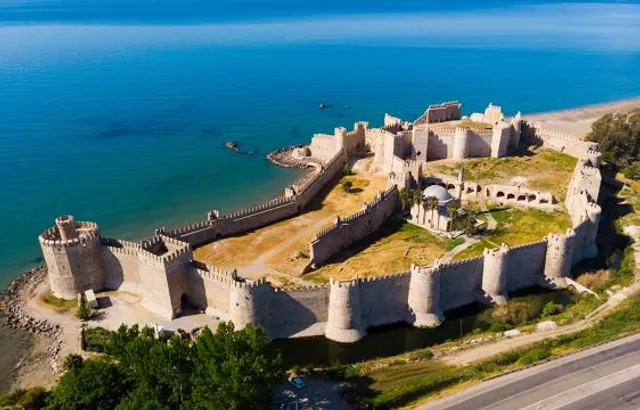
Visiting Mamure Castle is a true adventure. The castle is vast, with extensive walls and 39 towers offering numerous places to explore. Climbing to various levels, you can admire the fortress's grandeur and breathtaking views of the Mediterranean Sea and surrounding landscapes. A particular highlight is the opportunity to ascend the towers, though this is not an easy task—the narrow, steep stairs present a challenge but add excitement to the entire experience.
Inside the castle, you can see the rebuilt mosque, hammam, and cisterns, which provide a sense of life in ancient times. However, the most impressive experience is walking along the defensive walls, which testify to the strategic importance of this site in the past.
Overall, Mamure Castle combines fascinating history with stunning views. It is an excellent destination for history and architecture enthusiasts, as well as those seeking unique experiences and...
Read more