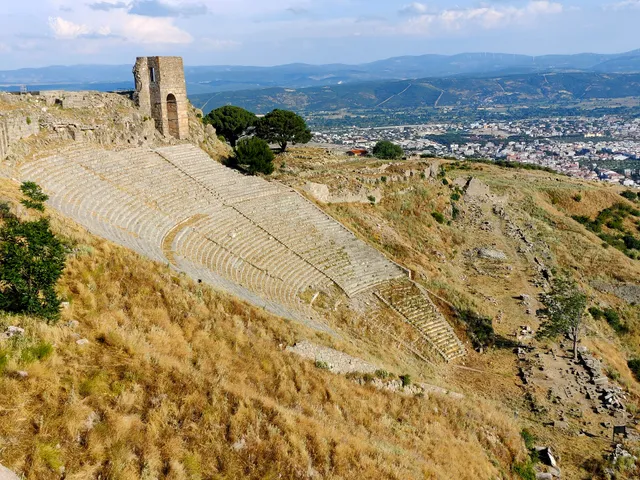
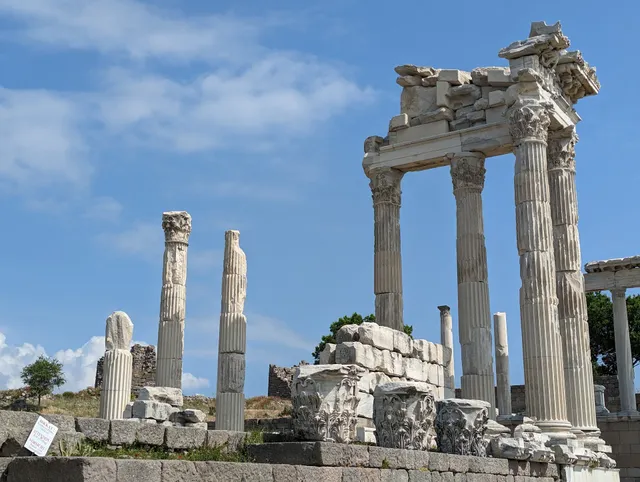
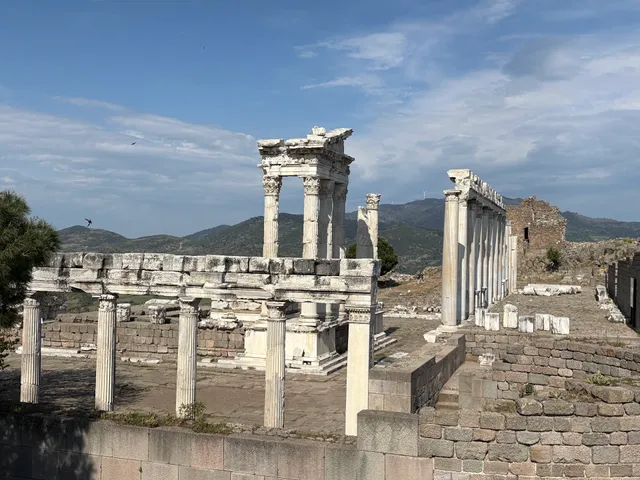
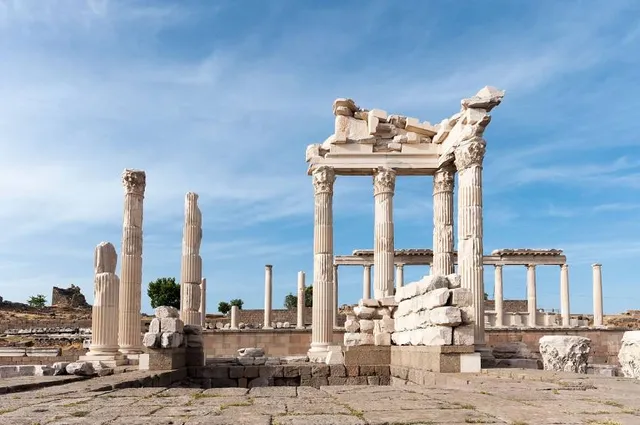
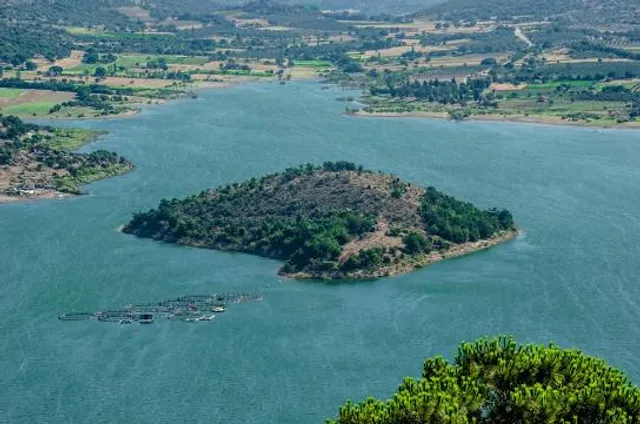
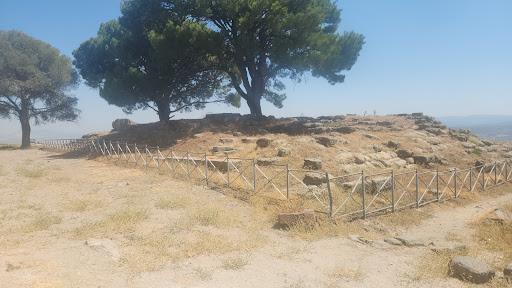
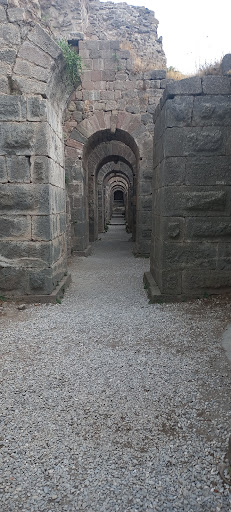
Pergamon lies on the north edge of the Caicus plain in the historic region of Mysia in the northwest of Turkey. The Caicus river breaks through the surrounding mountains and hills at this point and flows in a wide arc to the southwest. At the foot of the mountain range to the north, between the rivers Selinus and Cetius, there is the massif of Pergamon which rises 335 metres (1,099 ft) above sea level. The site is only 26 km from the sea, but the Caicus plain is not open to the sea, since the way is blocked by the Karadağ massif. As a result, the area has a strongly inland character. In Hellenistic times, the town of Elaia at the mouth of the Caicus served as the port of Pergamon. The climate is Mediterranean with a dry period from May to August, as is common along the west coast of Asia Minor.
The Caicus valley is mostly composed of volcanic rock, particularly andesite, and the Pergamon massif is also an intrusive stock of andesite. The massif is about one kilometre wide and around 5.5 km long from north to south. It consists of a broad, elongated base and a relatively small peak - the upper city. The side facing the Cetius river is a sharp cliff, while the side facing the Selinus is a little rough. On the north side, the rock forms a 70 metres (230 ft) wide spur of rock. To the southeast of this spur, which is known as the 'Garden of the Queen', the massif reaches its greatest height and breaks off suddenly immediately to the east. The upper city extends for another 250 metres (820 ft) to the south, but it remains very narrow, with a width of only 150 metres (490 ft). At its south en d the massif falls gradually to the east and south, widening to around 350 metres (1,150 ft) and then descends to the plain towards the southwest.
History
Pre-Hellenistic period
Settlement of Pergamon can be detected as far back as the Archaic period, thanks to modest archaeological finds, especially fragments of pottery imported from the west, particularly eastern Greece and Corinth, which date to the late 8th century BC.Earlier habitation in the Bronze Age cannot be demonstrated, although Bronze Age stone tools are found in the surrounding area.
The earliest mention of Pergamon in literary sources comes from Xenophon's Anabasis, since the march of the Ten Thousand under Xenophon's command ended at Pergamon in 400/399 BC. Xenophon, who calls the city Pergamos, handed over the rest of his Greek troops (some 5,000 men according to Diodorus) to Thibron, who was planning an expedition against the Persian satraps Tissaphernes and Pharnabazus, at this location in March 399 BC. At this time Pergamon was in the possession of the family of Gongylos from Eretria, a Greek favourable to the Achaemenid Empire who had taken refuge in Asia Minor and obtained the territory of Pergamon from Xerxes I, and Xenophon was hosted by his widow Hellas.
In 362 BC, Orontes, satrap of Mysia, used Pergamon as his base for an unsuccessful revolt against the Persian Empire.only with Alexander the Great were Pergamon and the surrounding area removed from Persian control. There are few traces of the pre-Hellenistic city, since in the following period the terrain was profoundly changed and the construction of broad terraces involved the removal of almost all earlier structures. Parts of the temple of Athena, as well as the walls and foundations of the altar in the sanctuary of Demeter, go back to the fourth century.
Possible coinage of the Greek ruler Gongylos, wearing the Persian cap on the reverse, as ruler of Pergamon for the Achaemenid Empire. Pergamon, Mysia, circa 450 BC. The name of the city ΠΕΡΓ ("PERG"), appears for the first on this coinage, and is the first evidence for the name of the city.
Coin of Orontes, Achaemenid Satrap of Mysia (including Pergamon), Adramyteion. Circa 357-352 BC
Hellenistic period
Image of Philetaerus on a coin of Eumenes I The Kingdom of Pergamon, shown at its greatest extent in 188 BC Over-life-size portrait head, probably of Attalus I
Lysimachus,...
Read more


 Learn more insights from Wanderboat AI.