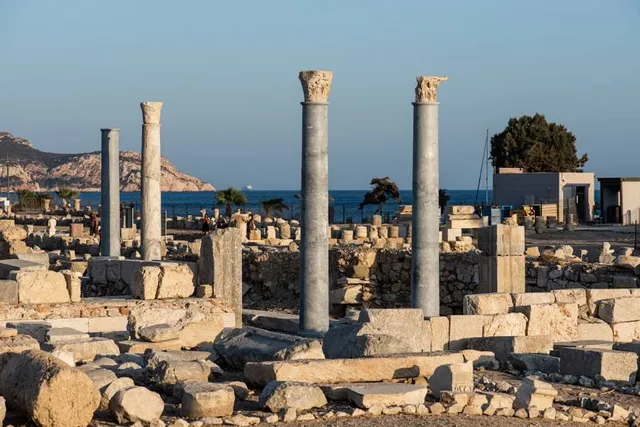
KNIDOS ANCIENT CITY Knidos, one of the rich and famous cities of the Classical Era world, is today 70 km. It was established on the Tekir Cape at the point where the Aegean and Mediterranean Seas meet at the far end of the Datça Peninsula. The ancient city of Knidos is one of the most important Western Anatolian coastal cities. It is within the borders of Yazı Village, Datça District of Muğla Province. It is connected to Datça by a road of 35 km, the last 8 km of which is stabilized. Sea transportation is done by excursion boats and yachts during the tourism season. Knidos was built on terraces both on the south-facing tip of the peninsula and on the northern slope of Kap Krio (Deve Boynu), which was originally an island but was turned into a peninsula over time. The city is surrounded by a strong fortification wall with round and angular towers. It is possible to see the best preserved parts of the fortification walls, which are thought to have been built in the 4th century BC, in the Acropolis. Outside the city walls, approximately 7 km to the east. There is a Necropolis (cemetery) spread over a wide area in length. A street extending in the east-west direction on the mainland on the axis, and below and above this road, public buildings, up and down theaters, Demeter Sanctuary, a small odeon, Aphrodite Temple, Corinthian Temple, Roman Tomb, Agora, Monumental Building, Hellenistic Stoa, Dionysus Temple and Byzantine Church, Roman Period Bouleuterion, Propylon and building remains such as stepped street are located. Strabo states that Knidos was founded along the coast and on the island in front of it. Later, the sea between the island and the land was filled, thus two separate ports were obtained. Of these, the smaller one in the north was called the "North Harbour". This port was used for military purposes. The southern port on the other side is reserved for trade ships. Today, the ruins of the breakwater that covers the harbor mouth and the tower in the northern harbor can be seen. The city of Knidos was established according to the grid plan of Hippodamos. Therefore, four wide streets parallel to each other in the east-west direction intersect with a steep street in the north-south direction. In accordance with the location of the land, streets and avenues sometimes crossed each other by stairs and...
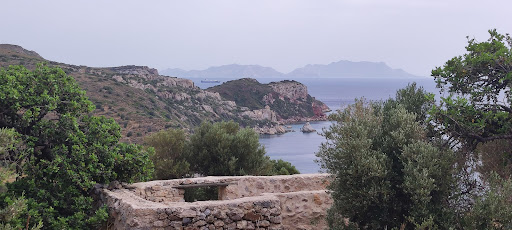
Read moreA very special open-air museum and ancient site. Located directly on the sea with a view of today's Greek islands from ancient Greece.
Knidos was an ancient city located in modern-day Turkey, which flourished during the Hellenistic and Roman periods. It was situated on the Datça Peninsula, at the intersection of the Aegean and Mediterranean Seas, which made it an important center for trade and commerce.
The city was famous for its architecture, especially the Temple of Aphrodite, which was one of the most important religious sites in the ancient world. The temple was built by the architect Sostratus of Cnidus and was adorned with many works of art, including the famous statue of Aphrodite by Praxiteles.
Knidos was also known for its medical school, which was founded by the philosopher Eudoxus in the 4th century BCE. The school was renowned for its studies in anatomy and physiology, and it produced many famous doctors and medical scholars.
The city was heavily influenced by Greek culture, and its architecture, art, and literature reflected this. However, it also had a diverse population, with many traders and merchants from other parts of the Mediterranean.
Unfortunately, Knidos was destroyed by an earthquake in the 4th century CE, and its ruins were largely forgotten until the 19th century when archaeologists began to excavate the site. Today, visitors can explore the ruins of the ancient city, including the remains of the Temple of Aphrodite, the theater, and the agora.
Overall, Knidos was an important center of culture, learning, and trade in the ancient world, and its legacy can still be seen in the ruins that...
Read moreKnidos Antik Kenti is a mesmerizing archaeological site nestled along the stunning coastline of Turkey. Steeped in history and surrounded by breathtaking natural beauty, this ancient city offers a truly unforgettable experience for history enthusiasts and nature lovers alike.
Walking through the ruins of Knidos is like stepping back in time, as you wander among the remnants of ancient temples, theaters, and streets that once bustled with life. The well-preserved structures provide a glimpse into the rich cultural heritage of this former Greek settlement, offering insights into daily life, trade, and architecture during antiquity.
Perched on the tip of the Datça Peninsula, Knidos boasts panoramic views of the Aegean Sea, making it a photographer's paradise. Whether you're exploring the remains of the iconic Temple of Aphrodite or admiring the intricate details of the ancient amphitheater, every corner of Knidos offers a photo-worthy moment against the backdrop of azure waters and rugged cliffs.
Aside from its historical significance and natural beauty, Knidos also offers visitors a tranquil escape from the hustle and bustle of modern life. The serene atmosphere invites contemplation and reflection, making it the perfect place to unwind and reconnect with the past.
Overall, Knidos Antik Kenti is a hidden gem waiting to be discovered. With its fascinating history, stunning scenery, and serene ambiance, it's an experience that will leave a lasting impression on all who visit. Highly recommend adding this extraordinary site to your...
Read more