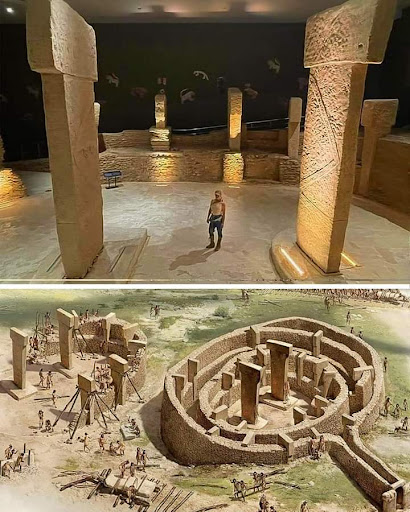
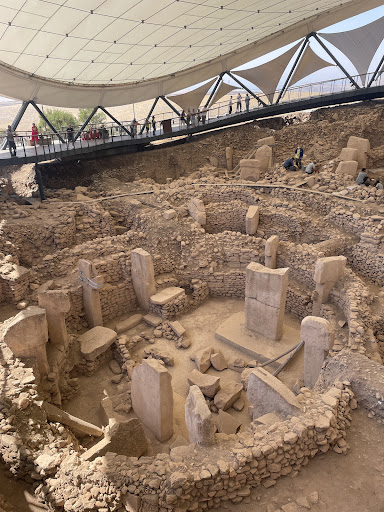
UNESCO World Heritage List in 2018 with its amazing monumental architecture. In Turkey, '' Göbeklitepe Year 2019 "was declared. Göbeklitepe, of which only a small part has been excavated, changed the history of humanity with its 12 thousand-year history. Göbeklitepe, which is considered to be the oldest and largest cult center in the world, proved the effect of religious belief on the transition to settled life.
Although a limited part of this prehistoric settlement that dominates the Harran Plain has been excavated, its extraordinary findings have disrupted much information about the Neolithic Age. The Göbeklitepe excavations near Örencik Village of Şanlıurfa were carried out by German archaeologist Prof. Dr. Klaus Schmidt launched it and lasted 20 years until his death in 2014. Gobeklitepe; He made important contributions to our understanding of hunter-gatherer life, the transition to agriculture and animal husbandry, temple architecture and the birth of art. Its existence is BC. It was abandoned after continuing until around 8 thousand. It has not been used for other or similar purposes.
The most interesting finds in Göbeklitepe are 'T' shaped monumental obelisks (Steller), which can reach 6 meters in length and 40 tons in weight. 10-12 of these mysterious obelisks are arranged in a circular plan and built with stone walls between them. A pair of large opposing obelisks in the middle and the obelisks around it form round or oval closed spaces. Although six of these places have been unearthed as a result of excavations, it is known that geomagnetic measurements found 20 of these places.
Most of the obelisks have human, animal or abstract symbols. In addition to these oldest reliefs carved into stone, three-dimensional animal reliefs are also found. The obelisks with hand, arm and finger motifs on their bodies are interpreted as stylized human sculptures. From the welcome section, the excavation area can be reached in one minute by shuttles. Animation and information at the entrance are unmissable. The excavation area, divided into A, B, C and D, has been surrounded by a walking tour route and covered.
Make sure to visit the Şanlıurfa Archeology Museum. Because the magnificent works of art and statuettes found in Göbeklitepe excavations are exhibited here. Leopard reliefs, wild boars, storks, foxes, gazelles, scorpions, snakes and headless human relief in the temple structures are important findings related to the belief of the period. In addition, an impressive replica of Göbeklitepe is waiting for its visitors in a...
Read moreThere are substantial grounds to claim that the most significant archaeological discovery of the 21st century is the Göbeklitepe. First of all, it dates back to 12 thousand years ago. In other words, it’s approximately 8 thousand years older than the pyramids and 7 thousand years older than the Stonehenge. Furthermore, it is even older than the human transition to settled life. Therefore, contrary to the widely held view, it proves the existence of religious beliefs prior to the establishment of the first cities.
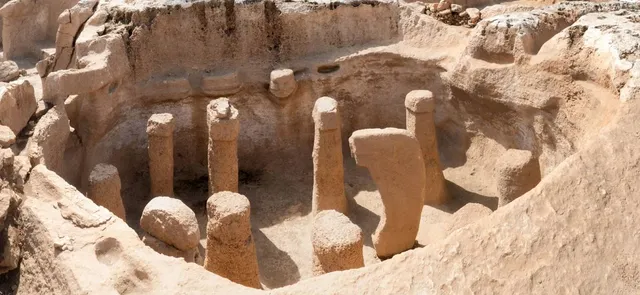
Findings of researchers at Göbeklitepe shows that a religious class existed even at such early ages, division of society into social classes took place well before the widely assumed dates, and perhaps the first agricultural activity may have been conducted in the region. The site is also remarkable with the first patriarchal thought, the first terrazzo flooring and the first statues and reliefs of the Neolithic Age. As a result, all this new information has been added to the collective knowledge of humanity and into the history books. On the merits of its contribution to human history, Göbeklitepe was inscribed to the UNESCO World Heritage List in 2018.
While the discovery of Göbeklitepe site took place in 1963, the first scientific excavation started in 1995, eventual findings of which added new pages to the history, changing long standing assumptions. Rather than being used as a settlement, the area actually served religious purposes and contain a number of temples. In that respect, it is not only the oldest centre of worship, but also the largest one. Although six of those temples were unearthed to date, on the basis of geomagnetic surveys, the total number of those monumental structures is believed to be twenty, with all temples sharing a resemblance to each other, making this entire region suggestive of being a centre of faith and pilgrimage during the Neolithic Age. There are six-metre-tall T-shaped stone pillars, carved with reliefs of animals, erected to form circles. Those carvings that maybe the earliest three dimensional depictions of animals carved into stone are testament to the artistic ability of our ancestors. Professor Klaus Schmidt, who had led the excavation work in the site for 20 years, firmly stated that the T-shaped stone pillars represented human figures since some of them have carvings of hands...
Read moreGöbekli Tepe (Turkish: [ɟœbecˈli teˈpe], Kurdish: Girê Mirazan or Xirabreşkê) is a Neolithic archaeological site located in the Southeastern Anatolia Region of Turkey. Here are some fascinating details about Göbekli Tepe:
Age and Inhabitants: The settlement was inhabited from approximately 9500 BCE to at least 8000 BCE during the Pre-Pottery Neolithic period. It represents one of the oldest known permanent human settlements in the world.
Monumental Structures: Göbekli Tepe is famous for its large circular structures that contain massive stone pillars—the world's oldest known megaliths. These structures were probably used in connection with rituals, most likely of a funerary nature. The distinctive T-shaped pillars, some up to 5.50 meters tall, are carved with images of wild animals and provide insights into prehistoric religion and iconography.
Archaeological Significance: The site is located in Upper Mesopotamia, a region where the earliest farming communities emerged. Göbekli Tepe demonstrates innovative building techniques and the integration of decorated T-shaped limestone pillars. The imagery found at Göbekli Tepe is also seen at contemporaneous sites in the Upper Mesopotamian region, suggesting a close social network during this core period of Neolithization.
Purpose and Debate: No definitive purpose has been determined for the megalithic enclosures. Some interpret it as a sanctuary used by nomadic hunter-gatherer groups, while others consider it a settlement. Göbekli Tepe challenges our understanding of the Neolithic Revolution—whether farming led to settled communities or vice versa.
Engineering Marvel: The monolithic T-shaped pillars were carved from adjacent limestone and showcase advanced architectural and engineering technology. They likely bear witness to the presence of specialized craftsmen and possibly the emergence of more hierarchical forms of human society.
Göbekli Tepe remains a captivating mystery, offering glimpses into our ancient past and the complex interplay of culture, religion, and...
Read more