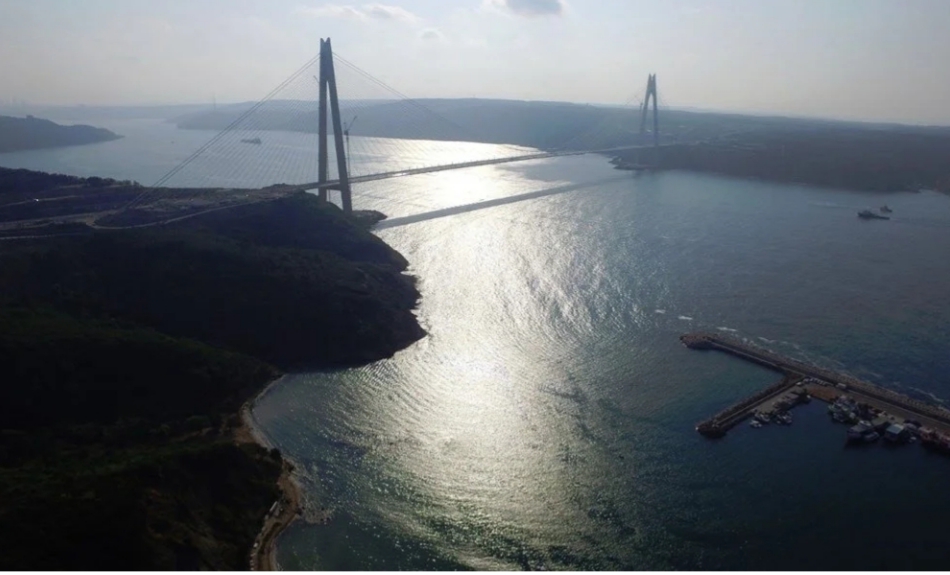
The Yavuz Sultan Selim Bridge (Turkish: Yavuz Sultan Selim Köprüsü) is a bridge for rail and motor vehicle transit over the Bosphorus strait, to the north of two existing suspension bridges in Istanbul, Turkey. It was initially named the Third Bosphorus Bridge (with Bosphorus Bridge being the First Bosphorus Bridge and Fatih Sultan Mehmet Bridge the Second Bosphorus Bridge). The bridge is located near the Black Sea entrance of the Bosphorus strait, between Garipçe in Sarıyer on the European side and Poyrazköy in Beykoz on the Asian side.
The foundation stone laying ceremony was held on 29 May 2013. The bridge was opened to traffic on 26 August 2016.
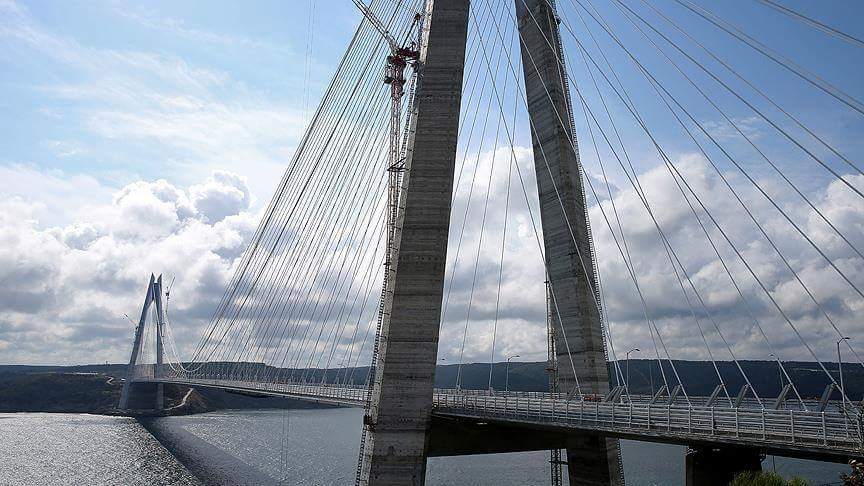
At 322 m (1,056 ft), the bridge is one of the tallest bridges in the world. After the Millau Viaduct in France and the Pingtang Bridge in China, it is the third-tallest bridge in the world of any type. The bridge is also one of the world's widest suspension bridges, at 58.4 metres (192 ft) wide.
ProjectEdit
See also: Northern Marmara Motorway
The bridge is part of the projected 260 km (160 mi) Northern Marmara Motorway (Turkish: Kuzey Marmara Otoyolu), which will bypass urban areas of Istanbul in the north connecting Kınalı, Silivri in the west and Paşaköy, Hendek in the east. The 58.4-metre-wide (192 ft) bridge is 2,164 m (7,100 ft) in length with a main span of 1,408 m (4,619 ft). The main span is the ninth longest suspension bridge in the world.
Designed by the Swiss engineer Jean-François Klein (project leader) and by the French structural engineer Michel Virlogeux from T-ingénierie (a Geneva-based company), the bridge is a combined road-rail bridge. It carries four motorway lanes and one railway line in each direction. The construction was carried out by a consortium of the Turkish company İçtaş and the Italian company Astaldi which won the bid to construct the structure on 30 May 2012. The budgeted cost of the bridge's construction was 4.5 billion TRY (approximately US$2.5 billion as of March 2013). The construction was originally expected to be completed in 36 months with the opening date scheduled for the end of 2015.
On 29 May 2013 then Prime Minister Recep Tayyip Erdoğan directed the construction management team to finish the construction within 24 months, and projected an opening date for 29 May 2015.
The bridge toll is set to be 9.90 between the motorway exits Odayeri and Paşaköy. It is expected that at least 135,000 vehicles will use the bridge daily in each direction. Minister of Transport and Communication Binali Yıldırım stated that of the total area to be nationalised for the bridge project, 9.57% was private property, 75.24% was forested land, and the remaining 15.19% was already state-owned land.[13]
In June 2018, in the course of the Turkish currency and debt crisis, Bloomberg reported that Astaldi, an Italian multinational construction company, was poised to sell its stake in the flagship Yavuz Sultan Selim Bridge project for $467 million. The project had failed to meet projections, requiring Ankara to boost operators' revenue from treasury coffers, and since early 2018 the partners in the joint venture sought restructuring of $2.3 billion of debt from creditors. On July 30, 2018, China's ICBC is authorized as the lead regulator to refinance the $2.7 billion current loan...
Read more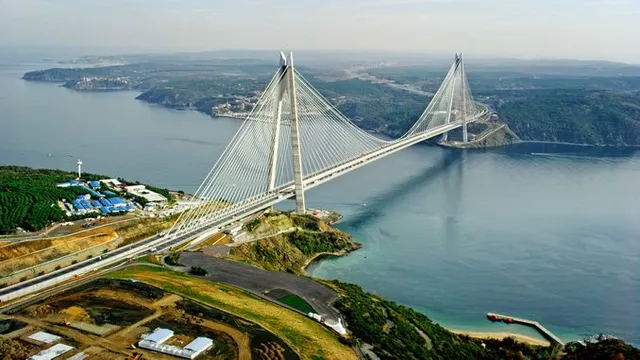
 Learn more insights from Wanderboat AI.