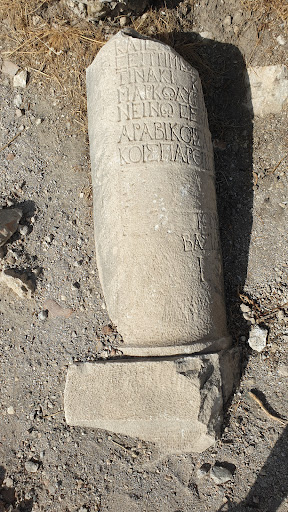
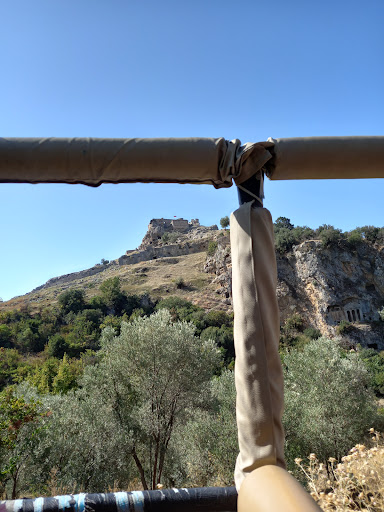
Tlos - Mugla The ancient writer Panyasis introduces Tlos, Pınara, Xanthos and Kragos, all cities in the Xanthos valley, except Kragos, as the children of Praxidike and Tremile, a nymphe. Tlos is the same city as Dlawa in the lands of Lukka in the Hittite texts in the 14th century BC, Tlawa in the Lycian inscriptions in the later period, and the city of Tlos in the Greek texts, and that its foundation is in the II. It is considered to have gone up to thousands. When approaching the city, the dominant view of the acropolis greatly affects the visitors. The surrounding of the acropolis hill, which is naturally sheltered by steep slopes, has been fortified with fortifications from place to place. The early period city walls and rock tombs in the north-east direction of the acropolis are examples of Lycian culture. The fortification walls, which are mostly observed in the eastern and south-eastern parts, were built in the Roman period and were repaired in the Byzantine period using the materials of many buildings and even some sarcophagi. The Late Period structures built with spolia stones at the top are the walls of a brain settlement commissioned by the Ottoman Empire in the 19th century. The ruins mentioned above are interesting in that they exhibit the cultural phases of the acropolis hill simultaneously in a narrow space. On the eastern slope of the acropolis, there is a stadium where crepis can be counted up to 12 rows of seats that continue parallel to the city walls in the area that forms the support of the carefully worked Roman period city walls. The building groups observed across the stadium belong to the Roman Period and must belong to the agora and its sections, although their functions cannot be clearly expressed today. The remains we observed in the southern part of this area belong to the gymnasion, palestra and bath structures. On the east of the site, there is a theater from the Roman Period, mostly built on vaulted galleries. The stage building of the theater with a single diazoma survived up to the third floor of the northern section. The Lycian inscription blocks in the northern paradox must have been used as spolia at the time of expansion or repair. To the south of the stadium, at a point overlooking the Xanthos valley, there is a three-storey bathhouse built during the...
Read moreFantastic experience at Tlos. Spectacular ruins, currently under excavation and reconstruction, from the Lycian era, passing through the influence of the Persian, Roman and Ottoman Empires over the ages. Local excavations have suggested that there were settlers in the area as early as the 15th century BC.
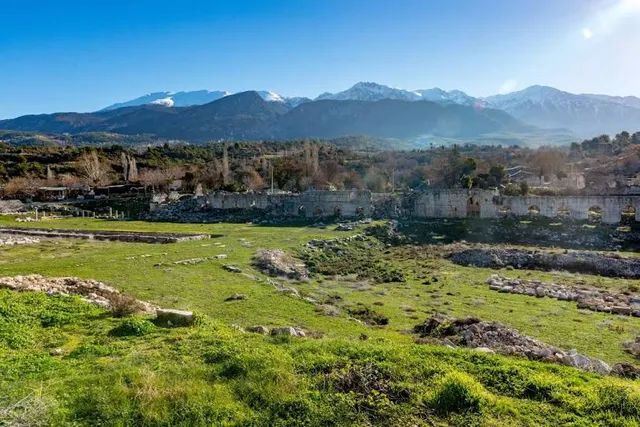
Not as developed in terms of tourist amenities, compared to Patara, but I would argue that it's more visually stunning, as all of the currently unearthed ruins and tombs are within a relatively small area and can be seen in one stunning panoramic vista. The site includes an Amphitheatre, Stadium and tombs carved into the rock face.
A special mention has to go to the gentleman who sells hand carved ornaments, and who took the time to sit with my Wife and I, whilst we had a cooling drink, and discussed the fascinating history of the site at length. He truly was a fountain of knowledge. I could have spoken to him for hours, but unfortunately the searing heat was melting my will to live.
In summary, highly recommend if you like your history and architecture. Be warned though, there is little shade, so bring plenty of water, although there is a small cafe serving reasonably priced drinks. A hat and sunscreen are also essential.
It's clear that Tlos will only improve with time, as excavations continue, so it will be interesting to see the changes in the...
Read moreWhy this isn't more advertised baffles me. We went to it as we we were passing close by, expecting to spend 30mins or so having a look around. In the end we spend many hours examining an elaborate site of an ancient city that rivals anything you will see in Greece or Italy. The area is a complete ancient metropolis without any imposition of modern structures. Though some areas are of limits due to it still being excavated what you can see is impressive in its scope. Climb the Acropolis for some stunning views of what would have being this cities fertile hinterland. With the mountains in the background and the lush wooded slopes it is serenely beautiful. Maybe because it is not so well known it was also sparsely visited when we were there which added to the peaceful quality we enjoyed resting and taking in the view. We were hiking that day and so had hiking boots. I would recommend a pair for this site to enjoy to the maximum as it is strewn with small and medium rocks. There are very few paths without these obstacles. Every aspect of ancient Lycian, Hellenic and Roman city life is represented...
Read more