Bwindi Impenetrable Forest National Park, located in southwestern Uganda, is a natural wonder that lives up to its name. Viewing this extraordinary UNESCO World Heritage Site through a detailed map unveils not only its thick vegetation and rugged terrain but also the intricate network of trails, villages, and conservation zones that define the park's character.
The first impression from the map is the sheer density of the forest. The park spans over 321 square kilometers and is mapped as a patchwork of steep ridges, narrow valleys, and deeply forested slopes. The topography is clearly rugged, with altitude levels ranging from about 1,160 to over 2,600 meters. The elevation contours and shading help highlight just how mountainous this rainforest is, which contributes to its status as a biodiversity hotspot.
The map efficiently marks out the major sectors of the park: Buhoma in the north, Ruhija in the northeast, Rushaga and Nkuringo in the south. These sectors are vital access points for gorilla trekking, and each is shown with clear labels indicating ranger posts, lodges, and trailheads. The division of sectors is not just for orientation—it’s also critical because gorilla families are habituated to specific areas, and permits are issued per sector. The map reflects this structure well, allowing travelers to plan logistics accordingly.
Several hiking trails are marked, including the Munyaga River Trail, Waterfall Trail, and Rushura Hill Trail in the Buhoma sector. These are crucial for visitors interested in forest walks and bird watching. The network of footpaths is woven through the forest and often follows natural features such as streams and ridge lines, which are visible on the map. The Impenetrable aspect of the forest is tangible even in map form—it is a maze of green, intersected by only a few narrow access routes.
Community boundaries and nearby villages such as Kanyanchu and Rubuguri are also shown, underlining the coexistence of conservation and local livelihoods. This is significant, as community-based tourism is central to Bwindi’s success story. The map subtly reflects how conservation areas and human settlements lie side-by-side, emphasizing the delicate balance between protecting endangered mountain gorillas and supporting local economies.
Water sources such as rivers and waterfalls are also marked, important not just for navigation but also for understanding the ecology of the area. These freshwater sources help sustain the thick forest and are lifelines for the fauna.
From a practical standpoint, the map includes access roads from Kabale and Kisoro, the two main towns that link Bwindi with the rest of Uganda. Road conditions are rough, and this is depicted with line textures indicating gravel or unpaved roads, a useful touch for visitors planning overland journeys.
Overall, the map of Bwindi Impenetrable Forest National Park is both informative and inspiring. It captures the intense greenery, complex topography, and structured eco-tourism approach of one of Africa’s most biologically rich and emotionally moving destinations. Whether you're tracking gorillas or exploring its misty trails, the map sets the stage for a true...
Read moreWe chose gorilla trekking in Uganda as it was much cheaper than Rwanda, and safer than Congo. We were very impressed, and would happily do it again, although at that cost, it's a once-in-a-lifetime experience for us.
Our morning started at Ruhija with a dance by some of the locals before a briefing about the trek. You can then opt for a porter and pick a walking stick for the trek (highly recommended). The porter is optional, but you support the community by hiring one.
Groups get divided according to fitness levels, and each group gets assigned a family of gorillas to track for the day. Each morning, a group of trackers are sent out to find your gorilla family. You head in their general direction until they know where the gorillas are, so you start on large well-used paths, and slowly branch off onto smaller paths as you get closer. The final stretch is usually bushwhacking on steep, sometimes slippery terrain (this is where the walking stick comes in).
The time can vary greatly depending on a number of factors. Your allocated family may be be near or far, they may be moving away or towards you as you're walking, and the trackers may have issues finding them quickly. As a result, you may find them within an hour, or it could turn into a 10 hour trek. So go prepared with enough water and food for the day.
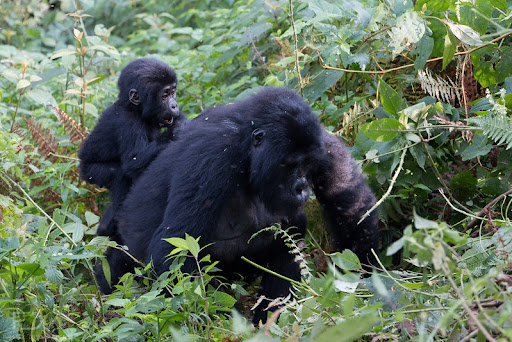
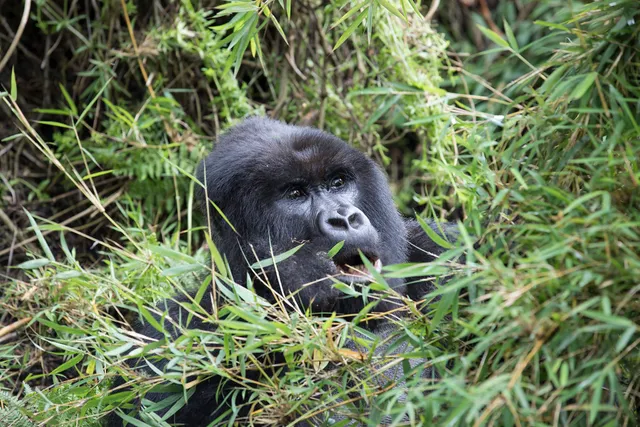
You spend an hour with the gorillas, and it was truly amazing seeing such rare creatures in the wild. The babies stole the show, and you get to within a few metres of them!
Our guide was good, informative, and communicative (something many guides in Uganda were not). If you plan to tip, be aware that we actually had a team of 7 people - a main guide, two escorts for safety/security, and four trackers that you meet when you reach the gorillas.
The terrain can be quite hard going, especially once you break away from the path - it's steep and slippery (from damp vegetation), but is quite doable if you're moderately fit. I would not attempt this if I were not an active person, although they may assign you an easy/close group of gorillas. I believe you can also opt for an "African Helicopter" where they will stretcher you in and out for something like 300 USD. This makes it accessible to disabled people or people who would otherwise not be able to make the hike.
All-in-all a brilliant trip, and highly...
Read moreIn 1991, the Pygmy (a.k.a. Batwa) people who had lived in harmony with the forest as nomadic hunter-gatherers for thousands of years, were evicted from the forest in the name of Conservation, with the justification of them being "gorilla-hunters" which was false. We felt very conflicted because it is vitally important to conserve the forests, both for the animals (including but not limited to gorillas) and for the wellbeing of all humans, especially in a country where virtually every other inch of land is farmed, and that which is forested is timber plantations of pine and eucalyptus. But conservation could easily have coexisted with the ongoing presence of the Pygmy people in their ancestral lands, given that they were not farming nor traditionally hunting gorillas, and lived in an almost infinitely more sustainable way to those of us reliant on agriculture. They even remained living in the forests in the 1930s when the land was officially allocated for environmental protection (but claimed by the colonial government). The issue with this National Park is that the government in 1991 saw an opportunity to make huge amounts of money from tourism to see the gorillas and instead of working with the Pygmies to conserve the forest and the gorillas, they forced them out, and all this with no compensation, no provision of alternative land, no education of how to live outside the forest, and no respect for their knowledge of the forest, medicinal plants and understanding of the animals. From our discussion with local people, we have learned that the alleged 10% of money from the gorilla tracking fees that goes to the local people is almost entirely a lie, and you can see that for yourself in the living conditions of people who, if they were receiving 10% of the 800 USD per person fee to track gorillas, would be very well-off. I have no doubt that the people working in the park are extremely knowledgeable and passionate about the incredible forest, and I am positive that the forest being a protected area is absolutely vital, but the way the situation and indigenous people have been abused by the government is appalling. My decision to not visit this awesome place, and to publish this review, is my small way of trying to make this issue heard when it is so well hidden from the tourists who are just trying to...
Read more