You MUST go!
If you are in the UAE, the Mleiha Archaeological Centre is an absolute MUST go-see-do! The centre brings together the best of all worlds.
Nature, flora, fauna The centre is located in the picturesque desert of Sharjah where the majestic, golden dunes sweep against rocky outcrops that date as far back as 70-90 million years. These are home to a plethora of fossils. There is also desert wildlife – as a quick look at the tracks in the dunes will reveal the nocturnal hunts of the Arabian red fox. The Mleiha landscape is also dotted with flora – some indigenous to the UAE like the ghaf and sidr trees.
Adventure You can learn about all these things and more through the different tours they offer. There is also desert exploration in a 4X4 – a gentle ride, or dune bashing or a dune buggy tour for the adrenaline junkie. We’ve enjoyed both options in a 4x4 and the hair-raising, scream-inducing dune bashing is a favorite of mine.
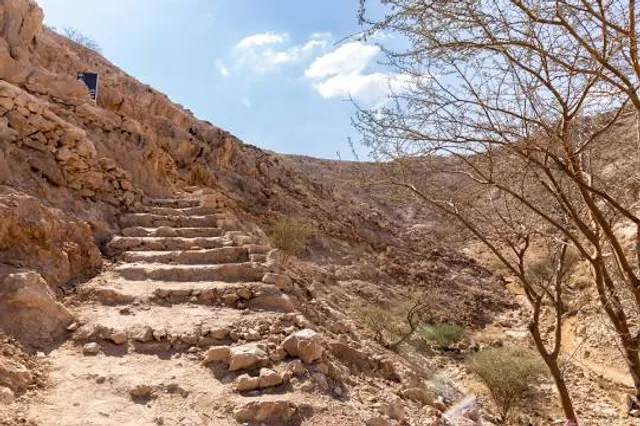
You can also explore the outcrops – Fossil Rock and Camel Rock – in other ways. You can trek or go on horseback. In addition to the horseback tours, the centre offers training as well. I’ve started those and the trainer Ahmed Sarhan is excellent: gentle, patient, firm, attentive, present, and clearly passionate about horses.
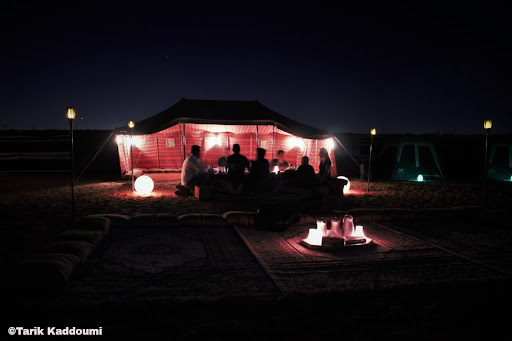
If you’re like me and you can’t get enough – you have the choice of camping overnight. It is great! You just show up and they have everything ready for you: tent with inflatable mattress and sleeping bag, majlis seating area - both covered and under the stars - a campfire set-up, dinner with grills, dips, and salads, and breakfast in the morning. I can’t say enough how fulfilling this experience is.
History, archaeology, geology You can also learn about the precious archaeological finds at the centre’s excellent museum. Honestly, there is so much to learn, I’d like to keep going back – and take copious notes! The reason why this particular site is unique, not just in the region, but in the world, is because it has not one, but TWO Stone Age settlements: Paleolithic and Neolithic. In addition to this, the centre has some outdoor archaeological sites too, all worth a visit, like Umm an-Nar Tomb and the Bronze Age Tombs at Jebel Faya.
You can also learn a lot about the region’s tectonic past through the rock outcrops throughout Mleiha. They tell a fascinating story. Picture yourself on a mountain, placing your palm on the fossilized shell of a marine creature from 70 million years ago. It’s mind-blowing.
Astronomy There’s tech too in the form of a powerful telescope. We don’t just look at the earth, we also look at the skies. The centre offers stargazing and if it’s your kind of thing and have a smart phone or camera with you, you can take incredibly beautiful photos of the moon through the telescope. If you’re a passionate photographer, there’s plenty to photo document during the day and night. The last time we went our guide used his camera lens to zoom into the nest of Bonellis’ eagles high on top of one of the mountains. We even heard the chick’s cries echoing during the night as we sat around the campfire.
Workshops As if it weren’t enough to experience all this wondrousness first hand, the centre also offers a variety of workshops.
In conclusion All these are available in both readymade and customizable packages.
I first went to Mleiha with family and friends in 2015 and I’ve kept going back. There is so much to see, do, learn, and the centre keeps updating and upgrading the experiences so that every time we go there we are so comprehensively enriched, we just can’t wait for the next time! Through it all, we’ve had the expert guidance of Anurag Amin whose knowledge and passion for the region’s history, geology, archaeology, and wildlife are in itself a pleasure to experience. Over the years Anurag has organized and lead our experiences at Mleiha with dedication and excellent attention to detail.
It’s not an exaggeration to say that when we have visitors, we make sure we take them to Mleiha for an...
Read moreMeliha Archaeological Centre is a visitor centre and exhibition based around the history and archaeology of the areas surrounding the village of Mleiha in Sharjah, the United Arab Emirates. Built around a preserved Umm Al Nar era tomb,the centre details the excavations and discoveries made over the past 40 years at Mleiha and surrounding areas (including Al Thuqeibah, Jebel Faya, Al Madam and Jebel Buhais), particularly the important Faya North East find, which provides evidence that 'anatomically modern humans' were in the Mleiha area between 130,000 and 120,000 years ago. These finds point to the spread of humanity from Africa across the Red Sea to the Persian Gulf region, and onward to populate the world through Iran, India, Europe and Asia. The centre was opened on 24 January 2016 by the Ruler of Sharjah, Sheikh Sultan Bin Muhammad Al Qasimi.The multi-phase eco-tourism development is intended in future to comprise accommodation, a campsite and an astronomical observatory, with a total investment of some UAE Dhs 250 million. It will also include the development of a 450 km desert park. The centre was developed by the Sharjah Investment and Development Authority (Shurooq) The widespread archaeological evidence unearthed throughout the Mleiha area dates back as far as the Palaeolithic period, some 130,000 years ago.[5] This would place the habitation of the area firmly within the time when it is thought anatomically modern human communities first left Africa and started to expand globally.
Later, as the last Ice Age gave way warmer climates, graveyards and adjacent settlements have been found which point to Neolithic communities who lived there from 11,000 years ago, with finds of tools at the location consistent with the Neolithic Ubaid or Arabian Bifacial tradition of 5,000-3,100 BCE. Civilization evolved during the succeeding Bronze Age from 3,000 BCE onwards, with elaborate communal tombs found at Mleiha, including the Umm Al Nar tomb, a feature is notable by its absence at the nearby necropolis of Jebel Buhais which otherwise represents uninterrupted evidence[6] of human burial throughout the known periods of human settlement in the area.
The centuries that followed witnessed the introduction of the underground falaj irrigation system and the cultivation of dates and other cereal crops. The widespread archaeological evidence unearthed throughout the Mleiha area dates back as far as the Palaeolithic period, some 130,000 years ago.This would place the habitation of the area firmly within the time when it is thought anatomically modern human communities first left Africa and started to expand globally.
Later, as the last Ice Age gave way warmer climates, graveyards and adjacent settlements have been found which point to Neolithic communities who lived there from 11,000 years ago, with finds of tools at the location consistent with the Neolithic Ubaid or Arabian Bifacial tradition of 5,000-3,100 BCE. Civilization evolved during the succeeding Bronze Age from 3,000 BCE onwards, with elaborate communal tombs found at Mleiha, including the Umm Al Nar tomb, a feature is notable by its absence at the nearby necropolis of Jebel Buhais which otherwise represents uninterrupted evidence of human burial throughout the known periods of human settlement in the area.
The centuries that followed witnessed the introduction of the underground falaj irrigation system and the cultivation of dates and other...
Read moreWant experience the UAE in its originality? Understand the lives of its inhabitants before it was a rising star on the global map? Interested in seeing the sands of time shift with every passing moment under the starry skies, than Mleiha Archaeological Center is the place to go! I booked the non-exclusive package for the overnight stay and I did not regret it a single bit. The price may seem a bit too much, but for what you get - it is so worth it. Peace, quiet, the silence of the night, a bonfire and a lesson in celestial wonders. With our package came a tent equipped with air beds, the tent was awesome too. A huge carpet with pillows and a small table outside our tent, regular Mleiha staff patrolling the area to see if guests need anything, a well maintained washroom and you can even grill your own food (which we did!). There was an astronomical star-gazing session, where seasoned astronomers told us about the beautiful heavens and we could spot venus, Jupiter and Saturn, sights I'll never forget, theough scientific telescopes positioned to see the skies in all its glory. The next morning we were taken to see the beautiful sunrise and boy, was it awesome. Breakfast was provided. My honest opinion is to opt for transportation provided by the centre due to its location, the drivers pick and drop you to your doorsteps and are warm and friendly. My SPOC was Nada and she was so helpful and prompt, our driver was Shah Jahan. Overall, a unique way to maintain treasures of the past by actually living in the same sands of eras gone by. Truly this place is a lesson in how, even barren landscapes hold rich histories. An additional tip: opt for a visit to the museum to add depth to your stay there and to know more about how people lived, what they revered and how the place holds a rich position in...
Read more