The fort was the last outpost of Al Qasimi resistance to British forces in 1819,[2] when a punitive expedition was sent from Bombay to quell the troublesome seafaring tribe, who had committed 'piracy and plunder' according to the British.
Ras Al Khaimah fell to the British force on 9 December 1819.[3] Following this, three ships were sent to blockade the nearby village of Rams to the North. They landed a force on 18 December, which fought its way inland through date plantations to the hilltop fort of Dhayah on the 19th. There, 398 men and another 400 women and children held out, without sanitation, water or effective cover from the sun, for three days under heavy fire from mortars and 12-pound cannon.
The hilltop fort of Dhayah, in Ras Al Khaimah, UAE. The two 24-pound cannon from HMS Liverpool which had been used to bombard Ras Al Khaimah town from the landward side were once again pressed into use and dragged across the plain from the coast at Rams, a journey of some four miles. Each of the guns weighed over 2 tonnes. After enduring two hours of sustained fire from the big guns, which breached the fort's walls, the last of the Al Qasimi surrendered at 10.30 on the morning of 22 December.[4]
Many of the people in the fort were herders and farmers from the date groves of Dhayah who had fled there on the arrival of the British and of the 798 people who surrendered, only 177 were identified as fighting men. The British flag was briefly flown from the fort before it was blown up. British losses from the action at Dhayah included 1 officer and 3 men killed and 16 wounded.[5]
The British expeditionary force then blew up the town of Ras Al Khaimah and established a garrison there of 800 sepoys and artillery, before visiting Jazirat Al Hamra, which was found to be deserted. They went on to destroy the fortifications and larger vessels of Umm Al Qawain, Ajman, Fasht, Sharjah, Abu Hail, and Dubai. Ten vessels that had taken shelter in Bahrain were also destroyed.[6] The Royal Navy suffered no casualties during the action.[3]
The Sheikh of Rams and Al Dhaya (named on the treaty as the 'Sheikh of Zyah'), Hassan bin Ali, was a co-signatory of the General Maritime Treaty of 1820, which established peace followed the cessation of hostilities.[7] That treaty between the British and the Sheikhs of what was formerly known as the Pirate Coast and what would become known as the Trucial Coast led to the establishment of what is known today as the United Arab Emirates (UAE).
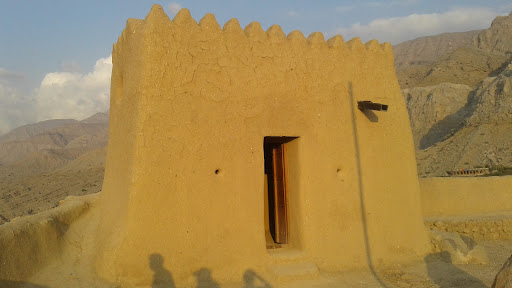
The ground area of Dhayah Fort. Two small buildings stand at either end. Further fortifications Edit A larger fortification constructed from mud bricks sits at the foot of the hill. This 'Sur' was used as a retreat for local people. A third element of fortification at Dhayah are watchtowers in the palm groves. Between the three fortifications, the area was rendered secure against local conflict, if not so against the large British guns.[8]
The fort is unusual in that it is the highest hilltop fort (as opposed to tower or lookout post) in the UAE.[1] It commands 360 degree views of the surrounding lush wadiscape and plains. Remains in the area to the base of the hill at Dhayah show the area was inhabited as far back as the Wadi Suq period.[1]
Dhayah fort as it stands today was rebuilt after 1819 and restored in the 1990s. A relatively small fortification, it lacks a natural source of water.[8] By the time of J. G. Lorimer's survey of 1906, the area of Dhayah was...
Read moreDayah Fort in Ras Al Khaimah (RAK) is a remarkable testament to the region's rich history and architectural legacy. Situated atop a rocky outcrop, this ancient fortress offers visitors a captivating journey into the past, providing a glimpse into the strategic importance and defensive prowess of the area.
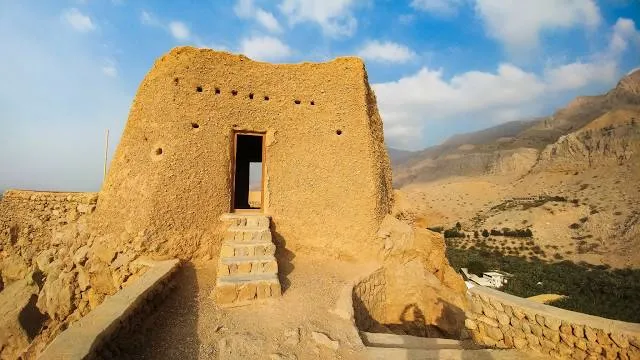
Approaching Dayah Fort, one is immediately struck by its commanding presence against the rugged landscape of RAK. The fort's sturdy walls and imposing towers stand as silent sentinels, evoking a sense of awe and admiration for the craftsmanship and ingenuity of its builders.
Stepping through the fort's gates, visitors are transported back in time, as they explore the labyrinthine passageways, hidden chambers, and towering battlements that once echoed with the sounds of ancient conflicts. The fort's well-preserved architecture and intricate details offer a fascinating glimpse into the military strategies and daily life of the past.
From the vantage points of Dayah Fort's ramparts, visitors are treated to breathtaking views of the surrounding landscape, with rugged mountains, lush valleys, and the shimmering waters of the Arabian Gulf stretching out before them. It's a scene of natural beauty that perfectly complements the historical significance of the fort itself.
In addition to its architectural and historical significance, Dayah Fort serves as a cultural hub, hosting events, exhibitions, and educational programs that celebrate the heritage and traditions of Ras Al Khaimah. Visitors can immerse themselves in the rich tapestry of RAK's culture through art, music, and interactive experiences, gaining a deeper appreciation for the region's unique identity.
Overall, a visit to Dayah Fort in Ras Al Khaimah is a must for history enthusiasts, culture lovers, and curious travelers alike. With its ancient walls, panoramic views, and vibrant cultural scene, Dayah Fort offers a truly unforgettable experience that illuminates the rich tapestry of Ras Al Khaimah's past...
Read moreDhayah Fort, a castle-like structure, is on the UNESCO World Heritage Tentative List and stands proud amidst the arid mountains and fertile date wadis of northern Emirate Ras Al Khaimah. The fort forms the centre of this lush oasis and boasts spectacular views from the mountains across palm trees and verdant lands to neighbouring Oman and down to the sea.
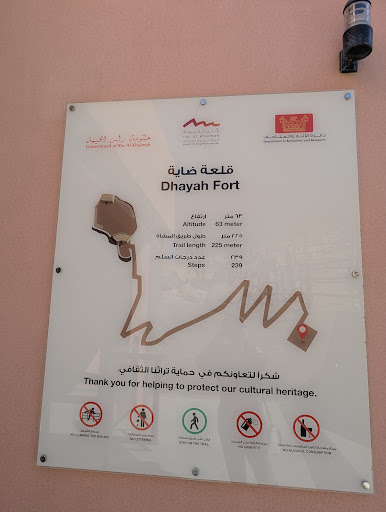
Dhayah Fort is the only hill fort remaining in the United Arab Emirates. It dates back to the Late Bronze Age (1600 – 1300 BC) when locals used it for settlement and fortification. The twin-peaked golden mud-brick fortress was built during the 19th century and restored in the late 1990s. It is an important historical monument where the 1819 battle between British troops and local Qawasim tribes took place. It’s worth climbing the zigzagging steps to bear witness to the spectacular views.
At the base of the hill lies a slightly larger fort used by people that lived and worked in the palm gardens. They would retreat here with their animals in times of danger. Single watchtowers are peppered throughout the fertile oasis of Dhayah to ensure optimal communication.
The fort stands on a 70-metre high hill that rises grandly between the date palm gardens and the Jebel Jais mountains to form the central hub of the lush oasis. Over the past few centuries, the original watering system has remained unchanged, where run-offs from the mountains were collected during the infrequent rains.
At the base of the fort lies 12 large Wadi Suq tombs from between 2,000 to 1,300 BC. Four of the tombs have already been excavated to reveal impressive Southeast Arabia funerary structures. Ras Al Khaimah Department of Antiquities and Museums intends to turn this entire area into an archaeology park.
The climb to Dhayah Fort is uneven and rocky. It is not accessible to prams, wheelchairs and other mobility aids. There is no lighting, so it’s advisable to visit the fort during...
Read more