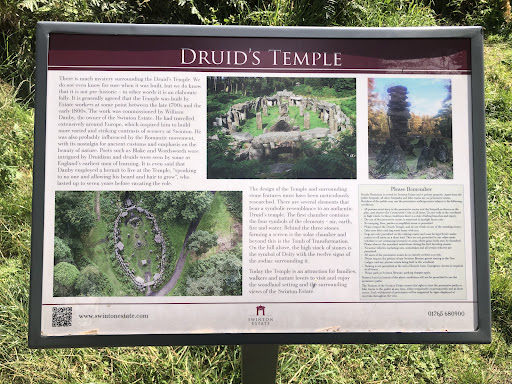
The Druid's Temple is a Regency-era folly in open woodland near the Yorkshire village of Ilton, near Masham. The folly was loosely modelled after Stonehenge and illustrates the fanciful ideas about Druids held by Georgian and early-Victorian antiquarians.
HISTORY
William Danby (1752-1832) was an eccentric 19th-century country squire, a former Sheriff of Yorkshire and the owner of Swinton Park, near Masham. In the aftermath of the Napoleonic Wars, the residents of Danby's Yorkshire estates were suffering from a serious economic depression, so he decided to do something about it.
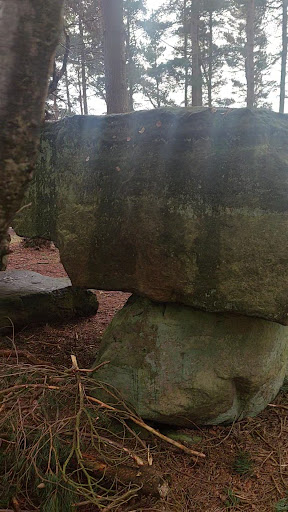
Danby was inspired by the stone circle at Stonehenge, which leading antiquarians incorrectly assumed had been created by the Druids of Celtic Britain. He decided to create his own Druid's Temple, modelled loosely on Stonehenge.He hired unemployed workmen and paid them one shilling per day to create a fanciful folly based on a circle of standing stones. The stones ranged up to 10 feet high and formed an arrangement measuring 100 feet long. The standing stones were arranged around a low stone altar. At the back of the circle was a cave in the style of a tomb.
There are two large stone circles. One is in the form of a vesica piscia (intersecting circles creating an eye-shaped outline) that has four monolithic standing stones and a central monolith like a phallic symbol on a stepped base. Three more stones form a screen to an antechamber, and beyond that is a circular chamber centred on the altar, or sacrificial stone. Beyond that is the tomb area.
On the hillside overlooking the circle is a large column carved with the signs of the zodiac.Aside from the main temple, there are clusters of standing stones throughout the nearby woodland.
Not only did Danby design the temple, but he also hired a 'hermit' to live in the 'tomb' for seven years. The hermit was instructed to remain mute and let his hair and beard grow. It was always going to be a difficult task; the successful hermit lasted only four years in his role and it was rumoured that the requirements of the job drove him insane.
The Druid's Temple was built at a time when there was growing interest in British history - and a lot of confusing speculation that wasn't founded in facts. Antiquarians like Danby hearkened back to an idyllic golden age of British history, ruled by a Druidic elite.
The temple is fascinating not only as one of the most interesting follies in England but as an example of what the early 19th-century English wanted to think about themselves and their heritage.The Druid's Temple made an unexpected appearance in the national press in 2000 when Baroness Masham of Ilton argued in the House of Lords in favour of restricting public access to the countryside because, in her words, 'there has been Devil worship there'. According to Baroness Masham, her secretary was taking her dog for a morning walk and discovered a pig's head on the stone altar.
NOTE: The most commonly accepted date for the Druid's Temple is sometime around 1820. The official English Heritage listing, however, gives a date of around 1800.
Don't mistake this Druid's Temple folly in Yorkshire with the similarly named and entirely authentic Druid's Circle in...
Read more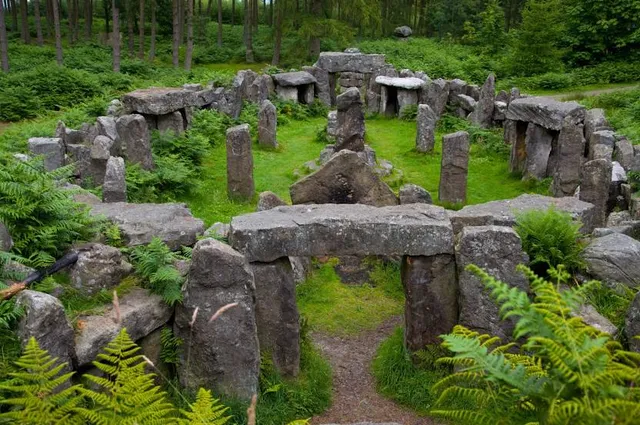
 Learn more insights from Wanderboat AI.