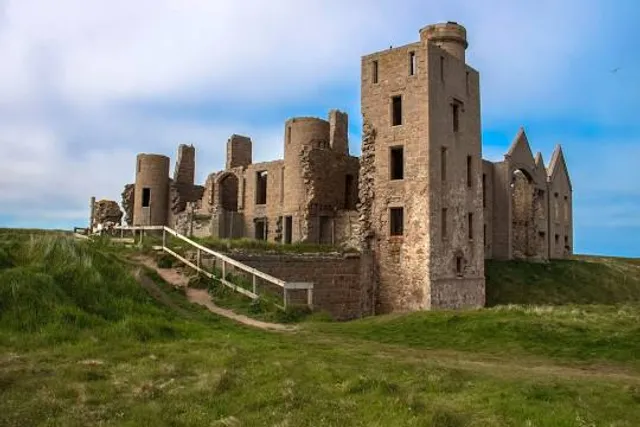
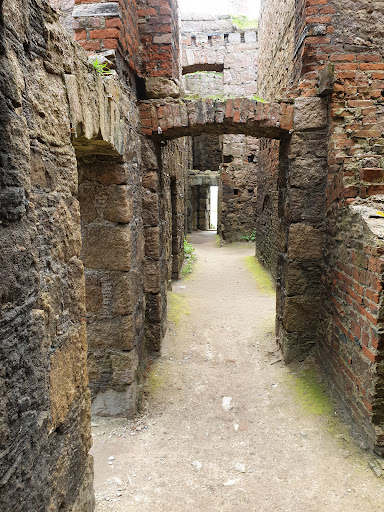
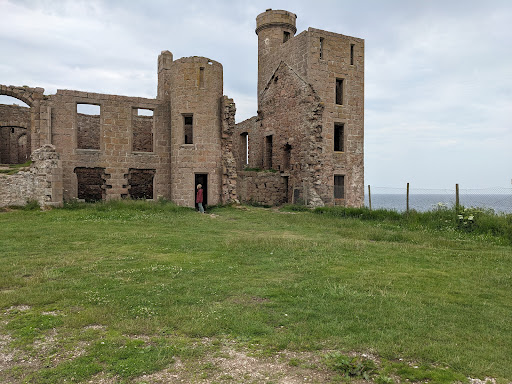
This is a magical castle, just outside the town Cruden by the coast. The track leading to the castle is full of pot holes so beware if you have a low bearing car, but if you can walk it, there is a carpark before the track to but its a couple of hundred yards walk. The castle its self is amazing, but its not maintained so can be a bit hazzardous. Its not for small children running about because of the the cliff faces and we found what must of been a storage room under one set of stairs that has a drop to anouther room very dangerous. Sadly there are no information plaques about the castle so heres some info:
The Clan Hay were a powerful family in the area for generations, having possessed the lands of Slains since the 14th century. In 1453 Sir William Hay, the clan chief, was made Earl of Erroll by King James II.1] At this time the local seat of power was Old Slains Castle, near Collieston some 8 kilometres (5.0 mi) to the south-west. Francis Hay, 9th Earl of Erroll, succeeded in 1585, and converted to Roman Catholicism. He conspired with other Catholic nobles, including the Earl of Huntly, with whom he joined in a brief rebellion in 1589. Erroll was also a signatory of the "Spanish Blanks", documents signed by members of the Catholic nobility of Scotland, and otherwise left to be filled in with the terms of Spanish aid.[2] Erroll was declared a traitor in 1594, and Old Slains Castle was destroyed in October on the orders of King James VI.[1] After a period abroad Erroll returned to Scotland, and abjured Roman Catholicism in 1597, subsequently returning to royal favour. He abandoned Old Slains and built a courtyard and square tower on the present site. Originally named Bowness, it later became known as New Slains.[3] The wings around the courtyard were extended in 1664 by addition of a gallery or corridor, and in 1707 the entrance front was renewed.[4] In 1820 William Hay, 18th Earl of Erroll, married Lady Elizabeth FitzClarence, the illegitimate daughter of King William IV and Dorothea Jordan.[5] In the 1830s the 18th Earl commissioned the Aberdeen architect John Smith to remodel the castle. This resulted in a virtual rebuilding of Slains in a Scots Baronialstyle, including granite facings, in 1836–1837.[4] Gardens were laid out in the late 1890s by the landscape architect T. H. Mawson.[6] In 1895 the author Bram Stokervisited the area, staying at a cottage near Cruden Bay, and he may have been a guest at Slains. The castle is commonly cited as an inspiration for Stoker's 1897 novel Dracula.[4 In 1913 the 20th Earl of Erroll sold New Slains,[1] ending more than 300 years of occupation by the family. It was purchased by Sir John Ellerman, the wealthy but secretive owner of the Ellerman Lines shipping company, who leased it out. In 1925 the roof was removed to avoid taxes,[4] and the building has deteriorated since. It is now a roofless shell, with most of the outer and inner walls standing to full height. In 2004 it was reported that the Slains Partnership was preparing plans for restoration of the building and conversion into 35 holiday apartments.[4]In August 2007 the scheme was granted outline planning permission by Aberdeenshire Council, but the plans were put on hold in 2009 due to the economic downturn.
The views are amazing just look at the pics and i found a pic of the castle in its hay day. The castle is well worth a visit but just keep in mind the dangers and...
Read moreSlains Castle: A Historic Gem with a Gothic Legacy
Slains Castle, perched on the dramatic cliffs near Cruden Bay in Aberdeenshire, is steeped in history and mystery. Its haunting ruins not only tell a story of Scottish nobility but are also linked to one of literature’s most famous Gothic tales—Bram Stoker’s Dracula.
The History of Slains Castle
The Old Slains Castle, located near Collieston, was originally built in the late 13th century but was destroyed by King James VI in 1594 after the 9th Earl of Erroll joined a rebellion against the crown. Following its destruction, the family moved further up the coast and constructed the New Slains Castle in the early 17th century.
Over the centuries, New Slains Castle was transformed from a defensive structure into a grand mansion, with significant expansions in the 19th century. It became a symbol of wealth and power for the Erroll family, hosting many notable visitors, including members of the aristocracy. However, financial difficulties led to the castle being sold in 1916, and its roof was removed in 1925 to avoid taxes, leaving it in ruin.
The Dracula Connection
Slains Castle’s Gothic presence and its proximity to Cruden Bay are thought to have inspired Bram Stoker’s Dracula. Stoker spent time in the area during the late 19th century, staying at the nearby Kilmarnock Arms Hotel. The castle’s eerie location, towering above the North Sea’s crashing waves, is said to have influenced Stoker’s description of Dracula’s castle.
Walking through the ruins today, it’s easy to imagine how the dramatic setting, with its labyrinth of crumbling walls and panoramic views of the wild coastline, captured Stoker’s imagination. Local legends and the area’s rich folklore likely added to the atmosphere that inspired his iconic vampire tale.
Visiting Slains Castle
Today, Slains Castle remains a popular destination for visitors seeking history, stunning coastal views, and a touch of the supernatural. While exploring the ruins, you can almost feel the weight of its storied past and the whispers of the Gothic fiction it helped to inspire. Accessible on foot via a scenic coastal path, it’s a must-visit for history enthusiasts, literary fans, and anyone looking to soak in the rugged beauty of Aberdeenshire.
Slains Castle stands as a testament to Scotland’s rich history and its lasting impact on global culture—especially for those intrigued by the...
Read moreDracula's Castle or so the locals would have you believe. Though the Internet says Bram Stoker stayed here it isn't 100% definitive, so take such claims with a grain of salt. From the carpark take the path to the right that's wide and made of crushed shells. It's a level, easy enough walk with a dilapidated castle at the end. Parts of the grounds are blocked off to prevent people from falling off the cliffs and to discourage people from poking around too much. None is truly a deterrent, but use some sense and don't become a cautionary headline for people back home (looking at you, Americans and youngish people with more hubris than prudence). The castle is definitely worth your time and some photographs. There is a little history posted online, but it seems a bit dubious as of the writing of this it implied the castle was being remade into luxury accomodations (approved by Aberdeenshire council 2006?). I'm not sure how it could make it as an apartment or hotel without extensive work. I also don't know who would want to do such work with the heavy equipment required given how close you are to the cliffs or who would cover the liability insurance since it's likely just an errant jaunt before little Johnny is sleeping with the fishes or swept out to the North Sea. If you want to make a longer day of it, start your journey in Culloden Bay, take Castle Street out of town to the Castle and then proceed to the car park and north along the paths towards Bullard of Buchan and look for the puffins and seagulls. There are majestic cliffs along the way...
Read more