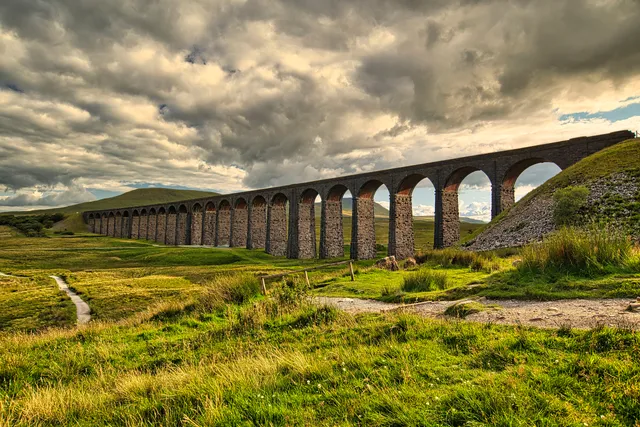
The Ribblehead viaduct is one of the most impressive engineering projects in England. It is also sat in wonderful scenery. Most people who park up at Ribblehead do so for two reasons. They will either take a short trip to the viaduct, take a photo or two and return to the car. Alternatively they will climb Whernside, the highest mountain in Yorkshire. However there is a third alternative. Why not add enjoyment to the visit to the viaduct by extending the walk to explore some of the most interesting sights of the nearby area. As a result you will discover a little more about the history of the famous viaduct.
Although the viaduct dominates the walk it is interesting to follow the railway tracks past Blea Moor station to Blea Moor Tunnel. The tunnel is one and half miles in length and was built in 1875 as part of the famous Settle to Carlisle railway. In addition it took four years to complete with the aid of seven mine shafts from the moors above. The whole feat of engineering is extraordinary. If you get lucky you may see a steam train head in to the tunnel.
The return walk should be varied by passing under the railway and past the farms on its west side. Quiet and full of interest it may be but the best reason is to give an alternative view of...
Read moreTotally stunning views and an amazing walk around Whernside (about 8 miles) assuming no cloud cover. The walk can be slippy on way down if stones are wet so be careful as it's a long way down if you fall ! Certainly wouldn't recommend for very young children but my 6 Yr old did well with alot of guidance and watching, however it was a perfect weather day, no place for a child in bad weather! The wonderful sense of achievement is amazing once you have climbed to the summit and be careful if it's high winds as the path is on the edge! Incredible work they have done on making most of the entire path either shale or rocks. Work ongoing. We saw a helicopter bringing rocks in which was a real treat. Parking is ok if you are early and there is often a snack van and ice cream van near the viaduct. Local pubs are superb after the walk for food and traditional ales. Lots of memorabilia in the pubs for interest.
Took us quite a few hours to walk around but that's only because we had the walk at a child's pace. The climb up is challenging at times but slow and steady walking is the key, 2 walking staffs also really help.
A beautiful, incredibly relaxing and tranquil place....go see...
Read moreCopied from Google The viaduct was designed by John Sydney Crossley, chief engineer of the Midland Railway, who was responsible for the design and construction of all major structures along the line. The viaduct was necessitated by the challenging terrain of the route. Construction began in late 1869. It necessitated a large workforce, up to 2,300 men, most of whom lived in shanty towns set up near its base. Over 100 men lost their lives during its construction. The Settle to Carlisle line was the last main railway in Britain to be constructed primarily with manual labour.
By the end of 1874, the last stone of the structure had been laid; on 1 May 1876, the Settle–Carlisle line was opened for passenger services. During the 1980s, British Rail proposed closing the line. In 1989, after lobbying by the public against closure, it was announced that the line would be retained. Since the 1980s, the viaduct has had multiple repairs and restorations and the lines relaid as a single track. The land underneath and around the viaduct is a scheduled ancient monument; the remains of the construction camp and navvy settlements (Batty Wife Hole, Sebastopol, and...
Read more