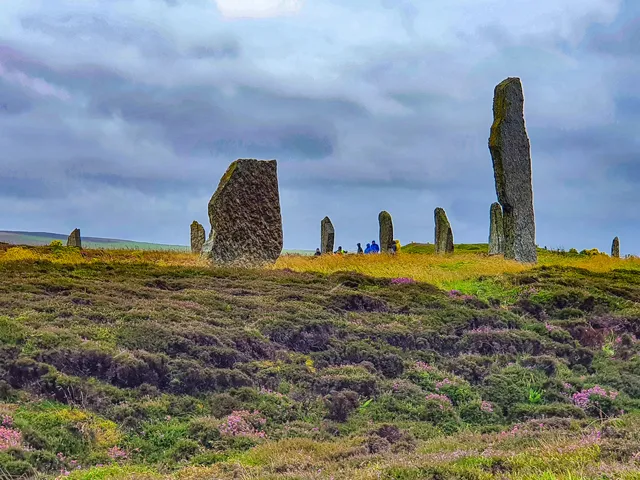
The spellbinding stone circle - the Ring of Brodgar - is arguably the most iconic symbol of Orkney's prehistoric past. It is a site of ritual and ceremony, and hauntingly beautiful.
The Ring of Brodgar is an archaeological treasure and without doubt one of the islands' most visited attractions. It can be found in a magical landscape that is the Heart of Neolithic Orkney UNESCO World Heritage Site and is one of the most photographed attractions in Orkney - particularly at sunset. The ring was built around 2500-2000BC and covering an area of almost 8,500 square metres it is the third largest stone circle in the British Isles - just pipped by Avebury and Stanton Drew.
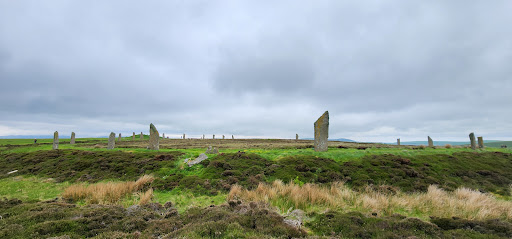
Sitting within a natural amphitheatre of hills and surrounded by a ditch, 27 of the original 60 stones survive today. According to legend, it was a religious shrine and possibly a place of ritual, while others believe the ring was built for the astronomical observation of the equinox and solstice. The truth is, we don't know for sure which only adds to the mystique.
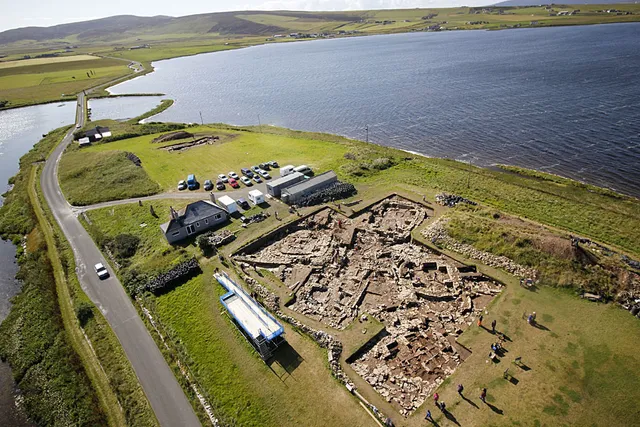
Nearby, the solitary Comet Stone keeps a watchful eye, while just one mile from the site the Standing Stones of Stenness cast their spell. Four giant megaliths, at a towering six metres, date back to 3100BC making it one of the oldest stones circles in Britain. Close by, the Barnhouse settlement reveals an excavated group of house dwellings dating from 3300-2600BC.
Other details:
The Ring of Brodgar is free to visit and open year-round. Some sections of the inner path may be closed periodically to allow the grass path to rest and regenerate.
Walk among the enigmatic stones of one of the most spectacular prehistoric monuments in the British Isles. The Ring of Brodgar Stone Circle and Henge is an enormous ceremonial site dating back to the 3rd millennium BC.
The Ring of Brodgar comprises:
-A massive stone circle, originally consisting of 60 stones – 36 survive today. -At least 13 prehistoric burial mounds. -A large rock-cut ditch surrounding the stone circle.
The Scottish geologist Hugh Miller, visiting in 1846, wrote that the stones ‘look like an assemblage of ancient druids, mysteriously stern and invincibly silent and shaggy’.
The Ring of Brodgar is part of the Heart of Neolithic Orkney World Heritage Site, a series of important domestic and ritual monuments built 5000 years ago in the...
Read moreA Mystic Circle in the Highlands - The Ring of Brodgar :
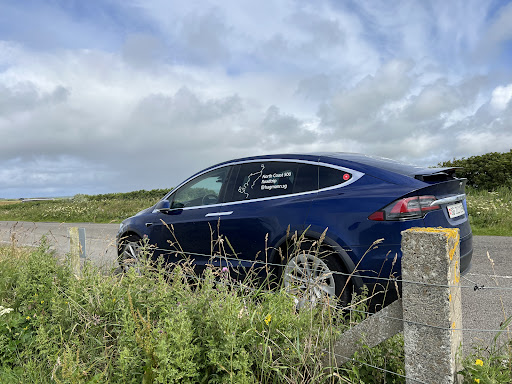
A must-see on our NC500 adventure was the Ring of Brodgar, an awe-inspiring part of the Heart of Neolithic Orkney World Heritage Site. This ancient stone circle and henge monument serves as a captivating window into Scotland's Neolithic past.
The sheer scale of the monument is a sight to behold. The ring, comprising numerous stones, creates a majestic spectacle against the surrounding landscape of lochs and hills. The setting sun casts an ethereal glow on the stones, making for an unforgettable visual experience.
Walking among these ancient megaliths, we couldn't help but feel a sense of connection to the people who erected them over 4,000 years ago. The site is well-preserved, allowing us to fully appreciate its historical significance.
Informative boards around the site offer fascinating insights into the ring's possible ceremonial uses and the people who might have used it. This information brought a deeper understanding and respect for the monument and its creators.
Despite being a popular site, the Ring of Brodgar never felt crowded. There is a tranquillity here that adds to the overall experience. Accessibility is excellent, with convenient parking and easy-to-navigate paths leading to the monument.
In conclusion, the Ring of Brodgar is an extraordinary piece of Neolithic heritage that brings a rich depth to the NC500 journey. Its historical significance, combined with its stark beauty, makes it a site that cannot be missed. It's a place that invites contemplation and provides a tangible link to our ancient ancestors.
Also very good to drive with the Scewo BRO electric...
Read moreThe Ring of Brodgar is noteworthy for being one of the largest Neolithic henges, with a diameter of 300 ft at the furthest point between stones, and a diameter of 400 ft when measured across the outer ditch. It is believed that the stone circle would have originally consisted of 60 standing stones, but only 36 can be positively accounted for today.
Brodgar's stones have stood for 4,000 to 4,500 years so a fair few of them will have succumbed to the elements and you can see one stone that bears the scars of a lightning strike. The massive heat generated by a lightning strike causes the stone to expand rapidly and thus open up fissures that split the stone apart. Look out for the information board which identifies this stone.
Around the Ring of Brodgar you can see several grassy mounds such as "Salt Knowe" and "Plumcake Mound". These are believed to be chambered tombs, but they haven't been fully excavated if even touched at all. Here there might be another Maeshowe Tomb waiting to be unearthed!
The Ring of Brodgar is a very popular stopping point for coach tours that visit Orkney. Consequently, it can be quite busy with tourists so try to visit early in the day or towards very late in...
Read more