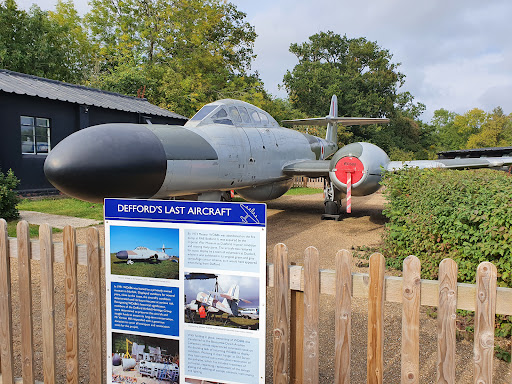
Construction of RAF Defford was completed in 1941, and for a few months the airfield was used as a satellite station by the Vickers Wellington bombers of No. 23 Operational Training Unit RAF (OTU), based a few miles away at RAF Pershore. In May 1942, the Telecommunications Research Establishment (TRE), responsible for radar research and development, and located near Swanage, moved to Malvern College. At the same time the Telecommunications Flying Unit (TFU), later named the Radar Research Flying Unit (RRFU), which operated flight trials on behalf of the TRE, transferred its aircraft to Defford. So hurried was the move to Defford that many of the personnel had to be accommodated in tents at first. However, at Defford the tempo of work carried out by TFU increased month by month, and by 1945 there were approximately 2,500 personnel and 100 aircraft on the station. Civilian scientists, flying from Defford with aircrews drawn from the Royal Air Force and Royal Navy, tested radar systems which were to revolutionise the operational capability of Allied aircraft. Early successes with Airborne Interception (AI) systems were demonstrated by John "Cats Eyes" Cunningham and other night fighter pilots. While Air to Surface Vessel (ASV) radar enabled the German U-boat menace to be effectively countered in 1943, and thus was critical to the success of the Battle of the Atlantic. By 1944, H2S radar was enabling accurate navigation and target identification to be achieved by Bomber Command crews, taking part in the strategic bombing offensive.
There were many other notable "firsts" demonstrated by TFU. A converted Wellington bomber was the forerunner of the modern AWACS aircraft. This was successfully used to detect fast moving German E-boats, and to control their interception by other aircraft. The world's first automatic approach and landing also took place at Defford in 1945, paving the way for today's airliners which are able to safely arrive at their destinations, whatever the weather. The world's first demonstration of an aircraft making a "hands off" automatic blind landing, using equipment the forerunner of modern ILS, was at Defford in January 1945.[2]
Postwar useEdit
TFU remained at Defford after the war, and was renamed the Radar Research Flying Unit (RRFU) in 1953. However, the airfield at Defford was too small to allow the operation of the large "V" bombers on flight trials, and so RRFU moved to nearby RAF Pershore in 1957.[3] Most of the technical and domestic sites at Defford were soon de-requisitioned, but the central part of the now disused airfield still houses the Satellite Communications facility operated by QinetiQ. The various dishes and aerials used can be seen from passing trains between Worcester and Cheltenham and from the M5 motorway near...
Read moreFantastic national trust location to visit. Carparking is ample and gravelled(be wary of potholes) Main cafe and shop facilities as you enter and the entry point is within the old Barack building. Great features.
Little clustered right after that with flowers and stalls but seasonal it looks good. It has a small park located to the right for children (not used it so don't know much)
Great wood land walks trailing through leading up to the church. Follow the routes round to the main house and you'll see many small out buildings and great views.
Cross the small river bridge and continue through the walks and onto the orangey (another cafe) where you can rest and admire back on Coombe house etc.
Staff always friendly and polite, there is always lots of dog walkers about however only notice one bin on route about for the dog bags. Minor point.
Over all a great visit, and worth going...
Read moreThis was a great day out for my small family. Lots to do and see. I would say for a day trip it needs to be a dry day as there us a lot of walking. We didn't get to see the museum as it was so sunny we explored the grounds.
The play Park was disappointing. Mainly because of the lack of containment. Both gates were very easy for kids to escape from. The forest park was amazing.
The cafe was pricey for what you got, especially the kids meal.
Parking was great. It's attended so they guide you to places which was a nice touch.
Also they run a shuttle service between the carpark and the main house, which was great for tired little legs, but also for the elderly...
Read more