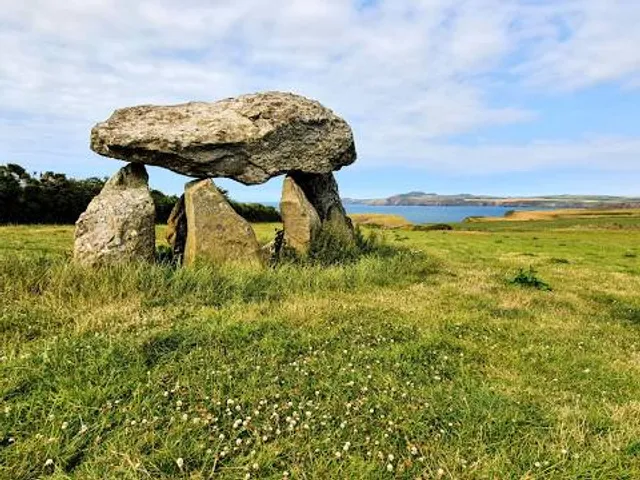
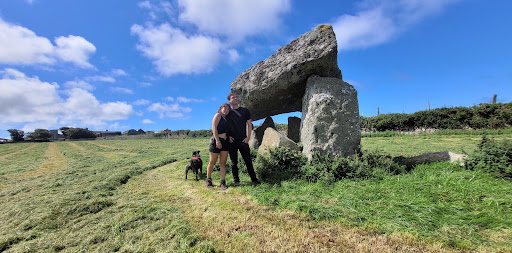
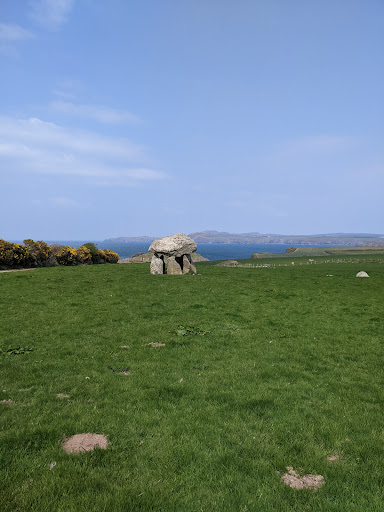
This megalithic monument sits in a meadow overlooking the beautiful Abercastle harbour and the Irish Sea. On a clear day you can see the Preseli Hills and you also have sightline with another monument, nearly 4 miles away, the unique and very jaunty Ffyst Samson.
Fantastic, peaceful site... if you park above the monument and walk down to it, make sure to continue walking down towards Abercastle and take in the view of Castle Island and the old forts it held.
CADW classifies this site as a Chambered Tomb, or Dolmen, and dates it at around 5000 years old. According to Coflein, the site was excavated in 1968. “This revealed four additional stone-holes, one having supported a further chamber stone, the others indicating a possible passage leading off to the northwest. Slight traces of a covering cairn were found to the south and it was shown that the monument had been raised over a pit 0.8 meters deep, filled with clay and stones. Find included a small quantity of burnt bon, pottery and flints.”
The site is named Carreg Samson, meaning Samsons Stone, because of an old legend that the Celtic Christian saint placed the capstone upon the standing stones using only his little finger. In the process his finger was severed and was buried nearby .But as this saint is said to have lived in the 5th century, the stones on this site had already been standing for thousands years, so this legend is likely a Christian adaptation of a much older traditional story.
You can watch a video with more detail on our YouTube...
Read moreCarreg Samson (also known as Carreg Sampson, Samson's Stone, or the Longhouse) is a 5000-year-old Neolithic dolmen located half a mile west of Abercastle near the Pembrokeshire Coast Path in Wales.
It is called "Samson" because of a local legend that Saint Samson of Dol placed the capstone in position with his little finger.
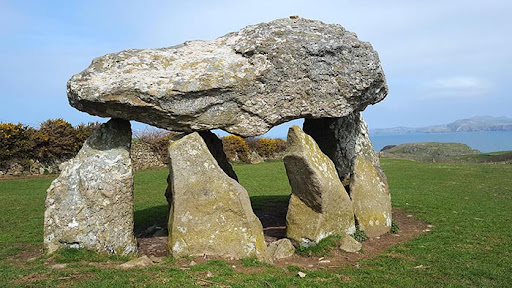
Carreg Samson has a capstone, 4.7 metres by 2.7 metres and 1.0 metre thick. The capstone rests on three of six stones 1.1 to 2.2 metres high.
The whole burial chamber was once covered by a mound of earth or stones and once these were removed stones were used to block the holes in the sides of the tomb so that it could be used as a shelter for sheep.
The site was excavated in 1968, which revealed four additional stone-holes, one having supported a further chamber stone, the others indicating a possible passage leading off to the northwest. Slight traces of a covering cairn were found to the south, and it was shown that the monument had been raised over a pit 0.8 metres deep, filled with clay and stones. Finds included a small quantity of burnt bone,...
Read moreCarreg Samson, otherwise known as Samson's Stone and the Longhouse crouches low in a farmers field above the bay of Aber Castle gazing out across the Irish Sea.
A large capstone 4.5 metres long by over 2.7 metres wide perches on three of the seven uprights, the monument being the remains of a large chambered tomb, although any sign of a covering mound if it existed has now disappeared. It has been further suggested that Carreg Samson was in fact a passage tomb but any trace of the low row of stones that may have formed a passage from the side of the mound up to the entrance of the chamber has also vanished.
A hundred years or so ago the dolmen was used as a sheep-shelter. The Samson connection comes from the legend that Saint Samson put the capstone in place himself using...
Read more