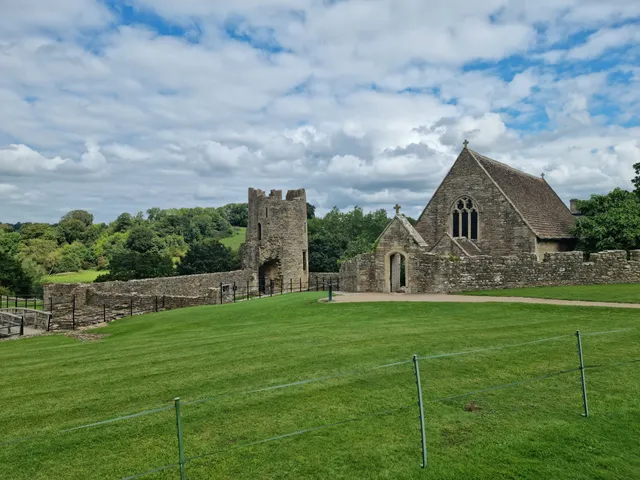
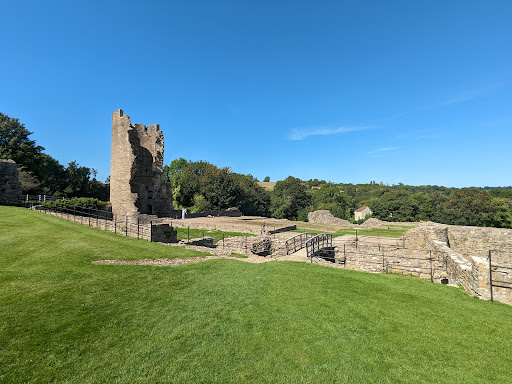
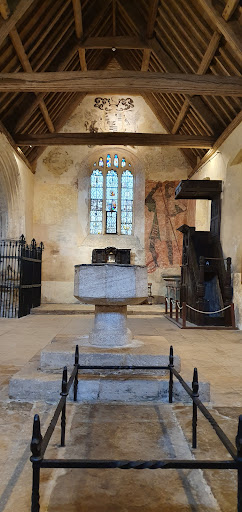
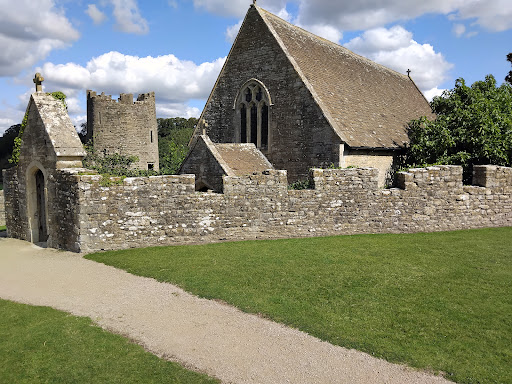
A medieval castle, the castle was built in two phases, the inner court was constructed between 1377 and 1383 by Sir Thomas Hungerford, who made his fortune as steward to John of Gaunt. The castle was built to a quadrangular design, already slightly old-fashioned, on the site of an existing manor house overlooking the River Frome. A deer park was attached to the castle, requiring the destruction of the nearby village. Sir Thomas's son, Sir Walter Hungerford, a knight and leading courtier to Henry V, became rich during the Hundred Years War with France and extended the castle with an additional, outer court, enclosing the parish church in the process. By Walter's death in 1449, the substantial castle was richly appointed, and its chapel decorated with murals. A number of lead, anthropomorphic coffins, some with moulded faces or death masks, were laid down in the crypt in the mid- to late-17th century. Four men, two women and two children were embalmed in the castle in this way, probably including Edward and Margaret, as well as the final Sir Edward Hungerford, his wife, son and daughter-in-law. Such lead coffins were extremely expensive during the period and reserved for the wealthiest in society. Originally the lead coffins would have been encased in wood, but this outer casing has since been lost. Great with the audio tour, not a massive place, free with Cadw membership, for parking you drive through the castle, a good...
Read moreThis is a special castle. As an English Heritage member I've been to quite a few historic houses and Castles (both intact and ruins) but this one has left an impression. Farleigh Hungerford is a ruin but thanks to the audio guide, which we listened to free with our phone, the castle was bought to life and it was very easy to visualise how it would have looked and how life was lived when it was fully functional. The best bit about this site is the onsite Church. I find it really hard to find historic places that make you feel as if you have stepped back in time but this is how I felt in the Church. There was barely any touch of modern, only the dim lighting, and it felt like it hadn't changed in centuries. Helped by the fact that there are beautifully preserved 600 year old medieval paintings still intact on the walls. You didnt need to be told by the audio guide that you were looking at something rare and extremely significant. We went to Farleigh Hungerford as an additional activity during our weekend in Bath but it ended up being the highlight of the trip. The English Heritage staff were knowledgeable and passionate and its really nice to speak to people who feel like they genuinely love their job and want to share their knowledge with you. This Castle is well...
Read moreIt is rather a unpopular site compared to the Great Bath of Bath. I was there 2 weeks ago and I liked it. It is rather a castle ruin. Managed by English Heritage, the castle provides you with a audio guide when you purchase the ticket. As a medievalist, I listened to all the labels and absolutely liked them. I'd say English Heritage obviously is a highly professional history organization. In terms of the castle, it is rather a shorter trip compared to others. It will take you around 1 hr to 1.5 hr to complete the whole walk and listen to all the commentaries. The chapel and its crypt here are rather smaller. I was apart from my companions when I entered the crypt and it was creepy to some extend. Given that the Hungerfords were barons before they got their property confiscated, the size of the castle is rather small. There's a pub by the castle. I ate dinner there with 2 friends. The food there was cheap and amazing. The aged couple who owned the pub...
Read more