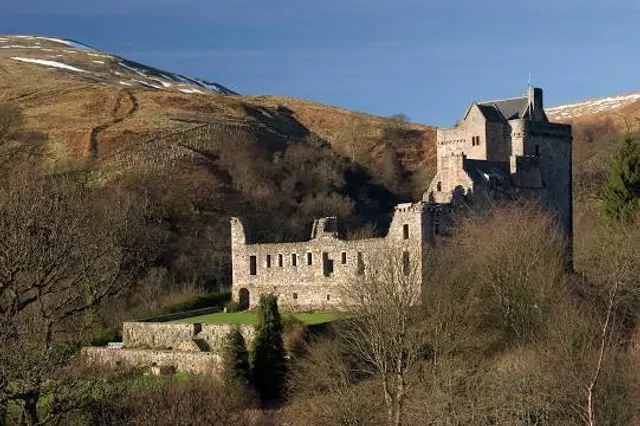
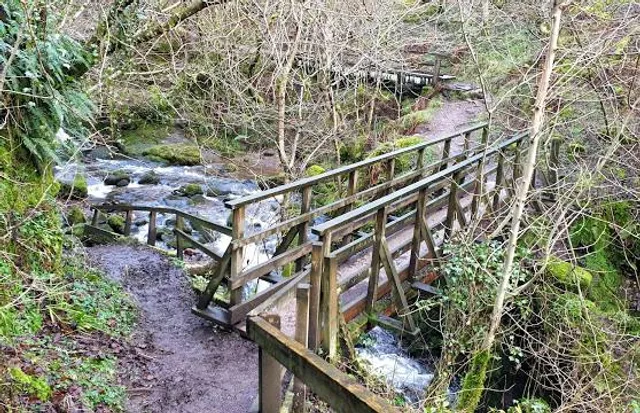
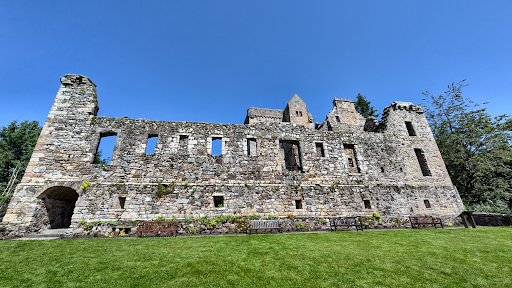
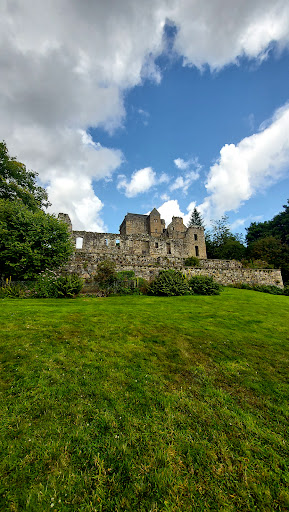
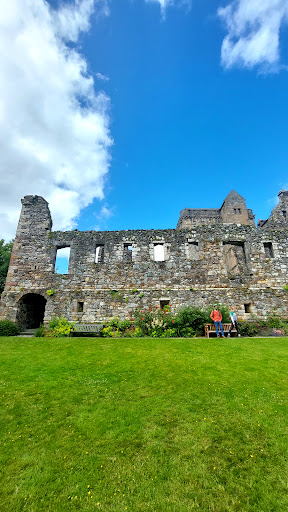
This is one of my favourite castles and we try to visit regularly. . Please note: in my opinion, if you have restricted mobility this may not be a viable choice for you due to the nature of the site being a) preserved historic with lots of large cobble stones and spiral staircases b) on top of an extremely steep and undulating hill. This is just my opinion, but I would hate someone to want to visit, and then be disappointed finding it unsuitable when they arrive. I am not sure if they have official wheelchair access either. . As I mentioned, the castle is fantastic and Historic Scotland have really kept it well, even the toilet is in an old castle 'toilet' with a wooden door and under an arch! There is a small wet-weather room with tables if you want to escape any sudden downpours. Luckily we went on a bright sunny day with clear views all the way over to the Pentland Hills. . The castle shuts for lunch for an hour in the middle of the day when all guests are asked to leave the castle, so plan your trip accordingly. If you need to wait for it to re open there are worst places... it sits at the top of Dollar Glen which is full of waterfalls, or if you stay at the top of the hill you can see for miles and you have a scenic backdrop of more rolling hillside and woodland. There are a couple of wooden benches but no shelter. . The castle has signboards which helpfully explain each area, and you are able to climb right to the very top of the castle via a steep spiral staircase and explore the rooms that come off it, there's even a tiny prison cell. . The gift shop is extremely small, so don't expect a full range of items but they have the essentials. Also, in my opinion, don't use the castle car park (it has 15 spaces and is closer to the castle, you have to drive over a ford), use the first car park on your right which is opposite a big wooden sign board for Dollar Glen. . This car park has space for about 20 cars and is free. A top tip is to walk down into the glen, then turn right and head up the glen past the waterfalls on the wooden bridges to the castle (this takes around 30 minutes and is on uneven ground but VERY picturesque). Then walk down from the castle on the steep tarmac road back to the car park. We tried it the other way around and it is arduous. You can often see families struggling to walk up the road, as the incline is insane. On our last visit a toddler had sat down in the middle of the road and thrown a tantrum because he didn't want to walk any further. . On that note, I would say that this site suits older children, young adults and fit older people. It is so beautiful and has a rich unique history - you just need to be aware of actually how steep/tiring the walk is (even if you park at the...
Read moreCastle Campbell is a medieval castle situated above the town of Dollar, Clackmannanshire, in central Scotland. It was the lowland seat of the earls and dukes of Argyll, chiefs of Clan Campbell, from the 15th to the 19th century, and was visited by Mary, Queen of Scots, in the 16th century.
The castle was originally known as Castle Gloom, possibly deriving from the Scottish Gaelic: glom, meaning a chasm, and referring to the narrow gorges to either side of the site. The naturally defended position may have been the site of a motte in the 12th century. The present tower was built in around 1430 for John Stewart, Lord Lorne (d.1463), or one of his kinsmen. About 1460, the property was acquired by Colin Campbell, 1st Earl of Argyll (d.1493), on his marriage to Isabel Stewart, Lord Lorne's daughter. The first historical record of the castle dates from the following year, when Pope Paul II issued a bull against Walter Stewart, son of Lord Lorne, for attacking and damaging the "Place of Glowm". Campbell, who was at the papal court at the time, may have been instrumental in arranging the Pope's intervention. The tower shows signs of early rebuilding following this episode.
The acquisition of Castle Gloom expanded the power of the Campbell family, from Argyll in the west into central Scotland, and suited Colin Campbell's position as Master of the Household to King James III of Scotland, which required his frequent presence at court. In February 1490, Campbell petitioned the newly crowned King, James IV of Scotland, to formally change the name of Gloom to "Castle Campbell", and this was done by an act of parliament. The change in name may imply that the term "castle" was seen as particularly prestigious, requiring royal approval for its use. At this time, the castle would have comprised the tower house, with other buildings arranged around the courtyard and gardens outside. The east range was probably added first, and some time after the accession of the 2nd Earl in 1493, the large south range was begun. This building shows the influence of the contemporary works at Stirling Castle, now known as the King's Old Building. It included a state apartment of hall, outer chamber and bedchamber, with large south-facing windows overlooking the gardens, and a view across the Devon Valley. The range also provided additional private lodgings, and was accessed via two symmetrically placed stairways facing...
Read moreAt the end of Dollar Glen stands the beautiful fifteenth-century ruin of Catsle Campbell. This castle was the main seat of the Argyll branch of the Campbell clan from the late fifteenth century until the mid-seventeenth century. The castle likely originated in the twelfth century as a motte-and-bailey castle and was originally called Catsle Gloom (derived from the Scottish Gaelic: glom, meaning "chasm," and referring to the narrow gorges on either side of the site). The large keep was built around 1430 by John Stewart, 2nd Lord Lorne. The Campbell clan acquired the castle through the marriage of Colin Campbell, the second Lord Campbell and first Earl of Argyll, to Elizabeth Stewart in 1465. In 1490, the castle's name was officially changed (and with the approval of King James IV of Scotland) to Castle Campbell. The Campbells continued to expand the castle in the following years. Due to the close ties of the Earls of Argyll to the Scottish Royal Family, this branch of the Campbell clan played an important role in Scottish politics. Their castle therefore welcomed several illustrious visitors, such as John Knox and Mary, Queen of Scots. During the religious conflicts of the 17th century, Castle Campbell remained intact, but in July 1654, royalists burned it down. After the Restoration of 1660, Archibald Campbell, the 9th Earl of Argyll, decided not to renovate the castle and moved into Argyll's Lodging in Stirling. Except for a brief occupation in 1715, the castle remained uninhabited and in 1805, it was given to Crauford Tait. His heirs donated the castle to the National Trust for Scotland in 1948, after which it was restored and opened to the public. Castle Campbell is certainly worth a visit, especially for its history, the walk to the castle, and the...
Read more