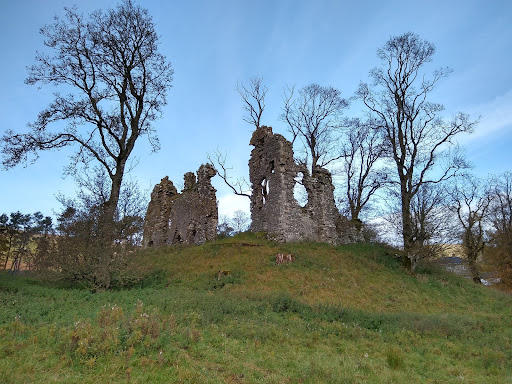
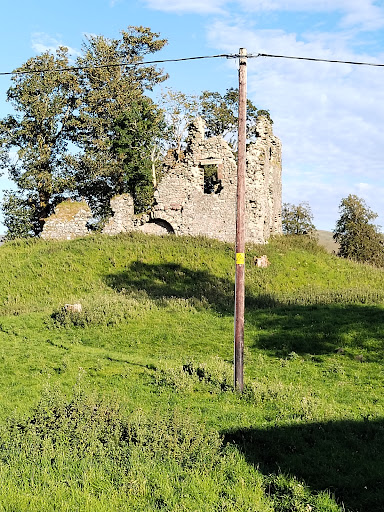
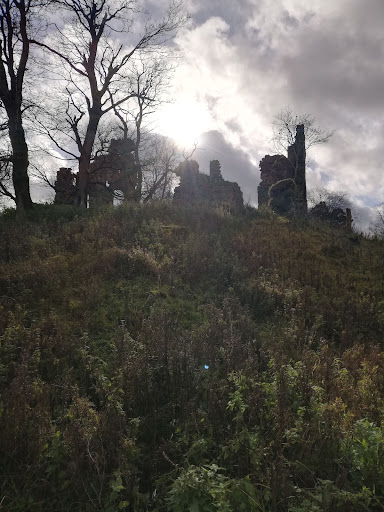
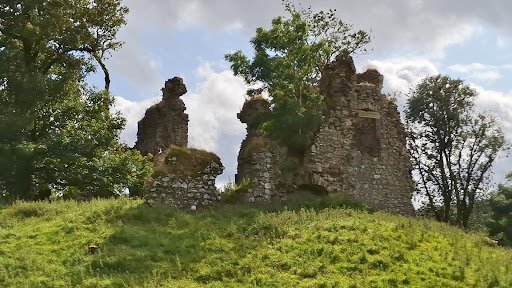
Very historic castle ruin, access is difficult but here is a bit about the history of the place,
Crawford Castle, substantially in ruins, is located on the north bank of the River Clyde, around half a mile north of Crawford, South Lanarkshire, Scotland. The ruins stand on an earlier motte and bailey earthwork. The castle is also known as Lindsay Tower, after its former owners, the Lindsay family. The strategic location of the castle guards the strategically important Mennock Pass from England into the upper Clyde Valley.
Archaeological excavations to the north-west of the castle have shown that a Roman fort, with a garrison of perhaps 300, existed at this site between 80 AD and 170 AD.
This site was the administrative center for the Barony of Crawford, at that time the largest and most influential barony in southern Scotland. The Barony was established before 1100 when records of the period show Sveinn, son of Thor, as Lord of Crawford. From this line descended the surname of Crawford as the original occupants of the barony. Crawford Castle was in existence by 1175, and was probably built as an earthwork and timber castle some time before this by Sveinn's father Thor, sheriff of Edinburghshire, or indeed by Thor's father Sveinn.
The Lindsay family inherited the barony of Crawford when William Lindsay married ca. 1154 the younger daughter of Thor, sheriff of Edinburghshire, and granddaughter of Sveinn, Lord of Crawford. Following the death of Thor in about 1165, it was probably William Lindsay who built the stone castle in 1175. He is recorded as Lord of Crawford by 1190. Crawford Castle is located in Crawford Parish. From an early date, the Clan Carmichael of Meadowflat acted as hereditary constables of the castle, retaining this post under successive owners.
In 1398, Robert II granted the title of Earl of Crawford to David Lindsay, who had won great praise on St George’s Day, 23 April 1390 for bravery in a duel with the Englishman Baron Welles on London Bridge after Welles, at a banquet in Edinburgh, and presumably after too much alcohol issued, as Champion of England, the challenge: "Let words have no place; if ye know not the Chivalry and Valiant deeds of Englishmen; appoint me a day and a place where ye list, and ye shall have experience."
At the accession of James IV in 1488 the barony of Crawford was transferred to Archibald Douglas, 5th Earl of Angus for supporting his father, James III, against the young prince's rebellion. The Earls of Angus held the castle until 1578, when their estates were forfeited by the young James V. James used Crawford as a hunting lodge until his own death in 1542. His mistress, Elizabeth Carmichael, was the daughter of the hereditary constable.
After 1542 the barony was returned to the Earls of Angus, the keepership of the Carmichaels of Meadowflat coming to an end in 1595. In 1633 the 11th earl was created Marquess of Douglas, and the castle was probably rebuilt after this date. The castle then passed to the Duke of Hamilton, before being sold to Sir George Colebrooke in the 18th century. After a period of use as a farmhouse, the building was abandoned at the end of the 18th century, and much of the stone reused to build the present Crawford Castle Farm. Four stone tablets bearing coats of arms, one with the date 1648, are built into the west and south walls of the Castle...
Read more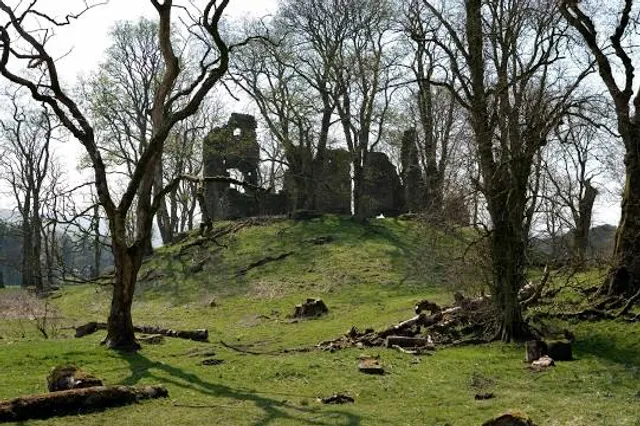
 Learn more insights from Wanderboat AI.