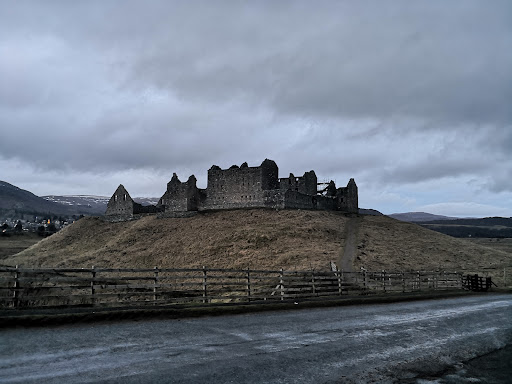
A bit of history, The prominent mound at Ruthven, on which the medieval castles and Hanoverian garrison were constructed, is strategically sited in the valley of the Spey, at a crossing point of routes north, south, east and west. This strategic significance is reflected in the military use that was made of this site and the part that the site and its inhabitants played in the military and political history of the troubled Highlands over at least half a millennia. • In the 13th century the site was chosen as the caput, or chief seat, of the Comyns in their Badenoch lordship. At this time the castle may have been of earth and timber construction. • In the later 14th century the castle was in the possession of Alexander Stewart (‘Wolf of Badenoch’) before reverting to the Crown. • 1451 reduced to a partial ruin • Towards the end of the 16th century the 6th Earl of Huntly erected a replacement stone castle. 1649 castle was garrisoned by the English under Cromwell. • 1689 castle ruined again. • In the early 18th century the barracks were built by the Hanoverian government to garrison infantry whose task was to police the locality in the wake of the Jacobite Rising of 1715. The well from the medieval period was retained. • The garrison was besieged (by MacPherson) and surrendered in 1745-6, the fifth Jacobite uprising. Thereafter, the barracks temporarily served as a rallying- point for the Jacobites following Culloden, but were allowed to fall into ruin, despite being re-acquired by the Duke of Gordon in 1792. There appears to have some subsequent landscaping of the parade ground, but no domestic reuse. • The barracks are therefore a forceful visible reminder of the Hanoverian government’s efforts to quash the Jacobites and disaffected Highlanders. • 1929 Offer of guardianship declined. • 1958 scheduled; concern expressed about condition or ruins in late 1950s, so site added to the Surveillance List (monuments which were regularly monitored and where, with the owner’s permission, the State undertook urgent repair works at its own hand and expense). Works took place from 1961 onwards. • 1968...
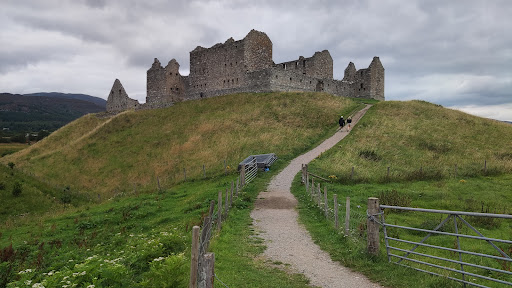
Read moreRuthven Barracks, standing on a grassy mound above Kingussie in the Cairngorms, is one of those places where history feels especially close. Built in the early 18th century in the wake of the 1715 Jacobite rising, the barracks were part of a network of government forts intended to keep the Highlands in check. Today, they survive as evocative ruins, their crumbling walls framed by sweeping views of Badenoch and the surrounding hills.
The site is most famous for its role in the final chapter of the Jacobite story. After the defeat at Culloden in 1746, the remnants of Bonnie Prince Charlie’s army gathered here, only to receive the crushing message from their leader: “Let every man seek his own safety in the best way he can.” Standing among the empty stone shells of the barracks, it is not hard to imagine the desolation of that moment.
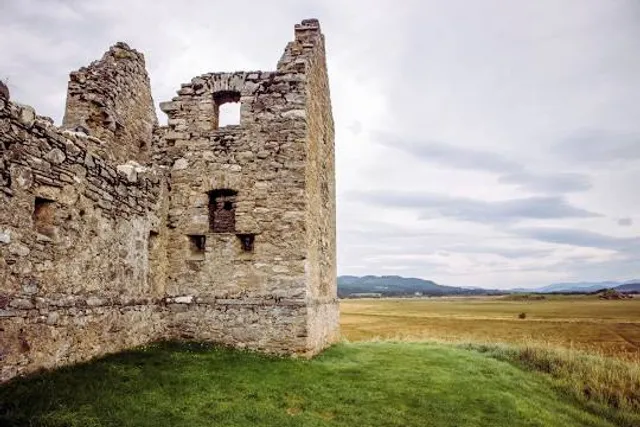
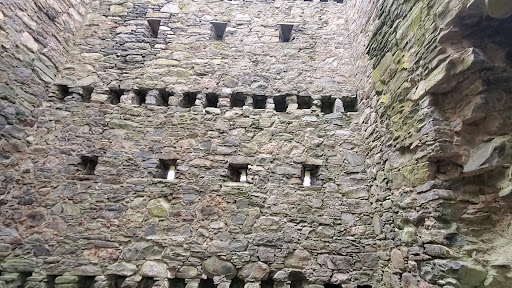
Though much of the structure has vanished, enough survives to give a sense of the barracks’ scale and purpose. You can still wander through the remains of the main block, climb staircases, and trace the outline of rooms once occupied by Hanoverian troops. There is a raw, unpolished quality to the ruins; unlike more curated historic sites, Ruthven Barracks remains quiet, free to enter, and largely left to the elements. That simplicity only adds to its atmosphere.
The experience is not about facilities—there are none—but about space, history, and setting. The combination of stark stonework, open sky, and Highland silence makes Ruthven Barracks a particularly haunting spot. For history enthusiasts and photographers, it is a gem; for casual visitors, it may be more of a brief stop than a destination in itself.
Verdict: Ruthven Barracks is a site of striking atmosphere and poignant history. Its ruins capture both the power of government authority in the Highlands and the tragic collapse of the Jacobite cause. Not polished, not crowded, but...
Read moreFor a quick half an hour it was a great stop. We arrived later in the afternoon (4pmish), after spending the day at the Highland Folk Museum, so the car park was quiet but still had three cars pull up after us.
The site has stunning views all around and has enough of the ruins remaining to feel there is a bit to explore. Some parts currently bordered off for maintenance so there will presumably be more at another time. Quite a few information points which was unexpected, usually with ruins like these you don't get more than one.
The area looks like it could be a place to start walks from and certainly seems a pleasant place to have a picnic. I think if a few benches had been placed up there it would be a benefit.
But ultimately a quick place to visit to accompany a day spent elsewhere makes this place the perfect addition to the day. We found it perfect to match up with the Highland Folk Museum which requires a much...
Read more