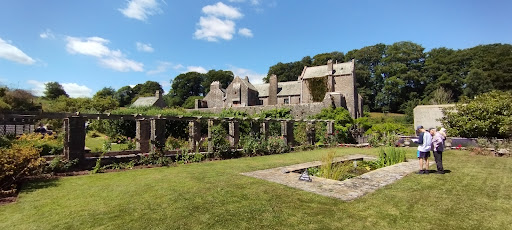
Excellent National Trust property, smaller than the other local properties, exceptional staff and volunteers, who dress up and tell the story of the family, great rose garden, no cafe. Interesting story of how the Gilbert’s re-bought the property, definitely should be on your visit list if you are coming to the Torbay area. As I have said it is not large, but would take 45 minutes to an hour to go around.
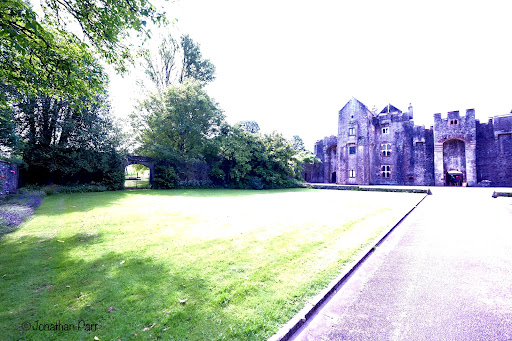
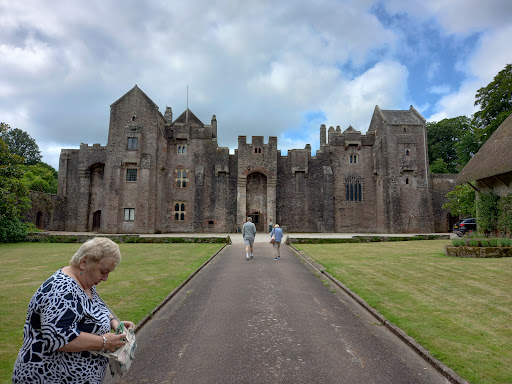
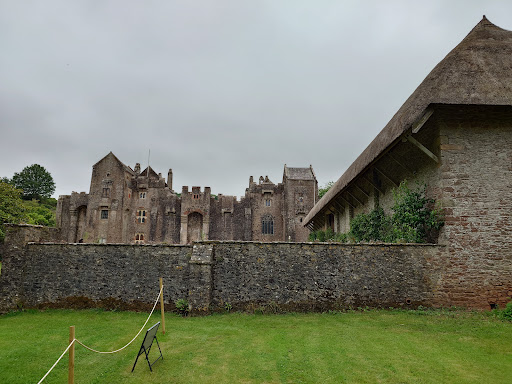
Compton Castle is a picturesque fortified manor house, bristling with turrets and parapets, in a sheltered valley setting. The castle was built by the Gilbert family, and a descendant of the same family inhabits the house today, though now the property is owned by the National Trust.
The roots of Compton Castle go back to the 12th century when a manor house here was owned by Sir Maurice de la Pole. In honour of the Pole family connection, the castle was known as Compton Pole.
In the middle of the 14th century, the manor was replaced with a large hall with a solar (family rooms) and service rooms at opposite ends. Around 1520 a fortified facade was added, by John Gilbert. Gilbert's son, also named John, helped command the English resistance to the Spanish Armada.
John was followed by Sir Humphrey Gilbert, half-brother of Sir Walter Raleigh. Gilbert had much in common with Raleigh; he was a seafaring adventurer, keen on exploiting the New World, and most famously helped to colonise Newfoundland.
It is thought that on a visit to Compton Castle after a trip to the New World, Raleigh smoked the first pipe of tobacco in Britain. The connection goes deeper, for Sir Humphrey named his son Raleigh Gilbert, and the younger Raleigh helped establish Popham Colony in Maine in 1607.
The Gilbert family held Compton until 1785. The property was allowed to fall into decay for the next century, but in 1931 a descendant named Commander Walter Raleigh Gilbert bought it back and 2 decades later gave it to the National Trust on condition that the family be allowed to continue living in the property.
The castle is surrounded by a strong curtain wall, rising 7.3 metres high (about 24 feet). The castle walls are fully 3 feet thick, made of local red sandstone dressed with ashlar. Outside the wall is a picturesque 18th-century...
Read moreA National Trust property, tucked away down a narrow lane; but well worth the effort to get there. There is a small amount of free parking outside of the grounds
Although it's referred to as a "castle" it's actually a fortified Manor house that started being constructed in the 1600s, and was allowed to go to ruin. Part of the roof, floors, stairs and some walls were reconstructed in the early 1900s.
It's worth noting that parts of the property are still lived in, and as such, a number of rooms and stairs are off limits to visitors.
There was an earlier property on the site, but there's no indication of where it might be; and no-one has been able to determine anything about the size and shape or even when it was constructed.
On the day that we visited, a volunteer, dressed in an appropriate costume for the 1600s was available to provide details of the various families that have owned and lived in the house. This was especially interesting and really brought the whole thing to life.
There are a couple of spiral stone staircases to get to the first floor; these are very narrow, and may be unsuitable for some of those with mobility issues.
A previous owner had served on HMS Squirrel, and a number of small stuffed squirrels have been carefully placed around the property for younger visitors to find; which was clearly very popular!
The volunteers have also arranged for a number of costumes to be set aside for visitors to use, in order to help get into the sense of what life was like. These were being used by young and older alike, and certainly made a difference.
All in all, a very pleasant and informative few hours. Highly...
Read moreOur visited lasted 1hr 15mins and involved a thorough explore of the accessible house, kitchen and inner court (1hr), a thorough explore of the outer court (10mins) and a few minutes looking through the small chapel and apple orchard.
The manor is a fantastic example of a fortified medieval manor with many surviving original features including squints, narrow staircases and guardhouses, and scars in the building’s fabric hint at the history of its development.
The guides are incredibly knowledgeable and provide detailed explanations as to the development of the fortified Manor House and the family history.
Only a small portion of the manor is accessible as much is still utilised by the Gilbert family as a private home and the guard house acts as a holiday home for NT members.
Parking is either on the green in front of the Manor House or in wet conditions (check the website!) in the opposite Castle Barton restaurant.
There is no onsite cafe, shop or bookshop but there is a...
Read more