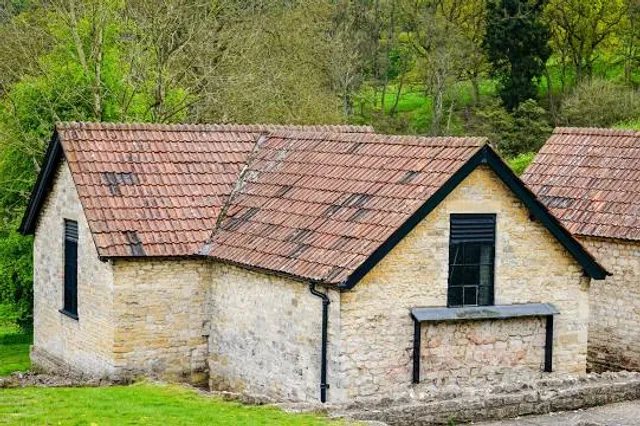
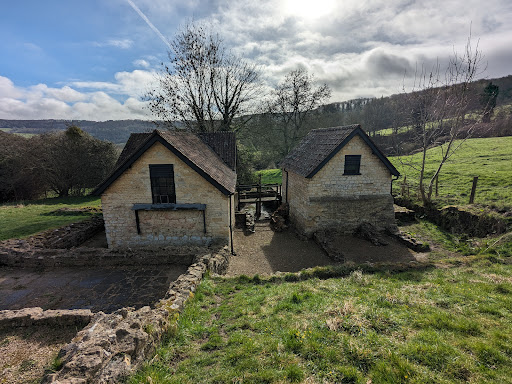
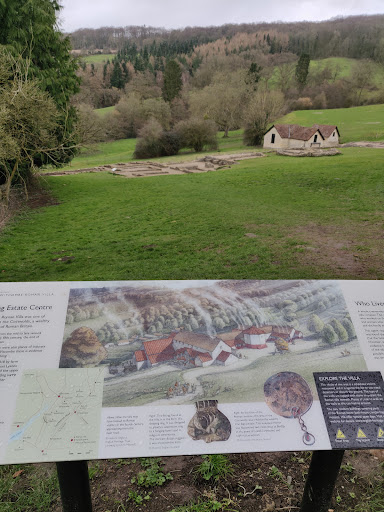
When the site was first excavated in the 19th century it was reported that parts of the villa were very well preserved. Walls of 6 ft high were documented, some still plastered. The bath house was one of the most complete examples known at the time and several mosaic floors were recorded. Poor conservation techniques and heavy rain have destroyed most of these features. The site currently consists of the remains of low walls which give a good idea of the general shape of the building. Two parts of the bath house are protected by small sheds, not accessible to the public, without prior notice.(See website) Besides its unusual shape, the villa has a few features worth noting, including a bath house and latrine, household shrine and an octagonal room of unknown use. The villa contained at least one substantial bath house, in the north-western wing. This included the latrine, which formed an L-shape around a dressing room (apodyterium). The dressing room led to the cold room (frigidarium) which contained a cold plunge bath and whose mosaic floor, decorated with a design of fish and sea creatures, is still well preserved under a modern protective building. This mosaic suggests an individual treatment of the standard sea animal and fish designs that are circulated in copy books. You can just make them out through the windows, better than not seeing them at all. It had at least one, possibly two, plunge pools – one of these is now detached from the building owing to landslides. A great place if you love your Roman history, (like us). Plus the bonus of being Free and you get it all to...
Read moreGreat Witcombe Roman Villa is one of the largest known Roman houses in Britain and one of several very wealthy villas in the Cotswolds. The villa at Great Witcombe was likely built between the mid-2nd and mid-3rd centuries and occupied until the Roman withdrawal from Britain in the 5th century. Stratigraphy was not recorded during the initial excavations of the villa in 19th century so the age range is based on coins found during excavations. Mosaic experts also weigh in on the styles of mosaics, indicating they are likely to be late 2nd century. The villa was originally a symmetrical U shape, with a range of kitchens and stores in the North East wing and a bath-house in the South West wing. Extensions and remodelling in the 4th century expanded the bath-house and replaced the rectangular dining area with an octagonal space. The site is fairly unusual for a Roman villa, terraced into uneven ground on the side of the hill and surrounded by springs and small streams. The villa occupies a series of four well buttressed terraces. The villa was at the centre of a large estate and archaeological finds indicate that tile manufacturing and metal working also occured at the site. Despite the rural location of the villa, the Roman road Ermine Way runs only a mile to the north connecting the key towns of Corinium and Glevum, today's Cirencester...
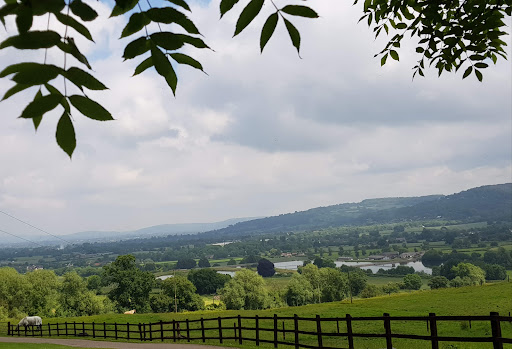
Read moreYet another example of Roman ingenuity and forward thinking, I am visiting a lot of archeological sites lately. This is in a beautiful setting and a lot of walks off it which are lovely. The Villa is easy to navigate and I just use google to give facts and gather historical note but there are plaques. My personal belief is that the actual Villa is one of those one hour maximum stops unless you are walking around the area. Car parking 🅿️ is a short distance and has a sign saying you can pay by phoning, I am not sure how this is enforced as I have been regularly and never seen anyone actually take any notice of the sign if indeed they see it ? Just be cautious, read it and this may influence your actions once you...
Read more