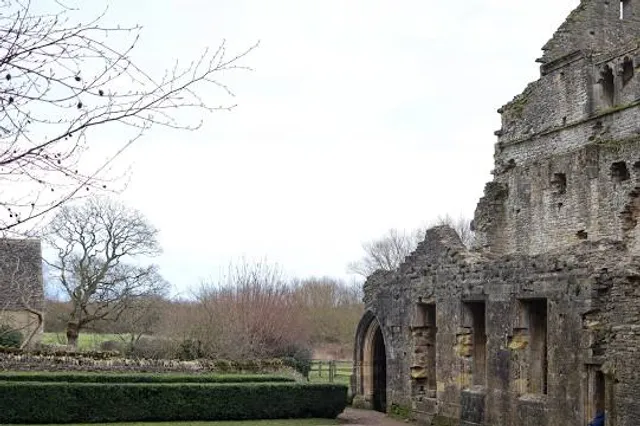
Most medieval ruins in the UK are either castles or monasteries; mansions are much less common, but Minster Lovell Hall is a fine example. A really nice place to visit very close to Witney. There has been a manor house at Minster Lovell since at least the 12th century, but the major part of the ruins seen today are those of a large new house built by William, Baron of Lovell and Holand, in the 1430s after his return from the French wars; occupied for nearly 300 years before being abandoned and partially dismantled. William was one of the richest men in England, and he built his house as a demonstration of his wealth. Following the defeat of the House of York in the battle of Bosworth in 1485 the hall passed into the hands of the Crown and eventually, in 1602, into the possession of the successful lawyer Sir Edward Coke. His descendant Thomas Coke, later Earl of Leicester, was in residence in 1721 and in 1728 he assumed the title Lord Lovell of Minster Lovell.
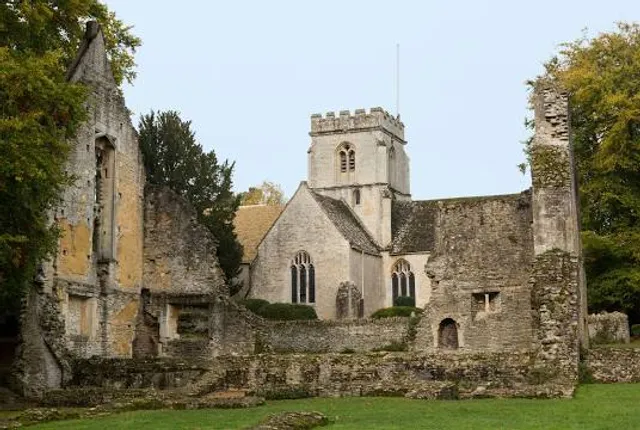
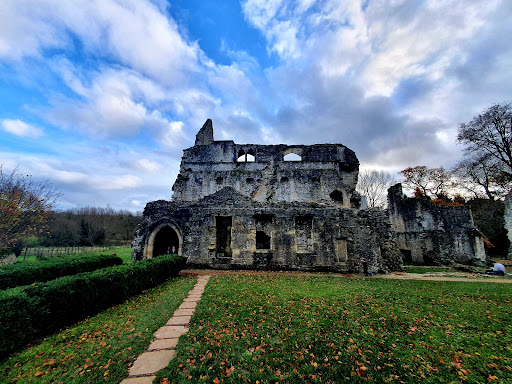
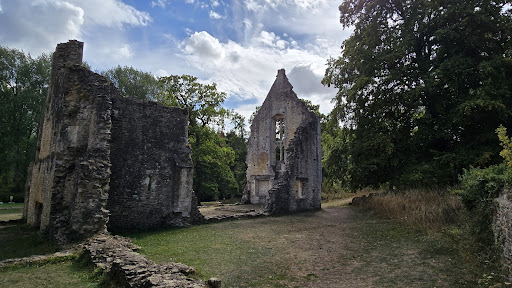
Around 1747 most of the buildings were dismantled, and materials sold for reuse; the east and west ranges and the kitchens being demolished for building stone. The northwest room, was later converted to a cottage, but all was derelict and abandoned by the time the ruins were acquired by the government, in 1935. The remains though are substantial. The largest section of the ruins is the great hall in the northeast corner, originally accessed from the north, via a cobbled path from the church. The vaulted entrance passageway led underneath the chapel, a first floor building on the north side, of which not much remains, though the walls of the two rooms underneath are mostly complete. The hall has unusually high walls, up to 40 feet, and large windows along each side.
To the west was a ground level chamber below a solar room, accessed via a spiral staircase, the upper section of which is still complete, though inaccessible from below, and then the northwest building which links to the west wing, a series of residential rooms. The east wing contained service rooms including pantry, bakehouse, kitchen, well and stables, with a cobbled floor that survives intact. Partly below the kitchen are some fragmentary foundations, thought to be from the earlier manor house.
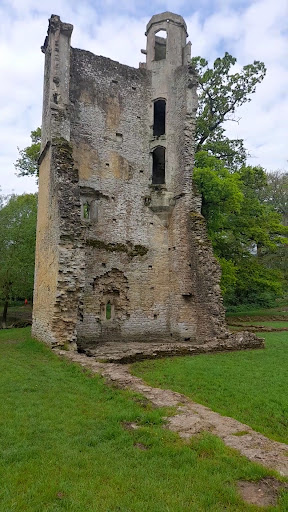
The tower at the southwest corner, the later addition, had four stories, the upper levels accessed via a staircase through an octagonal turret, and is illuminated by oriel windows. Three other surviving contemporary buildings lie a little way north - two barns, now converted to a private residence, and a circular dovecote, which is open to the public and may be viewed along a short path. Three shallow pools bordering the river where once fishponds, while land on the east side of the manor was used to grow vegetables and...
Read moreMinster Lovell Hall and Dovecote is one of Oxfordshire’s most evocative and beautiful hidden treasures. Situated beside the River Windrush, this atmospheric ruin tells a story of medieval grandeur, romantic decay, and quiet countryside charm.
Built in the 1430s by William, Baron of Lovell and Holand, the hall is remarkably well-preserved for a structure over 500 years old. The soaring walls of the Great Hall still dominate the site, and fragments of stone windows and towers offer a hauntingly elegant glimpse into the estate’s former splendour. Adjacent to the hall, the 15th-century dovecote—a round, honey-coloured stone building that once housed hundreds of birds—adds another fascinating layer to the story.
Beyond the architecture, it’s the setting that truly enchants. The ruins are framed by meadows and ancient trees, with the gentle flow of the River Windrush providing a tranquil soundtrack. On warmer days, the riverbank becomes a popular spot for paddling and picnicking, while walkers and photographers will find endless inspiration in the changing light and reflections.
Access to the site is free, and although the car park is a short walk away, the peaceful approach through Minster Lovell village is part of the charm. Signage around the ruins helps bring the history to life, and the nearby Old Swan pub makes for a perfect lunch stop.
In all, Minster Lovell Hall and Dovecote is a beautifully preserved slice of English heritage. Whether you're a lover of history, nature, or just looking for a quiet corner of the Cotswolds to explore, it’s well...
Read moreTucked away gem of a ruined 15th century Manor House beside the River Evenlode and its own fish pond.
Originally a home built for William Lovell, around 1440, and then later Sir Edward Coke, Attorney General to Elizabeth I and James I, (whose family later abandoned this place for their grander Norfolk seat at Holkham) this is an ideal place for a family picnic next to the shallow river.
Richard III visited the Hall at the time of Francis Lovell, William's grandson. The Hall fell forfeit following defeat at the battle of Bosworth.
Special features to look out for include two stone faces on the outside stone window of the great hall, purported to be William Lovell and his wife. Also, unusually, the stone vaulting (usually, mostly made of wood) at the main entrance, something similar of which is also found at Kenilworth Castle. In addition, the stone cobble pattern at the entrance to the Hall is pleasing to the eye and the foot, with its 'square diamond' shapes.
St. Kenelm's Church, named after a boy-king of the kingdom of Mercia, murdered by his tutor at the insistence of his sister (also known as St Cynehelm). Mentioned in Chaucer in the Nun’s Priest’s Tale, one of the Canterbury Tales.
It is all rather hidden away, but that is just part of its charm.
The Dovecote was not open...
Read more