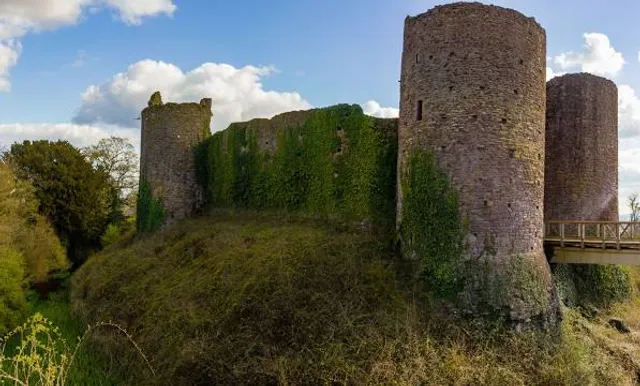
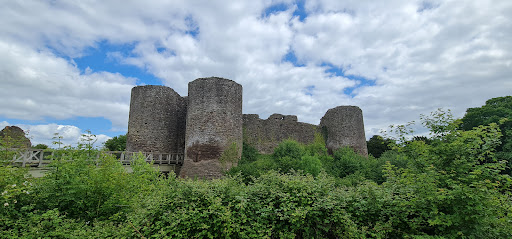
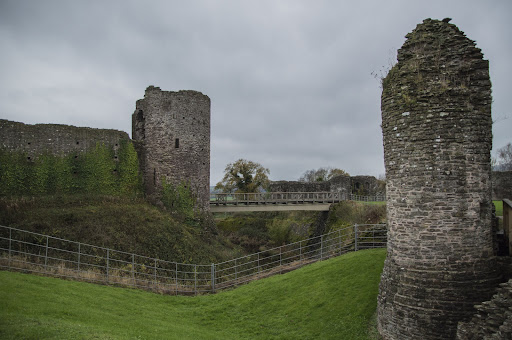
Y Castell Gwyn, also known historically as White Castle, is a fascinating ruined castle near the village of Llantilio Crossenny in Monmouthshire, Wales. Letâs explore its intriguing history:
Origins and Purpose:
Establishment: White Castle was established by the Normans following the invasion of England in 1066.
Protective Role: Its purpose was to safeguard the route from Wales to Hereford.
Features and Transformation:
Originally constructed from wood and earth, White Castle underwent a series of renovations that transformed it into the significant defensive structure we see today.
Medieval Name: The castleâs medieval name might derive from the white rendering used on its masonry.
Layout:
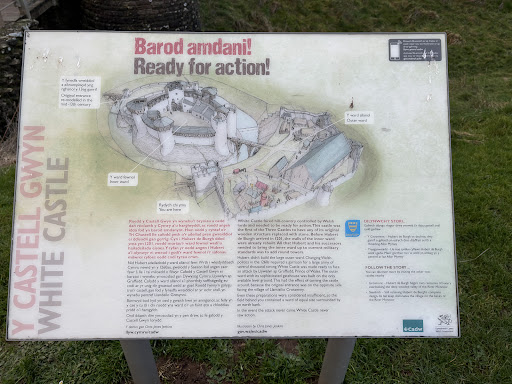
The large outer ward is as big as a football pitch.
The pear-shaped inner ward sits behind a deep, steep-sided, water-filled moat.
Lord Edwardâs Influence: Many of these features are attributed to the work of Lord Edward (later King Edward I), who took possession of the Three Castles (including White Castle) in 1254.
Forerunner: The modifications at White Castle can be seen as a forerunner of the mighty fortresses Edward I would later build in north Wales.
Visiting White Castle:
Opening Times: White Castle is open from April 1st to March 31st.
Facilities: Visitors can explore the castle, enjoy picnic tables, and appreciate its historical significance.
Directions:
By road: Take minor roads from B4233 near Llantilio Crossenny.
By rail: Abergavenny is the nearest station (approximately 13 km/8 miles away).
By bike: Follow NCN Route no. 42 (5.2 miles/8.4...
   Read moreWhite Castle also known historically as Llantilio Castle, is a ruined castle near the village of Llantilio Crossenny in Monmouthshire, Wales. The fortification was established by the Normans in the wake of the invasion of England in 1066, to protect the route from Wales to Hereford. Possibly commissioned by William fitz Osbern, the Earl of Hereford, it comprised three large earthworks with timber defences. In 1135, a major Welsh revolt took place and in response King Stephen brought together White Castle and its sister fortifications of Grosmont and Skenfrith to form a lordship known as the "Three Castles", which continued to play a role in defending the region from Welsh attack for several centuries.
King John gave the castle to a powerful royal official, Hubert de Burgh, in 1201. Over the next few decades, it passed back and forth between several owners, as Hubert, the rival de Braose family, and the Crown took control of the property. During this period, White Castle was substantially rebuilt, with stone curtain walls, mural towers and gatehouses, forming what the historian Paul Remfry considers to be "a masterpiece of military engineering". In 1267 it was granted to Edmund, the Earl of Lancaster, and remained in the hands of the earldom, and later duchy, of Lancaster until 1825.
Edward I's conquest of Wales in 1282 removed much of White Castle's military utility, and by the 16th century it had fallen into disuse and ruin. The castle was placed into the care of the state in 1922, and is now managed by the Cadw Welsh...
   Read moreWhite Castle is a hidden gem in the Welsh countryside, offering a peaceful and atmospheric experience for anyone interested in medieval history or scenic walks. The castle's moated design is especially striking, and the towering walls and gatehouses still feel imposing centuries later. Surrounded by rolling green hills and sheep-dotted fields, it's a quiet and serene spot perfect for exploring and taking in the rural beauty of Monmouthshire.
The site is largely untouched by modern commercial additions, which adds to its authentic charmâbut it does come with a few practical considerations. There are no toilet facilities on-site, so plan accordingly. Thereâs also no gift shop or cafĂ©, which might disappoint visitors expecting refreshments or souvenirs. Parking is available, but itâs very narrow and limited, especially during busier periods, so larger vehicles may find it difficult.
Despite these minor inconveniences, the experience is well worth it. Itâs free to enter, rarely crowded, and perfect for photographers, walkers, and those seeking a quiet piece of Welsh history. Just be sure to come prepared. If youâre after a raw, uncommercialised slice of medieval heritage, White Castle is an excellent choice. A truly peaceful and evocative...
   Read more