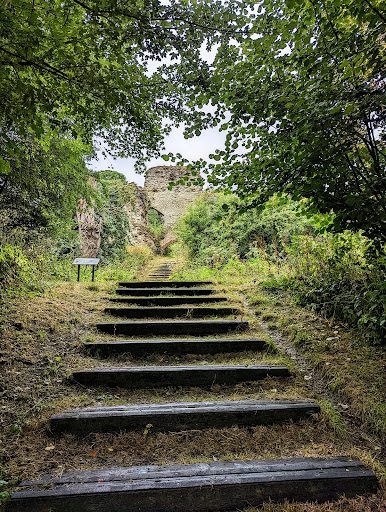
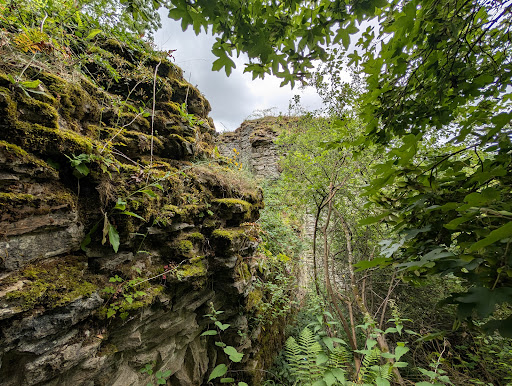
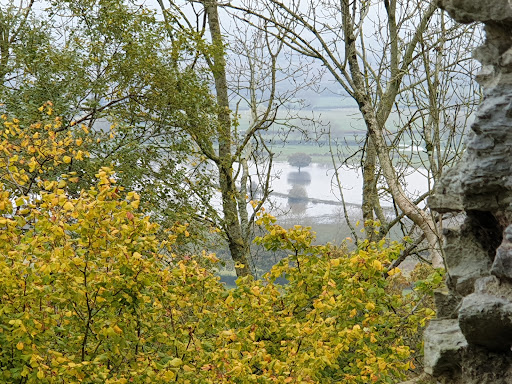
I don't write bad reviews as a rule, like good ones, they need to be justified...and so ... I knew beforehand access was limited but the reality was beyond even that expectation. The entire castle is overgrown, to the point of total neglect. Bio diversity is being used as an excuse for no management or repairs by English Heritage. There's a feeling of being corralled by plant life! As a result the extremely important archaeology cannot be appreciated. The keep is no longer accessible and there's no sign it ever will be again. The so called rare plants and ruins are all disappearing beneath more strident vegetation, and soft capped walls to preserve the fabric? Are they having a laugh? There are saplings growing! The ditches are full of mature trees and the views for which this castle is famed? You'll be lucky! With the keep shut off with chestnut paling and Harris fencing that is also overgrown and only extremely limited access to the remaining curtain walls, expect to feel that you are on the set of a Sleeping Beauty remake. Ah, yes...the 'romantic ruin' to quote the signs again. This is an important castle with great historic significance which far from being maintained for future generations is being lost. Nature can and does reinvigorate everywhere and anywhere but once archaeology is destroyed it is gone FOREVER. It only gets one chance and here it is seriously at risk. Plants, trees etc need to be managed to get the balance just right in order to prevent irreparable damage to buried deposits and upstanding fabric. It can and must be done for the benefit of both. The excuse that the layers are especially thick at this castle is precisely that, an excuse for abandonment. Those thick layers are actually archaeological remains. I'm all for nature and conservation, but this is an archaeological site primarily and evidence is being damaged and lost by root action, fallen trees etc. All we are seeing here is nature and biodiversity being used as an excuse for no management. The sign which says be patient..we are working on it...is almost illegible with age...oh, and the next excuses will be COVID , or that it came to them in this state... It is still a travesty. Simply excuse piled upon excuse. The main residence of the Mortimer's who dabbled in both English and Welsh history, who tried to topple kingdoms...as the sayings go ... 'they didn't let the grass grow under their feet'and at this sight 'they must be spinning in their graves'! No wonder it's free to get in. Just watch where you put your feet ....and don't bother with a picnic blanket...a machete, strimmer or bow saw might be more useful. It's very peaceful up there admittedly, but it feels as if no one dares to...
Read moreWigmore Castle was one of the many fortifications built near the English-Welsh border after the Norman conquest. It is cared for by English Heritage, a preserved in a semi-wild, overgrown state to promote biodiversity. Founded by William Fitz Osbern in 1067, the original timber and earthworks castle was built near the border to defend against attacks from the Welsh. The castle passed to the Mortimer family after Osbern’s death in 1071. They rebuilt the castle in stone and held it until the 15th century. Wigmore became the key fortification from which the Mortimers controlled large areas of central Wales. It served as the base for many military incursions into Wales, and was besieged in 1155 and perhaps also in 1264. The castle occupied a significant position, perched atop a steep, narrow ridge. The addition of larger towers and a central great hall in the 14th century highlighted the Mortimer’s high status. Lords of the Welsh March like the Mortimers had many special privileges, including the right to make war, to hold courts, and to receive certain revenues otherwise reserved for the king of England. Best known of the Mortimers is Roger Mortimer, mastermind behind the deposition and murder of King Edward II, lover of Queen Isabella and de facto ruler of England for a short while before his execution in 1330 by Edward III. The Mortimers moved to Ludlow in later in the 14th century and Wigmore began to deteriorate. During the Civil War it was slighted by its owners, the Harleys, as they were unable to defend both Wigmore and their home at Brampton Bryan. The castle remained remarkably undisturbed in the following centuries. English Heritage chose to keep the ruin is rather overgrown. It is home to many species of plants and animals, and the accumulated debris and plant growth protects the ruins from...
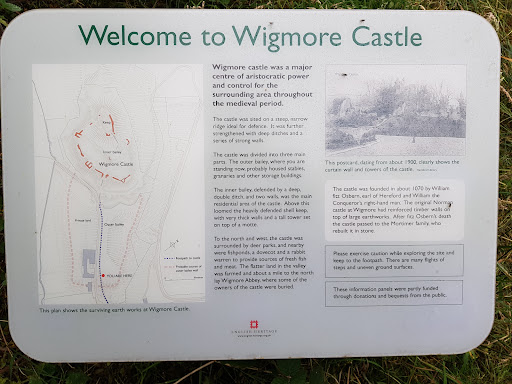
Read moreWigmore castle was a major centre of aristocratic power and control for the surrounding area throughout the medieval period.
The castle was founded in about 1070 by William fitz Osbern, earl of Hereford and William the Conqueror's right-hand man.
From shortly after the Norman Conquest until the early 15th century, Wigmore was home to the powerful Mortimer family, who were responsible for the castle and rebuilt it in stone as we see today.
There is no access to the keep at the moment due to deterioration of the wooden steps, so it is not safe to use them.
Proper footwear is a must in this place as paths can be a bit slippery after rain.
The castle is located a short walk ( around 10 minutes ) from Village hall car park which is free to park.
The village hall has a map board to show you the precise location of the castle.
Lots of information boards on the site too to gain knowledge about the owners of the castle.
Beautiful view points allow you to take amazing photos of the hills.
If you like history and ruins like we do, you will like...
Read more