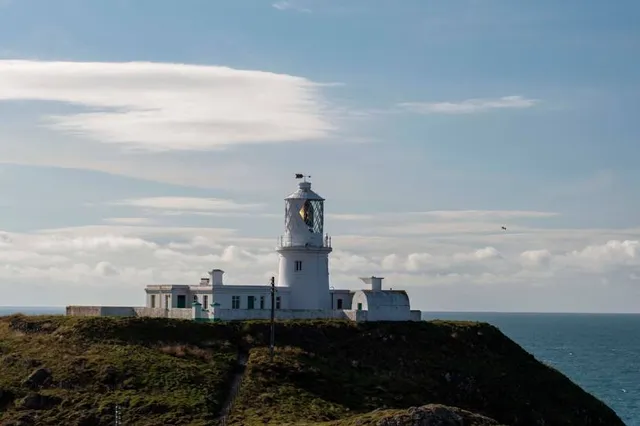
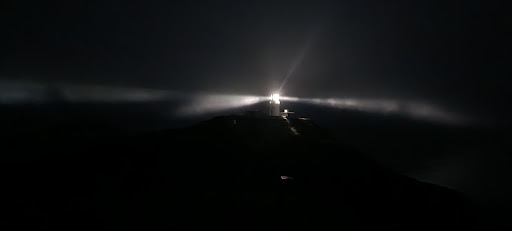
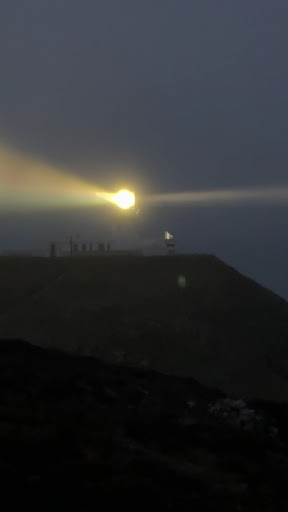
Built: 1908 Height of tower: 17 metres Range of light: 26 nautical miles The distinctive light pattern (also known as the nightmark) of each lighthouse is unique. Like the gaudy colours and patterns that sometimes decorate lighthouse exteriors (the daymark), they serve as an identifying feature to help sailors know exactly where they are along the coast. Went to see Strumble Head lighthouse on a dark foggy evening at end of June 2021. It was fascinating observing the light pattern of 4 x horizontal rotations then 4 vertical rotations of the light beam. It's also quite a strong sensory experience - you can hear the sea birds on the cliffs, listen to the sound of the sea as well as watch the amazing lighthouse beam.
Although you can see the lighthouse light beam from some miles away inland, we drove right to the end of a long winding single road which has a gravel car park at the end. It's a very slow drive down (maximum 15 to 20 mph) and you are literally in the middle of nowhere, right on the coastline nobody around & no houses for miles so make sure you are prepared for all eventualities đ Just like most of the Pembrokeshire region, at night there are no road or street lights for miles & miles - the lighthouse beam is the only light you'll see. I'd recommend having a good torch and spare batteries especially if you are planning to get out of the car to walk around, it is literally pitch black. We were staying in a B&B in Llandeloy approx 20 miles away from the lighthouse, however we were out stargazing on our first evening there and we could still see the beam from the lighthouse and it was at least 6-miles to the nearest coastline/cliff edge from our B&B. It was that alone that made us go and find the lighthouse in the first place, to see it in action because we were so impressed and didn't realise just how far away it was or how strong the beam was.
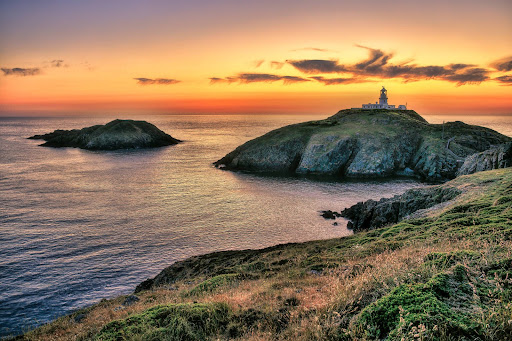
This Grade II listed building was erected to improve the safety of ships travelling the dangerous stretch of water between Ireland and Fishguard Harbour. Situated on Ynys Meicel (St Michael's Island) just to the west of Fishguard, it forms a link with the South Bishop Lighthouse, some 18 miles to the south west.
A footbridge was built across the turbulent sliver of sea that separates the islet from the mainland, but much of the building materials and regular supplies had to be winched across by jackstay cable. Look out for the handrail of the footbridge and the steps leading to it - it also serves as a pipeline to transport oil into the tower basement. Strumble Head Lighthouse was...
   Read moreStrumble Head Lighthouse was built by Trinity House in 1908.
Strumble Head Lighthouse stands on Ynysmeicl (St. Michael's Island), an islet to the west of Fishguard, separated from the mainland by a very narrow gap.
The station was built for the safety of sea traffic between Ireland and Fishguard Harbour, located behind cliffs and a breakwater three miles to the east. The light also formed a link with South Bishop light, 18 miles to the south-west. This stretch of coast is very dangerous, and some 60 vessels are known to have been lost along it in the 19th Century alone.
The original revolving lens system weighed 4½ tons, supported in a bath of mercury to reduce friction. A massive clockwork mechanism rotated it, driven by a quarter-ton weight which, suspended on a cable, dropped gradually down a cylinder running from top to bottom through the tower and had to be re-wound every 12 hours. The optical system was replaced by more compact equipment when Strumble Head lighthouse was fully electrified in 1965.
Despite the footbridge to the mainland across the narrow sound, Ynsymeicl's isolation and steep slopes set building problems typical of more remote rock towers. Building material and regular supplies were swung across by jackstay cable, between the winches near the cliff-top on the mainland and beside the lighthouse. The handrail of the footbridge and the steps to it also had a special purpose, as the pipeline to carry oil into the tower basement.
Strumble Head Lighthouse was converted to unmanned automatic operation in 1980. The lighthouse is now monitored and controlled from Trinity Houseâs...
   Read moreYou donât come to Strumble Head for a tour â you come for the feeling of being at the very edge of the land, where the road ends and nature begins.
Though access to the lighthouse itself is closed and the bridge is off-limits, that hardly matters. The real magic of this place is in the atmosphere: the wind off the sea, the crash of the waves against the cliffs, and the constant, quiet drama of the wildlife all around.
This is a fantastic spot for birdwatching, with seabirds riding the coastal winds, and if you're patient (and lucky), you might spot seals bobbing in the waters below. Bring binoculars, a jacket, and time â itâs the kind of place that rewards stillness and attention.
There are no cafĂŠs, shops, or curated viewpoints â just a narrow road, the distant blink of the lighthouse, and the raw edge of the Welsh coast. Strumble Head feels like a place between worlds â and thatâs exactly why itâs...
   Read more