An experience that everyone should have, I think. I know most people nowadays have no idea about what happened to Japanese Americans during WWII, because we've done our best to hush it up and forget about it. No one really talks about it anymore.
Coming here is a bit tough to stomach, but very eye opening. The stories of these people who were torn away from their homes, businesses, schools (basically their entire lives!) and forced to live in shacks in the desert, where dust and dirt poured in through every hole. The only thing these people were left with was each other. They had their second amendment rights revoked and every gun confiscated simply because the government deemed them a threat, because they looked like the enemy.
This place is a testament not only to the conditions of the internment camps and the hardships that they had to endure, but also to how low a great country can sink in times of crisis. The United States failed these people, ripped them away from their lives and violated almost every basic human right they had. And yet, something amazing happened. After the war, many Japanese Americans, including some that were interned here, came back to restore the place and turn it into a museum to warn against something like this happening again. They came back to the site of their greatest suffering, and put their time and money into a museum to warn of human atrocities and violations of human rights. They could have stayed gone, tried to leave this all in the past, but they knew that wouldn't do. This is a testament not only to the things that happened to them, but to the strength and kindness of Japanese Americans.
This place is an experience everyone should have at least once. A warning that no matter how much you love your country, and how protected you think your rights are, all it takes is the government issuing an order stating that you're a threat, and your rights no longer apply. War propaganda and nationalist rhetoric resulted in hundreds of thousands of US citizens being displaced and their lives essentially destroyed because of the way that they looked. A warning to always question your leaders and the actions of your government, lest you become complicit in an atrocity like this.
Make sure you watch the video as a starting point, it really opens your eyes and puts the rest of the museum...
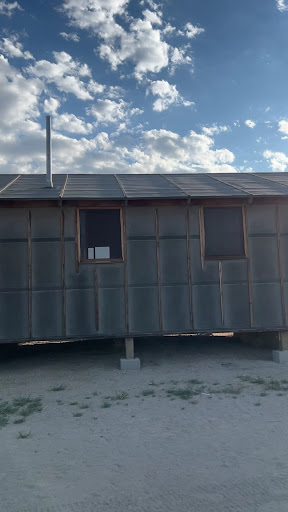
Read moreVisiting the Manzanar National Historic Site was a profoundly moving experience that blended history, culture, and reflection on a dark chapter of America’s past. Nestled in the starkly beautiful Owens Valley, between the Sierra Nevada and the White Mountains, this site preserves the memory of one of ten internment camps where over 120,000 Japanese Americans were unjustly relocated during World War II. Walking through the grounds, you can feel the weight of history—the resilience of a community uprooted from their lives due to fear and prejudice, yet who managed to create a vibrant cultural enclave despite the circumstances. The interpretive center is a gem, offering a deep dive into the stories of those who lived here between 1942 and 1945. Through photographs, artifacts, and personal accounts, it paints a vivid picture of daily life—families tending gardens, children playing baseball, and individuals maintaining traditions like origami and Buddhist ceremonies. The reconstructed barracks and guard tower stand as stark reminders of the wrong decision made by the U.S. government, driven by wartime hysteria rather than evidence, to strip citizens of their rights based solely on ancestry. Yet, what shines through is the strength and dignity of the Japanese American community, who turned adversity into a testament of endurance. Manzanar isn’t just a historical site; it’s a cultural touchstone that invites reflection on justice and humanity. The serene landscape contrasts with the harsh realities of the past, making it a place of both sorrow and inspiration. It’s a must-visit for anyone seeking to understand the complexities of history and honor the voices that refused to be silenced, even in the face of a...
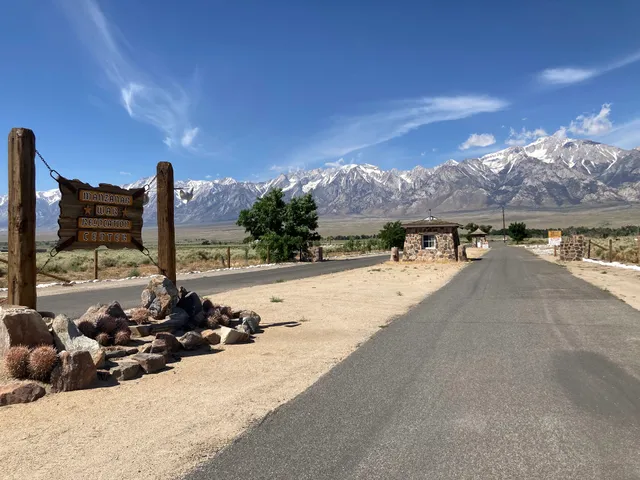
Read moreI grew up with a childhood friend whose parents met in Manzanar. So from 1942 to 1945 a total of 10 camps were opened in US that held approximately 120,000 Japanese Americans. Not only in California, but sadly also in Arizona, Wyoming, Colorado, Utah, and Arkansas. While This was not a destination we set out for but I’m glad we saw it in time and stopped to see it. It was not open by the time we drove to it however the gates don’t get closed up after the “tours” I don’t know for certain if anyone locks up later but during our 20 min drive we never saw a ranger or employee? It haunts me to think of the inhumane way our fellow humans were treated. I recommend listening to this Podcast called Order 9066 before you go for context. It’s moving and brings to life the humanity and gives names to the event that scars this nation. Much more than an educational experience. There are markers to identify the tar paper barracks that once stood. The Catholic Church, mess hall, rose garden etc. What a stark contrast meets you out front though when you see the guard tower still stands as a haunting reminder of what evil man can do to man. We were moved by the starkness of cruelty against the beautiful backdrop of snowcapped mountain peaks in the distance. Eerie but worth the drive I would say for sure. Most peculiar thing that hit me was the address: 5001 Highway 395 Independence, CA. The irony was not lost on us😞in total 145 Japanese Americans died while in confinement. One prays this never be...
Read more