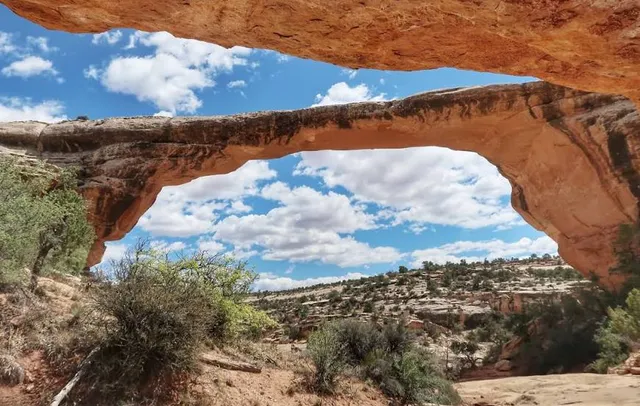
Natural Bridges National Monument ($10 per vehicle) is a great stop to make on the U.S. Route 95 Scenic Drive to see three impressive natural bridge land formations. The park is 35 miles west of Blanding and is open 24 hours a day.
Note: There is a small visitor centre near the entrance to the park where you can pay your entry fee, use bathroom and refill water bottles. There is a small exhibition area and gift shop section as well. The Visitor Centre is open from 9am to 5pm daily
At Natural Bridges, you are able to drive a short loop, taking you past three viewpoints where you can see and hike to the bridges named Kachina, Owachomo and Sipapu after the indigenous peoples who resided here in past centuries.
We most enjoyed Sipapu Bridge. In addition to this being a nice land formation to see from the viewpoint, there is an interesting hike down to the riverbed and canyon floor where you can see this giant natural bridge structure from the ground level.
We particularly enjoyed the stairs and ladder sections used as you scramble along slick rock and moderately challenging sections of the trail. Views of Sipapu are impressive throughout. We enjoyed taking photos from different vantage points as we descended and then climbed back out of the canyon.
You can hike at the other two natural bridges as well. Unfortunately, we only had enough time for one hike so only enjoyed the Kachina and Owachomo from the viewpoints. In addition to the natural bridges, there are ancient Anasazi dwellings known as the Horsecollar Ruin. If you are limited to the viewpoints, binoculars can be quit helpful seeing these ruins.
Overall, we very much enjoyed our time at Natural Bridges National Monument. This was a surprisingly rewarding visit and a place we would have happily stayed for a night or two if time had permitted. It is beautiful here and very quiet compared to what we found at the Mighty Five National Parks where you compete with throngs of other tourists for parking and hiking space. This wasn't the case at Natural Bridges.
Note: If you intend to visit Arches and Canyonlands National Parks as well during your visit to Southern Utah, you can buy a Southern Utah Park Annual Pass for $50 which includes Natural Bridges and Hovenweep National Monuments. This can help you save a bit of money on your entry fees to...
Read moreIn the world of sandstone rock formations, natural bridges are very different from arches. Even though the southwest desert is now dry, natural bridges were formed by water (streams) long ago. Visiting Natural Bridges NM gives one easy access to some of the best examples via three relatively short trails.
The Sipapu Bridge trail is 1.2 miles is length, listed as a 500 ft drop in elevation. This is the second largest natural bridge in the US.
The Kachina Bridge trail is 1.4 miles in length, listed as a 400 ft drop in elevation. Of the three, this is the most massive (deemed youngest) and the most recent to have major rockfall (1992).
The Owachomo Bridge Trail is 0.4 miles in length, listed with a 108 ft drop in elevation, and is considered the Park's most delicate bridge.
Another hiking option is the Loop Trail. At 8.6 miles in length, one can visit all three natural bridges on a single trail.
This Park's three natural bridges are spectacular. It is well worth a visit, whether just driving the loop road and pulling into the Vista lookouts, or hiking to any one (if not all three) massive sandstone features. One word of warning though. I don't know the lifespan of crows but when I visited, one (?) seemed very determined to happily pull out windshield wiper blades and chew on my windshield’s rubber seal. Mine wasn't the only car 'pranked'. I just picked the pieces off the parking lot ground and reinserted them later. Hopefully, it isn’t a habit passed on to offspring. Curious, though.
Another warning: if exiting the park southbound via UT Hwy 261, this road is NOT for the faint of heart. You literally come to the edge of the mesa, and the road drops you off the top (called the Moki Dugway) down a very steep, switch-backed grated dirt road for 3 miles dropping over 1,000 ft in elevation. On my trip, the warning sign was posted at the base of the cliff, after I exited this one lane road (wide spots on curves). You seemingly crawl down the steep face of the red mesa. Definitely,...
Read moreNatural Bridges National Monument is a U.S. National Monument located about 50 miles (80 km) northwest of the Four Corners boundary of southeast Utah, in the western United States, at the junction of White Canyon and Armstrong Canyon, part of the Colorado River drainage. It features the thirteenth largest natural bridge in the world, carved from the white Permian sandstone of the Cedar Mesa Formation that gives White Canyon its name. The three bridges in the park are named Kachina, Owachomo, and Sipapu (the largest), which are all Hopi names. A natural bridge is formed through erosion by water flowing in the stream bed of the canyon. During periods of flash floods, particularly, the stream undercuts the walls of rock that separate the meanders (or "goosenecks") of the stream, until the rock wall within the meander is undercut and the meander is cut off; the new stream bed then flows underneath the bridge. Eventually, as erosion and gravity enlarge the bridge's opening, the bridge collapses under its own weight. There is evidence of at least two collapsed natural bridges within the Monument. The main attractions are the natural bridges, accessible from the Bridge View Drive, which winds along the park and goes by all three bridges, and by hiking trails leading down to the bases of the bridges. There is also a campground and picnic areas within the park. Electricity in the park comes entirely from a large solar array near the visitors center. In 2007, the International Dark-Sky Association named Natural Bridges the first International Dark-Sky Park, which is a designation that recognizes not only that the park has some of the darkest and clearest skies in all of the United States, but also that the park has made every effort to conserve the natural dark as a resource worthy of protection.6 To date, Natural Bridges has the only night sky monitored by the NPS Night Sky Team that rates a Class 2 on the Bortle Dark-Sky Scale, giving it the darkest sky...
Read more