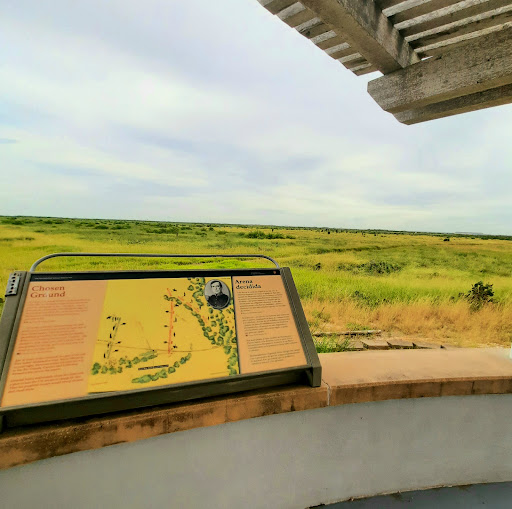
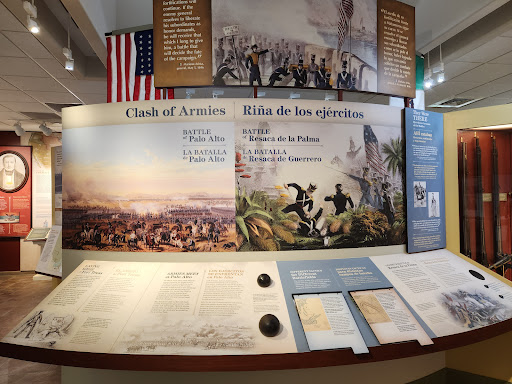
Palo Alto, the Battle that would mark the beginning of the Mexican-American War Campaign. A war that was ignited during the annexation of Texas because of a border dispute.
Mexico "placed the boundary of Texas on the Nueces River and viewed U.S. claims to the Rio Grande as an attempt to seize more territory."
[American] EXPANSIONIST AMBITIONS:
"Determined to expand his country, James K. Polk dismissed Mexican claims that they still owned Texas and moved to annex the young [Mexican] republic. He also insisted that Texas stretched to the Rio Grande, far beyond the boundaries recognized by Mexico."
"The limits of Texas are certain and recognized; never have they extended beyond the Nueces river." --Mexican General, Francisco Mejia, March 18, 1846
"MANY AMERICANS ACCUSED POLK of creating a boundary conflict by sending troops into the disputed territory."--quote illustrated at Palo Alto National Historic Park
This accusation would later be confirmed by Ulysses S. Grant as he recalled "We were sent to provoke a fight, but it was essential that Mexico should commence it..."-- Ulysses S. Grant, Personal Memoirs
In further study, we see this issue come up again when ABRAHAM LINCOLN questions and investigates president Polk's actions in congress. Congressman Abraham Lincoln, speaking in a session of congress says "...the president unnecessarily and Unconstitutionally commenced a war with Mexico....The marching an army into the midst of a peaceful Mexican settlement, frightening the inhabitants away, leaving their growing crops and other property to destruction, to you may appear a perfectly amiable, peaceful, un- provoking procedure; but it does not appear so to us." --Abraham Lincoln: Speech against Seizing Mexican Territory, Congressional Speech, January 12, 1848,
Later as a result of that war America would acquire a third of our modern days national land. All the land from Texas to as far north as Colorado and parts of Wyoming, and westward on to California. In the process Mexico would lose half her size to this acquisition.
At the time there were American supporters of the war named:
"All-Mexico" supporters [who] wished to absorb the entire [Mexican] country. In Mexico, many war-weary citizens were willing to surrender land to halt the fighting, while others wished to battle on to preserve [their] territory."
"The treaty was a compromise. Mexico's negotiators surrendered northern territories but refused to cede additional lands. U.S. President Polk wanted more territory, but ultimately accepted the treaty produced by his representative, Nicholas Trist."
FIND OUT HOW... the Mexican-American War led to the American Civil War.
"The Southern Rebellion was largely the outgrowth of the Mexican War. Nations, like individuals, are punished for their transgressions. We got our punishment in the most sanguinary and expensive war of modern time [the Civil War]." --Ulysses S. Grant
Arguably one of the best inside looks to what happened is in Grant's famous memoirs as he was dying in 1885 from cancer.
"To this day [I] regard the war, which resulted, as one of the most unjust ever waged by a stronger against a weaker nation. It was an instance of a republic following the bad example of European monarchies, in not considering justice in their desire to acquire additional territory. Texas was originally a state belonging to the republic of Mexico... An empire in territory, it had but a very sparse population, until settled by Americans who had received authority from Mexico to colonize. These [American] colonists paid very little attention to the supreme government, and introduced slavery into the state almost from the start, though the constitution of Mexico did not, nor does it now, sanction that institution... The occupation, separation and annexation were, from the inception of the movement to its final consummation, a conspiracy to acquire territory out of which slave states might be formed for the American Union."--Personal Memoirs of U.S. Grant, General of US Army/18th...
Read more
 Learn more insights from Wanderboat AI.